

Alternatives to Chemical Sunscreen for Toddlers
Table of Contents
- Why Parents Seek Alternatives to Chemical Sunscreen for Toddlers
- Mineral Sunscreen for Babies: The Safest Active Ingredients
- How to Apply Mineral Sunscreen Without White Cast
- UV-Protective Clothing and Rash Guards
- Sun Safety Tips for Toddlers Beyond Sunscreen
- FDA Sunscreen Regulations for Children: What Parents Should Know
- Comparison of Chemical vs. Mineral Protection Methods
- Conclusion: Building a Complete Sun Protection Strategy
Last Updated: August 9, 2026
Why Parents Seek Alternatives to Chemical Sunscreen for Toddlers
Chemical sunscreens containing oxybenzone, avobenzone, and octinoxate have raised concerns among parents worried about what their children absorb through their skin. Bright & Bold Swimwear helps families understand that effective sun protection doesn't require choosing between safety and practicality. Alternatives exist across a spectrum: mineral-based formulations, UV-protective clothing, and shade solutions, each offering distinct advantages depending on your child's age, skin sensitivity, and daily routine.
This guide walks you through practical alternatives to chemical sunscreen for toddlers, explaining how each works, where it excels, and how to layer them into a comprehensive sun protection strategy.
Mineral Sunscreen for Babies: The Safest Active Ingredients
Mineral sunscreen reflects ultraviolet radiation away from skin rather than absorbing into it. The active ingredients, zinc oxide and titanium dioxide, are the same compounds used in diaper rash creams for decades. For toddlers, mineral-based sunscreen offers broad-spectrum UVA/UVB protection without absorption concerns. Products like Thinkbaby SPF 50+ and Blue Lizard Kids Mineral SPF 50 are formulated for young skin with water resistance up to 80 minutes.
How Mineral Sunscreens Work Differently
Zinc oxide and titanium dioxide create a physical barrier on your child's skin. When UV rays hit this barrier, they bounce away rather than penetrating. This happens immediately upon application with no waiting period, a practical advantage when managing an impatient toddler.
The trade-off is texture. Mineral sunscreens tend to be thicker and leave a visible white cast, though newer formulations have improved this significantly. For many parents, this visibility is reassuring: you can see exactly where you've applied protection.
Water resistance varies by formulation. Most mineral options designed for toddlers claim 40-80 minutes of water resistance, requiring reapplication after swimming or heavy sweating.
Top Mineral Sunscreen Options for Toddlers
Thinkbaby SPF 50+ Mineral Sunscreen stands out for accessibility and consistent reviews. The 100% zinc oxide formula is EWG Verified and reef-safe. Water-resistant for 80 minutes, it's a solid choice for daily use and beach days.
Blue Lizard Kids Mineral SPF 50 combines zinc oxide and titanium dioxide with antioxidant-rich blue algae. The formulation is paraben-free and fragrance-free, addressing concerns about unnecessary additives. The 80-minute water resistance makes it practical for active toddlers.
Badger Balm Baby Mineral Sunscreen Cream SPF 40 takes a minimalist approach with 98% organic ingredients, including chamomile and calendula to soothe delicate skin. The 22.5% zinc oxide provides solid protection, ideal for toddlers with very reactive skin. Water-resistant for 40 minutes.
How to Apply Mineral Sunscreen Without White Cast
The white cast is mineral sunscreen's most visible drawback, but several techniques minimize it significantly.
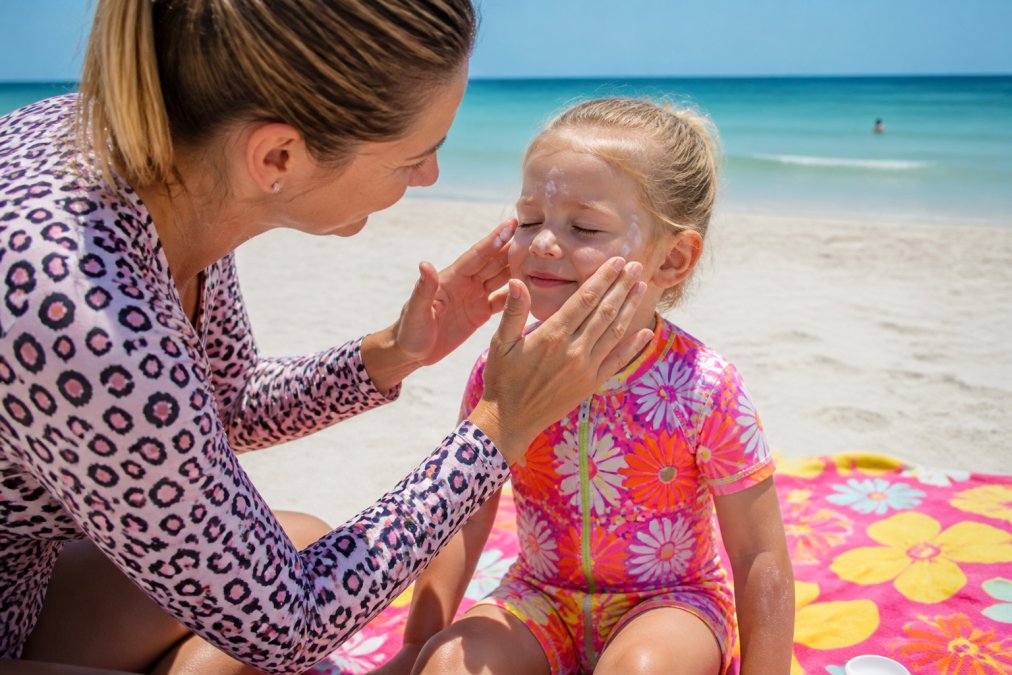
Start with less product than you think you need. A pea-sized amount for the face and a nickel-sized amount for each arm is typically sufficient.
Use your fingertips, not your palm. Fingertips allow more precise application and better control. Warm the product slightly by rubbing your fingertips together before touching your child's face.
Rub in circular motions for 30-60 seconds per area. The longer you work the product into the skin, the less visible the white cast becomes. Focus on areas that receive direct sun: the face, ears, neck, and the tops of hands and feet.
Apply to dry skin. Wet skin causes mineral sunscreen to bead up unevenly. Pat your child dry completely before application.
Consider tinted mineral options. Products with iron oxides added to match various skin tones reduce the white cast dramatically, particularly for toddlers with darker skin tones.
Layer strategically. Apply mineral sunscreen to exposed areas first, then add UV-protective clothing and hats. This reduces the total amount of sunscreen needed on any single area.
UV-Protective Clothing and Rash Guards
UV-protective clothing represents the most reliable alternative to sunscreen alone. Unlike sunscreen, which requires proper application and reapplication, UPF-rated garments provide consistent protection for as long as your child wears them.
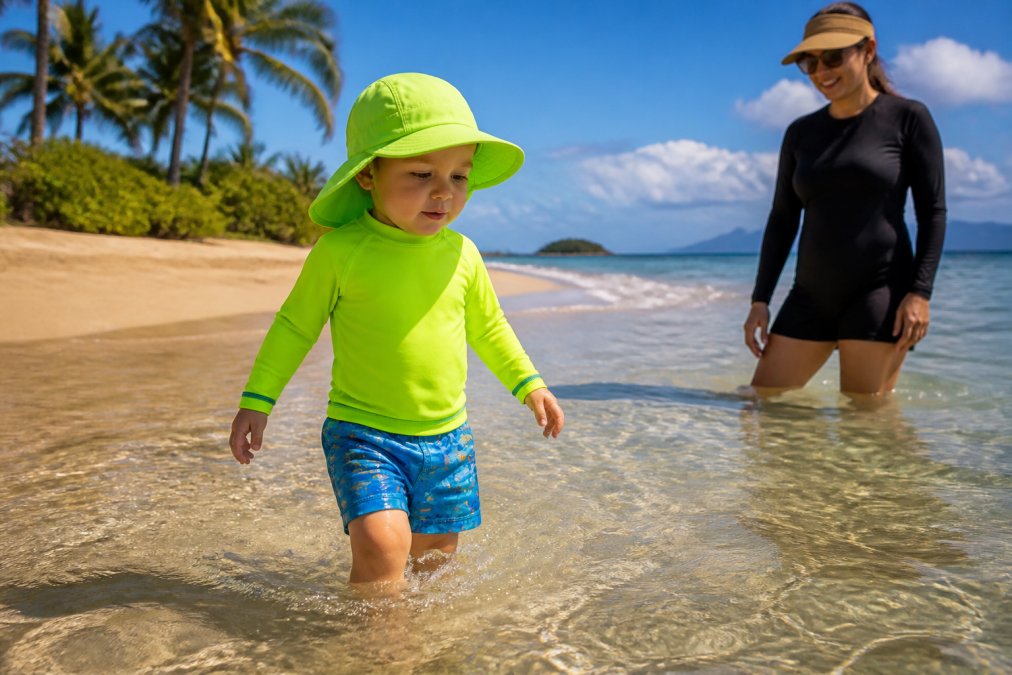
Why Rash Guards Outperform Sunscreen Alone
A UPF 50+ rash guard blocks approximately 98% of UV rays. Most people apply only 25-50% of the recommended amount of sunscreen, significantly reducing its effectiveness. Rash guards eliminate this application problem entirely.
Bright & Bold Swimwear's rash guard options, including the Boys Long Sleeve Rash Guard Swim Set and Girls Long Sleeve Rash Guard Set, both offer UPF 30+ protection while solving the visibility challenge. The high-visibility neon colors serve dual purposes: they provide sun protection through fabric coverage, and they make your child easily visible in water, a critical safety feature that goes beyond UV protection.

Rash guards are particularly valuable during peak sun hours (10 a.m. to 4 p.m.), when UV intensity is highest. The long-sleeve design provides coverage for the shoulders, upper arms, and back, areas that receive intense sun exposure and are often missed with sunscreen.
High-Visibility Swimwear for Extra Safety
Beyond sun protection, high-visibility swimwear addresses a critical safety concern: drowning prevention. Bright colors make your child instantly visible in water, allowing you and lifeguards to maintain constant visual contact. This is particularly important at beaches, lakes, and crowded pools.
When selecting UV-protective clothing, look for garments with UPF 50+ ratings, long sleeves for maximum coverage, and materials that dry quickly. Water resistance is built into quality UV-protective fabrics. Unlike sunscreen, which requires reapplication after 40-80 minutes in water, a rash guard maintains its protection throughout your entire beach or pool session.
Sun Safety Tips for Toddlers Beyond Sunscreen
Sun protection extends far beyond sunscreen and clothing. A comprehensive approach layers multiple strategies to minimize UV exposure.
Seek shade during peak hours. UV intensity peaks between 10 a.m. and 4 p.m. Scheduling outdoor activities before 10 a.m. or after 4 p.m. dramatically reduces sun exposure. When midday outdoor time is unavoidable, prioritize shade, trees, umbrellas, or pop-up tents.
Use wide-brimmed hats consistently. A hat with at least a 3-inch brim protects the face, ears, and neck. The Sunday Afternoons Kids' Play Hat offers UPF 50+ protection with an adjustable chin strap.
Protect eyes with UV-blocking sunglasses. Toddlers' eyes are particularly vulnerable to UV damage. Baby Banz Wrap-Around Sunglasses provide 100% UVA/UVB protection with a wraparound design that prevents light leakage.
Plan water time strategically. Combine rash guards, sunscreen on exposed areas, and frequent breaks in the shade. Limit continuous sun exposure to 15-20 minute intervals for toddlers under age 3.
Reapply sunscreen after swimming. Even water-resistant sunscreen washes off eventually. Pat your child dry and reapply every 80 minutes or immediately after exiting the water.
Check UV index before outdoor activities. The UV Index indicates how intense UV rays will be. On high-index days (8 or higher), extra precautions become essential.
Remember that sand and water reflect UV rays. Sand reflects up to 25% of UV rays, and water reflects an additional 10%. This means your child receives UV exposure from both direct sun and reflected rays.
FDA Sunscreen Regulations for Children: What Parents Should Know
The FDA classifies sunscreen as an over-the-counter drug, meaning all sunscreens sold in the United States must meet specific safety and efficacy standards. In 2019, the FDA proposed new regulations requiring additional safety data for 12 active sunscreen ingredients, including oxybenzone and avobenzone, reflecting scientific questions about absorption and systemic exposure.
For toddlers specifically, the FDA recommends that babies under 6 months avoid sunscreen altogether, relying instead on clothing, shade, and avoiding peak sun hours. For toddlers 6 months and older, both mineral and chemical sunscreens are considered acceptable, though mineral options are often recommended for sensitive skin.
The FDA does not restrict mineral sunscreens. Zinc oxide and titanium dioxide are recognized as safe and effective, with minimal absorption concerns compared to chemical filters.
The shift toward alternatives reflects a rational response to uncertainty. When equally effective alternatives exist, choosing the option with fewer unknowns is a reasonable parental choice.
Comparison of Chemical vs. Mineral Protection Methods
| Protection Method | UV Coverage | Water Resistance | Application Ease | White Cast | Best For |
|---|---|---|---|---|---|
| Chemical Sunscreen | Broad-spectrum | 40-80 min | Easy, quick | Minimal | Quick application, older toddlers |
| Mineral Sunscreen | Broad-spectrum | 40-80 min | Requires rubbing | Moderate to high | Sensitive skin, parental preference |
| Rash Guards (UPF 50+) | Shoulders, arms, torso | Permanent | Wear and forget | N/A | Extended water time, peak hours |
| UV-Protective Hats | Face, ears, neck | Permanent | Wear and forget | N/A | Daily outdoor play |
| Shade Solutions | Full body in shade | Permanent | Setup required | N/A | Rest periods, peak sun hours |
| UV-Blocking Sunglasses | Eyes, eye area | Permanent | Wear and forget | N/A | Outdoor activities, eye protection |
No single method is universally superior. Chemical sunscreen excels when you need quick, portable protection. Mineral sunscreen offers similar efficacy with fewer absorption concerns. UV-protective clothing provides the most reliable, maintenance-free protection for extended outdoor time. Shade and timing strategies eliminate UV exposure entirely during vulnerable hours.
The most effective approach layers these methods. A toddler wearing a rash guard and hat, playing in the shade during morning hours, with mineral sunscreen applied to exposed areas, receives comprehensive protection that no single method could achieve alone.

Building a complete sun protection strategy for your toddler means moving beyond either-or thinking. The most effective approach combines mineral-based sunscreen for exposed areas, UV-protective clothing like Bright & Bold Swimwear's rash guards for extended water time, shade during peak hours, and timing adjustments when possible. Bright & Bold Swimwear's high-visibility rash guards solve two critical problems simultaneously: they provide UPF 30+ sun protection while making your child instantly visible in water, reducing drowning risk. Start with our Best Sellers collection to find the right fit for your child's age and activity level, then layer in additional protection strategies based on your specific situation. Your child's safety in and around water deserves an approach that addresses both sun exposure and visibility.
Frequently Asked Questions
What is the best non-toxic sunscreen alternative for toddlers?
Mineral sunscreens with non-nano zinc oxide or titanium dioxide are the safest option for toddlers. Products like Thinkbaby SPF 50+ and Blue Lizard Kids Mineral SPF 50 offer broad-spectrum, water-resistant protection without oxybenzone or parabens. For maximum protection, combine mineral sunscreen with UPF 50+ rash guards and hats to reduce reliance on sunscreen alone.
How does mineral sunscreen for babies differ from chemical sunscreen?
Mineral sunscreen for babies uses physical blockers like zinc oxide and titanium dioxide that sit on the skin's surface and reflect UV rays, while chemical sunscreens absorb into the skin and convert UV rays into heat. Mineral options are gentler on sensitive toddler skin, don't require 15-minute wait times, and pose lower dermal absorption risks. However, mineral formulas may leave a slight white cast that fades with proper application technique.
Can UV-protective clothing fully replace sunscreen for toddlers?
UV-protective rash guards and clothing with UPF 50+ ratings block 98% of harmful rays on covered areas, significantly reducing sunscreen dependence. However, exposed skin like the face, ears, and hands still needs protection. The best approach combines high-visibility rash guards (which also help lifeguards spot your child) with mineral sunscreen on uncovered areas for complete sun safety tips for toddlers.
What do FDA sunscreen regulations for children require?
The FDA regulates sunscreen active ingredients and requires all products to carry clear SPF ratings and broad-spectrum claims. For children, only zinc oxide and titanium dioxide are considered Generally Recognized as Safe (GRAS). The FDA has restricted or banned ingredients like oxybenzone and parabens in children's formulas. Always check the label to confirm your sunscreen meets current FDA standards for pediatric use.
Why is high-visibility swimwear important beyond sun protection?
High-visibility swimwear serves a dual purpose: UPF 30+ sun protection and enhanced visibility in water for parents and lifeguards. Bright neon colors help caregivers spot children instantly, reducing drowning risk. When combined with mineral sunscreen on exposed skin, high-visibility rash guards create a complete safety system that protects both from UV damage and water-related hazards.
This article was written using GrandRanker