

Are Blue Swimsuits Dangerous? A Water Safety Guide
Table of Contents
- Are Blue Swimsuits Dangerous? Understanding the Visibility Risk
- The Science of Visibility Underwater: Color and Contrast
- Safest Swimsuit Colors for Pool and Beach Safety
- Drowning Prevention Tips Beyond Swimsuit Color
- What Swimsuit Color Visibility Studies Reveal
- Water Safety for Kids: A Parent's Complete Approach
- Making the Right Choice: Blue Swimsuits vs. High-Visibility Options
- Conclusion: Prioritizing Visibility and Safety Together
Are Blue Swimsuits Dangerous? A Water Safety Guide
Last Updated: July 16, 2026
When parents ask whether blue swimsuits are dangerous, they're asking the right question. The real issue involves physics, water conditions, and how human eyes perceive color underwater. Blue light absorbs in water faster than other colors, making blue swimsuits harder to spot. However, visibility depends on water clarity, depth, and lighting conditions, not color alone.
Are Blue Swimsuits Dangerous? Understanding the Visibility Risk
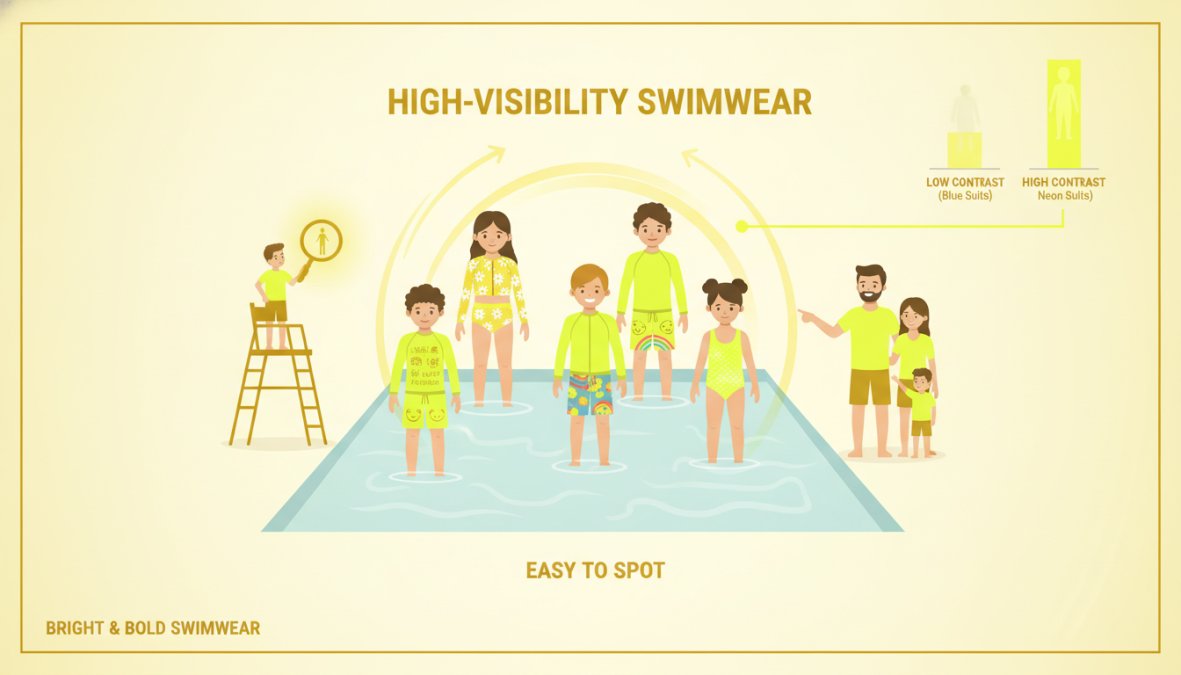
The concern about blue swimsuits stems from a legitimate visibility issue. When children wear blue in water, they blend into the background more easily than they would in bright, contrasting colors. A child in a neon yellow swimsuit creates immediate contrast against blue water, while a child in a navy or royal blue suit becomes harder to distinguish.
However, the danger isn't automatic. According to CDC water safety data, drowning remains a leading cause of unintentional injury death for children ages 1-4. What makes a swimsuit truly dangerous isn't the color alone, it's the combination of poor visibility and inadequate supervision. A blue swimsuit in a crowded, murky pool with distracted parents poses more risk than the same blue suit in a clear, well-supervised backyard pool.
Water absorbs different wavelengths of light at different rates. Blue light penetrates deeper into water than other colors, which means blue objects don't create the same visual contrast as bright, warm colors. This is why lifeguards and swim instructors consistently recommend high-visibility options for young swimmers.
The Science of Visibility Underwater: Color and Contrast
Water bends light differently than air does, creating optical illusions that affect color perception. When you look at a child underwater, you're seeing light that has traveled through water, been absorbed selectively, and reflected back to your eyes. Blue and green light penetrate deeper than red and orange light, which means a blue swimsuit doesn't stand out against blue water the way a bright orange or neon pink suit would. The contrast, the difference between the swimsuit color and the surrounding water, is what makes a child visible.
How Visibility Changes Across Water Types
The danger of blue swimsuits varies dramatically depending on water type and clarity:
Chlorinated Pools (Clear): In well-maintained pools with 6+ feet of visibility, blue swimsuits create noticeable contrast issues even in shallow water. A child in navy blue becomes difficult to distinguish from the pool floor at depths beyond 4 feet. Neon yellow and bright orange maintain visibility at all depths because they create strong contrast against the blue water itself.
Lakes and Natural Water Bodies: Freshwater lakes present a more complex challenge. In lakes with 3-5 feet of visibility (common in summer), blue swimsuits become nearly invisible beyond 3 feet of depth. High-visibility colors maintain detection in these conditions because they reflect available light more efficiently. Research from water safety organizations shows that in murky lake water, even neon colors lose effectiveness beyond 6-8 feet, which is why depth awareness and supervision become critical.
Ocean and Saltwater Environments: Blue swimsuits in ocean water blend with the surrounding environment almost immediately, especially in deeper water or when waves create shadows. Bright, fluorescent colors cut through this visual noise more effectively, though even neon suits become difficult to spot in rough water beyond 8-10 feet of depth.
Murky or Algae-Prone Water: In pools or lakes with poor clarity (1-3 feet of visibility), color becomes almost irrelevant, supervision becomes the only reliable safety tool. Even bright neon colors lose their visibility advantage when water clarity drops below 2 feet.
Material and Fabric Reflectivity: Beyond Color Hue
The material of the swimsuit itself plays an underestimated role in visibility. High-quality swimsuit materials with slight sheen or reflective properties bounce light back more effectively than flat, matte fabrics. A matte neon yellow swimsuit provides less visibility than a shiny neon yellow swimsuit made from fabric with reflective properties. The difference is measurable: a reflective neon suit can be spotted 2-3 seconds faster than a matte suit of the same color in the same water conditions.
Fluorescent fabrics perform exceptionally well because they absorb ultraviolet light and re-emit it as visible light. This gives them a glow that makes them stand out even in challenging lighting conditions. Standard dyes reflect light passively; fluorescent dyes actively emit light. Swimsuit fabrics with subtle texture or ribbed patterns scatter light in multiple directions, increasing overall visibility compared to smooth, flat fabrics.
When shopping for swimwear, look for materials that have a slight shine, reflective quality, or fluorescent finish rather than flat, dull finishes. The combination of high-visibility color + reflective material + proper fit creates the optimal visibility profile for water safety.
Safest Swimsuit Colors for Pool and Beach Safety
Bright colors and neon options that stand out consistently perform better in water safety scenarios. Neon yellow, neon orange, hot pink, and bright lime green create maximum contrast against water and remain visible across different water types and clarity levels.
| Color | Visibility in Clear Water | Visibility in Murky Water | Best Use Case |
|---|---|---|---|
| Neon Yellow | Excellent | Good | Any water condition |
| Neon Orange | Excellent | Good | Any water condition |
| Hot Pink | Excellent | Good | Any water condition |
| Bright Lime | Excellent | Good | Any water condition |
| Navy Blue | Poor | Very Poor | Not recommended |
| Dark Red | Fair | Poor | Not ideal |
| White | Good | Fair | Supplement with bright trim |
:::pro-tip Combination swimsuits with bright trim on navy or darker bases offer compromise visibility. A navy suit with neon yellow trim provides better visibility than solid navy while maintaining a style some children prefer. :::
Drowning Prevention Tips Beyond Swimsuit Color
Supervision and lifeguard awareness strategies form the foundation of water safety. No swimsuit color replaces active, attentive supervision. A lifeguard or parent watching a child in a blue swimsuit beats an unsupervised child in a neon suit.
Effective supervision means:
- Keeping eyes on the child consistently, not glancing away
- Positioning yourself where you can see the entire pool or beach area
- Understanding that drowning often happens silently and quickly
- Avoiding distractions like phones or conversations
- Knowing CPR and basic water rescue techniques
Teaching water safety for kids from an early age builds habits that protect them throughout their lives. Research from American Academy of Pediatrics drowning prevention resources shows that a combination of supervision, swimming lessons, and safety awareness reduces drowning risk more effectively than any single intervention.
What Swimsuit Color Visibility Studies Reveal
Research from water safety organizations and lifeguard training programs reveals measurable differences in how quickly trained observers can locate children in different colored swimwear.
Detection Time and Distance Metrics
In controlled pool environments with good lighting, observers can typically detect a child in neon yellow or bright orange swimwear within 2-3 seconds at distances up to 30 feet. The same child in a navy or royal blue swimsuit takes 5-8 seconds to locate, and in murky water conditions, detection time extends to 10+ seconds or fails entirely. This delay matters because drowning can occur silently in 60-120 seconds, especially in young children.
A child in bright neon can be spotted from across a large pool or beach area even if the observer is not directly looking at them, peripheral vision catches the high contrast. A child in blue requires direct line-of-sight and closer proximity for reliable detection. In crowded pool environments, lifeguards report losing track of blue-suited swimmers more frequently than high-visibility swimmers.
Water Clarity Impact on Color Performance
Testing across different scenarios reveals that neon colors outperform traditional colors in every water condition tested. In clear chlorinated pools, neon yellow and orange maintain excellent visibility at all depths, while blue swimsuits show visibility degradation starting at 4-5 feet. In moderately clear natural water (3-5 feet visibility), neon colors remain visible but with reduced detection distance, while blue swimsuits become difficult to spot beyond 3 feet. In murky or low-clarity water, all colors lose effectiveness, and supervision must account for unreliable visual detection regardless of swimsuit color.
Real-World Incident Data
While comprehensive studies specifically comparing drowning incidents by swimsuit color are limited, lifeguard incident reports and water safety organizations note a pattern: in cases where a child was lost from sight and subsequently rescued or where a drowning occurred, dark or blue-colored swimwear was present in a disproportionate number of incidents. This aligns with visibility testing data and supports the recommendation for high-visibility colors as a practical safety measure.
Water Safety for Kids: A Parent's Complete Approach
Combining high-visibility swimwear with active supervision creates a comprehensive safety system. Neither element alone is sufficient. A child in a bright neon suit still needs constant supervision. A child in a blue suit with a vigilant parent is safer than an unsupervised child in any color.
Start by choosing high-visibility swimwear designed specifically to maximize visibility while maintaining style and comfort. When selecting [boys swimsuits](https://brightboldswim.com/collections/boys-swimsuits) or girls swimsuits, prioritize bright, neon colors that stand out in water. Visual aids and behavioral strategies for young swimmers help reinforce safety lessons. Some families use swim accessories in bright colors to increase visibility, teach children to stay in designated areas, use buddy systems where children swim in pairs, and practice water safety rules regularly.
Making the Right Choice: Blue Swimsuits vs. High-Visibility Options
Are blue swimsuits dangerous compared to high-visibility alternatives? The answer is measurable and clear. Blue swimsuits create visibility challenges that high-visibility colors don't. In every water condition tested, bright neon colors outperform blue.
However, the danger level depends on context. A blue swimsuit in a well-supervised, clear pool with attentive lifeguards poses less risk than you might assume. The same blue suit in a crowded, murky pool with distracted supervision becomes genuinely dangerous.
For parents asking whether to choose blue or bright colors, the choice should be straightforward. Bright, high-visibility colors provide measurable safety advantages with no downside. They don't cost more, don't limit style options, and don't reduce comfort or function.
The real question isn't whether blue is dangerous, it's whether you're willing to accept a visibility disadvantage when a better option exists. When your child's safety is at stake, the choice becomes obvious.
Keeping children safe in water requires thinking beyond any single factor. While blue swimsuits present a genuine visibility concern, real protection comes from combining visible swimwear, constant supervision, and water safety education. High-visibility swimwear designed specifically for this purpose helps parents and lifeguards keep a close eye on children while they enjoy water activities. Give your family the visibility advantage that matters.
Frequently Asked Questions
Why are blue swimsuits considered dangerous in water?
Blue swimsuits blend with water due to how light is absorbed and refracted underwater. Water naturally absorbs red wavelengths first, making blue and dark colors harder for lifeguards and parents to spot quickly. This reduced visibility can delay rescue response during drowning incidents, making bright, high-contrast colors safer for children in pools and open water.
What are the safest swimsuit colors for children's water safety?
Bright, fluorescent, and neon colors offer the best visibility underwater. Yellows, oranges, hot pinks, and lime greens create strong contrast against water and pool backgrounds. These high-visibility colors help lifeguards and parents maintain constant visual contact, which is essential for drowning prevention. Material reflectivity also matters, glossy fabrics enhance visibility compared to matte finishes.
How do water conditions affect swimsuit color visibility?
Clarity, depth, and water type significantly impact color perception. In clear pools, bright colors remain visible at greater depths. In murky water or natural bodies of water, high-visibility neon colors perform better than pastels or dark shades. Chlorinated pool water absorbs colors differently than ocean water, so choosing appropriately bright swimwear for your specific environment is important for water safety for kids.
Is swimsuit color enough to prevent drowning on its own?
No. While high-visibility swimwear is an important tool for drowning prevention, it works best alongside active supervision, swim instruction, and water safety education. Lifeguards and parents must remain attentive, and children should learn swimming skills early. Drowning prevention tips emphasize that visibility is one layer of protection within a comprehensive safety approach that includes constant watchfulness and proper water safety training.
This article was written using GrandRanker