

Child Water Safety Vest Reviews: What Parents Should Know
Table of Contents
- Quick Comparison: Child Water Safety Vest Options
- How We Evaluated These Water Safety Vests
- US Coast Guard Approved Life Jacket for Kids: What Parents Must Know
- The Best Swimming Gear for Toddlers: High-Visibility Swimwear That Works
- How to Teach a Child to Swim: Building Confidence Beyond the Vest
- Fitting and Sizing a Child Water Safety Vest Correctly
- Which One Should You Pick?
- Conclusion
- Frequently Asked Questions
Last Updated: September 19, 2026
Quick Comparison: Child Water Safety Vest Options
A child water safety vest is a flotation device designed to keep a young swimmer buoyant and visible in the water. At Bright & Bold Swimwear, we built our approach around one plain truth: you can't supervise what you can't see. That's why visibility sits at the center of everything we make.
Here's the honest starting point. A vest and a brightly colored swimsuit do different jobs. The vest keeps a child afloat. The suit keeps a child findable. Parents need both, and most families only shop for one.
Below, we break down what actually matters when you're choosing flotation gear and swimwear for a child aged 2 to 7.
| Option | What It Does | Best For | Price |
|---|---|---|---|
| Boys Short Sleeve Rash Guard Set | UPF 30+, neon visibility, two-piece | Warm-weather pool and beach days | $45.99 |
| Boys Long Sleeve Rash Guard Set | UPF 30+, full sleeve coverage | Long sun exposure, swim lessons | $45.99 |
| Girls Long Sleeve Crop Top Set | UPF 30+, full-coverage bottoms | Active swimmers who want less fabric | $45.99 |
| Girls Long Sleeve Full Coverage Set | UPF 30+, collar-to-waist top | Fair or sensitive skin | $45.99 |
| Girls Long Sleeve Zip One Piece | UPF 30+, shoulder-to-wrist coverage | Maximum sun protection | $45.99 |
| Girls Sleeveless Back Zip One Piece | UPF 30+, unrestricted arm movement | Serious swim lessons | $45.99 |
How We Evaluated These Water Safety Vests
We judged every option against four things: visibility in water, sun protection, fit and comfort, and how well it holds up to repeated washing and chlorine.

The visibility question matters most. Traditional blue and black swimwear disappears against pool water. Neon colors cut through that visual noise, which gives a parent or lifeguard a faster lock on a small swimmer in a crowded pool.
Comfort came second. A child who's tugging at a strap or complaining about scratchy fabric isn't focusing on swimming. That's a safety problem, not just an annoyance.
US Coast Guard Approved Life Jacket for Kids: What Parents Must Know
A US Coast Guard approved life jacket for kids is a flotation device that has passed federal testing for buoyancy, turning ability, and performance in the water. The Coast Guard label is the single most important thing to check before you buy, but the label itself is where most parents stop reading, and that's a mistake.
Here's the plain-language version of a confusing rule. The U.S. Coast Guard boating safety guidance draws a hard line between two categories of gear:
- Life jackets (also called personal flotation devices, or PFDs) are designed to keep an unconscious or exhausted wearer face-up and breathing. They carry a Coast Guard approval number and a performance type printed on the label.
- Swim aids, inflatable arm bands, foam discs, pool noodles, and most "swim vests" sold in the toy aisle, carry no federal approval. They help a child practice in shallow water under direct adult supervision. They are not designed to save a life.
The performance types matter because they tell you what the device is actually built to do. The most common types you'll see for children are:
- Type II (near-shore buoyant vest): Turns most wearers face-up and is intended for calm, inland water where rescue is quick. This is the classic blocky children's vest.
- Type III (flotation aid): Comfortable and good for conscious swimmers in calm water, but it requires the wearer to tilt their head back to stay face-up. A child who panics or goes limp may not get that turn.
- Type V (special-use device): Includes some inflatable and hybrid designs. It only counts as a life jacket when worn exactly as the label's conditions state, read those conditions carefully.
Why does the distinction matter so much?
When you check a label, look for four things:
Boys Short Sleeve Rash Guard Swim Set →
- The Coast Guard approval number
- The performance type (II, III, or V)
- The approved weight range in pounds
- The intended use, near-shore, calm water, or specific activities
The Best Swimming Gear for Toddlers: High-Visibility Swimwear That Works
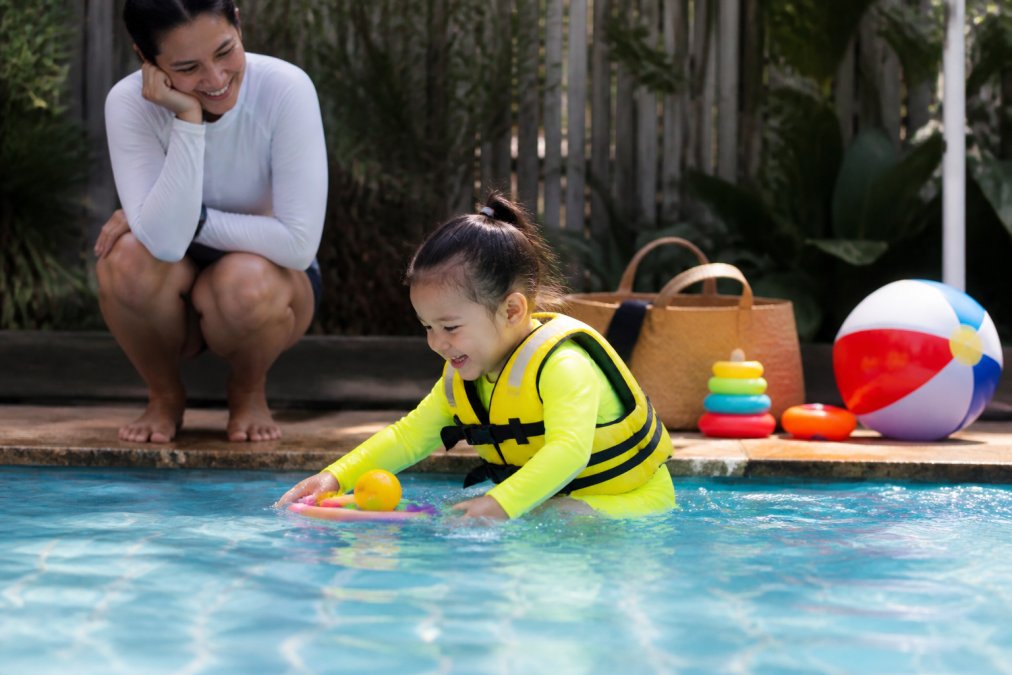
The best swimming gear for toddlers pairs a proper flotation device with high-visibility swimwear. The vest keeps them up. The suit keeps them seen.
How to Teach a Child to Swim: Building Confidence Beyond the Vest
Learning to swim takes time, and a flotation device is a stepping stone rather than a destination. The goal is a child who can float, breathe, and move without help.
A few things that help:
- Blowing bubbles to build breath control
- Floating on the back with your hand supporting the head
- Kicking while holding the wall
- Jumping in and turning back to the wall
Fitting and Sizing a Child Water Safety Vest Correctly
A properly fitted vest stays put when you lift the child by the shoulders. If it slides up past the ears, it's too loose, and a loose vest is the single most common reason a child ends up floating with their chin at the waterline instead of their head clear of it.
- The weight range on the label matches your child's current weight
- The chest strap and buckle system sit snug, not tight, you should be able to slide two fingers under the strap, no more
- The vest doesn't ride up when your child raises both arms overhead
- There's no gap you can fit a fist through at the sides
- The crotch strap (if the vest has one) is fastened, it's the feature that stops ride-up on small children
- The collar supports the head without pressing on the throat
- Supervised shallow water, no vest. Let your child practice floating and kicking while you stay within arm's reach. This is where they learn what their own buoyancy feels like.
- Vest on, but unzipped in shallow water. They feel the vest's support disappear gradually rather than all at once.
- Vest off in the shallow end, vest on for the deep end. Skills get tested where it's safe, and the vest stays available where it isn't.
- Vest reserved for open water and boating. Once your child can swim a short distance and turn back to the wall, the vest becomes boating gear rather than pool gear.
Which One Should You Pick?
Match the suit to the day, not to a single "best" answer.
Conclusion
Drowning remains a leading cause of accidental death for young children, and supervision is the first line of defense. The CDC guidance on drowning prevention is blunt about it: close, constant, attentive watching is what saves lives. Gear supports that effort, it doesn't replace it.
Frequently Asked Questions
What is the difference between a US Coast Guard-approved life jacket and a swim vest?
A US Coast Guard-approved life jacket is a certified personal flotation device designed to turn an unconscious wearer face-up in the water, and it is required on boats and open water. A swim vest is a learn-to-swim aid that adds buoyancy but carries no federal approval and cannot substitute for a life jacket. For pool play and lessons, a swim vest can help build water confidence, but for boating, lakes, or the ocean, always use a USCG-approved life jacket sized to your child's weight.
How do I ensure a child's water safety vest fits correctly?
Check the weight range on the label first, since fit is based on weight, not age. Put the vest on your child and lift it by the shoulders; if it slides up past the chin or ears, it is too loose. Adjust every buckle and strap until the vest hugs the torso snugly without restricting breathing or arm movement. Test it in shallow water before any deeper swim, and recheck the fit each season as your child grows.
Are toddler swimming vests safe for pool use?
Swim vests can be a helpful part of pool time when used with constant adult supervision, but they are not a safety device and should never replace watching your child. They add buoyancy and can help toddlers practice kicking and floating during lessons. Keep your child within arm's reach at all times, and pair the vest with high-visibility swimwear so you and the lifeguard can spot them quickly in a crowded pool.
What is the safest flotation device for a toddler learning to swim?
For learning to swim in a pool, a properly fitted swim vest paired with one-on-one adult supervision and formal swim lessons is a practical setup. For any open water, boats, or the beach, a US Coast Guard-approved life jacket sized to your child's weight is the only device that meets federal safety standards. Many parents use both: a swim vest for lessons and a certified life jacket for lake and ocean days.
Should my child wear a swim vest at the beach?
At the beach, a US Coast Guard-approved life jacket is the safer choice because of waves, currents, and deeper water. Swim vests are meant for calm, shallow pool environments and do not meet the standards required for open water. Even with a certified life jacket, keep your child within arm's reach, watch for rip currents, and choose high-visibility swimwear so they stand out against the water and sand.