

Drowning Prevention Tips for Parents: 7 Essential Safety Layers
Table of Contents
- Why Drowning Prevention Requires Multiple Safety Layers
- Constant Supervision: The Foundation of Water Safety
- Pool Safety Checklist for Parents: Physical Barriers and Prevention
- Water Safety Rules for Kids: Teaching Competency and Awareness
- Signs of Dry Drowning and Secondary Drowning: What Parents Must Know
- CPR for Parents: Emergency Response Training That Saves Lives
- Technology and Visibility: Modern Tools for Water Safety
- Beyond the Pool: Open Water and Rip Current Safety
Drowning Prevention Tips for Parents: 7 Essential Safety Layers
Last Updated: July 8, 2026
Drowning is a leading cause of unintentional injury death for children, yet most parents underestimate how quickly it can happen and how silently. This guide covers drowning prevention tips that actually work, moving beyond generic checklists to address the real barriers parents face when protecting their children around water. According to the American Academy of Pediatrics, most drowning incidents happen in familiar settings with a supervising adult present. This isn't about fear; it's about shifting how you approach water time with intention and specific strategies.
Why Drowning Prevention Requires Multiple Safety Layers
Relying on a single safety measure fails because water emergencies happen across different contexts: backyard pools, bathtubs, beaches, and unexpected exposures. A child who wears a life jacket at the public pool still needs supervision in the bathtub. A strong swimmer still needs barriers around an unsupervised pool. When you combine constant supervision, physical barriers, water competency training, and emergency preparedness, you create a framework where no single failure point can lead to tragedy.
Constant Supervision: The Foundation of Water Safety
The most critical drowning prevention tips for parents start with understanding what supervision actually means. It's not checking on your child periodically or keeping them in your general vicinity. It's focused, distraction-free watching where you maintain visual contact and can reach your child within seconds.
Touch Supervision and Distraction-Free Watching
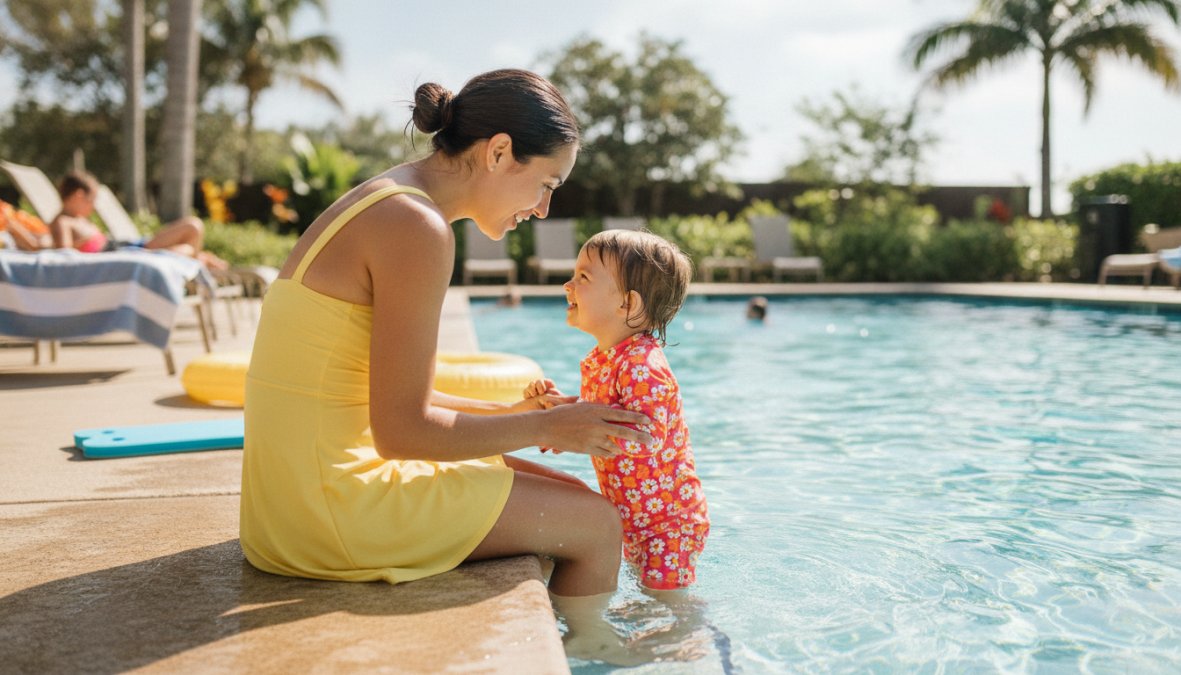
Touch supervision means you can reach your child by extending your arm. For young children and weak swimmers, this is non-negotiable. Your child should be within arm's reach at all times in or immediately adjacent to water. The average drowning is silent and takes less than two minutes.
Distraction-free watching means your phone stays in your pocket, your attention stays on the water, and you're not reading, chatting with other adults, or managing multiple children simultaneously without backup. Create a physical setup that supports focused supervision: position yourself between the sun and the water so glare doesn't obscure your view, and sit at pool level rather than standing for better sightlines.
Bright & Bold Swimwear's high-visibility boys swimsuits and girls swimsuits in vibrant colors make it easier to maintain visual contact, reducing the cognitive load of supervision.
Overcoming Psychological Barriers to Supervision
Focused supervision is mentally exhausting. After 15-20 minutes of intense watching, attention naturally drifts. The solution is rotation: take turns with another adult every 20 minutes. When it's your turn to supervise, you're "on." When it's not, you can relax completely.
Normalcy bias, the assumption that because nothing bad has happened yet, nothing will, is equally dangerous. Create accountability structures by assigning one adult as the designated water watcher for specific time blocks using a visible marker, whistle, or colored armband. This clarity prevents the diffusion of responsibility that leads to tragedy.
Pool Safety Checklist for Parents: Physical Barriers and Prevention
Physical barriers are your second layer of protection. They can't replace supervision, but they prevent unsupervised access and buy you critical seconds to respond if a child enters the water unexpectedly.
Four-Sided Fencing and Pool Alarms
A four-sided fence that completely surrounds the pool creates a barrier between the house and the water. The fence should be at least four feet high with self-closing, self-latching gates. Pool alarms serve as a backup detection system, alerting you the moment someone enters the water. The combination of four-sided fencing and alarms is more effective than either alone.
Drain Covers and Suction Entrapment Prevention
Drain covers and anti-entrapment devices prevent suction entrapment, a rare but serious risk. Federal law now requires anti-entrapment drain covers on all residential and public pools. If you have an older pool, verify that your drains meet current standards. Check them regularly, as covers can degrade or come loose.
| Safety Barrier | What It Does | Best For | Limitation |
|---|---|---|---|
| Four-sided fencing | Prevents unsupervised pool access | Permanent above-ground and in-ground pools | Requires consistent gate closure |
| Pool alarms | Alerts when someone enters water | Backup detection for brief lapses | Can produce false alarms |
| Drain covers | Prevents suction entrapment | All pools with drains | Requires regular inspection |
| Life jackets | Provides flotation if child enters water | Non-swimmers and weak swimmers | Not a substitute for supervision |
Water Safety Rules for Kids: Teaching Competency and Awareness
The third layer of protection is teaching your child water competency and safety awareness. A child who understands water behavior, can manage their breathing, and knows their own limits is safer in water emergencies.
Formal Swimming Lessons and Water Competency
Formal swimming lessons teach specific survival skills: breath control, how to float if panicked, how to move through water efficiently, and how to respond to water in their face. Look for instructors trained in survival swimming or water survival skills specifically. Start lessons early, children as young as one year old can begin water familiarization. By age 4-5, most children can learn basic survival skills. Lessons should be ongoing; one season isn't enough.
Understand the limits of lessons. A child who completes swimming lessons is not "water safe." They're more competent in water, but they still need supervision, barriers, and all other safety measures.
Life Jackets and PFDs: When and How to Use Them
A properly fitting personal flotation device (PFD) provides flotation if a child enters water unexpectedly. The key is proper fit: check by lifting the child by the shoulders of the jacket, their chin and ears should stay inside. If their head slips through, it's too large.
Use PFDs in high-risk situations: around open water, at beaches with currents, in boats, and during water activities where supervision might be divided. For children who can't swim, consider wearing a PFD even in supervised backyard pool situations. Coast Guard-approved Type III PFDs are comfortable enough for extended wear.
Signs of Dry Drowning and Secondary Drowning: What Parents Must Know
Dry drowning and secondary drowning describe respiratory distress that develops hours after water exposure. Both conditions develop gradually over minutes to hours after the initial water incident. The child might seem fine immediately after, then develop respiratory distress, fatigue, or behavioral changes.
Watch for these signs after any water incident where water went up the nose, the child coughed or gagged, or the child was submerged: persistent coughing or difficulty breathing, unusual fatigue, vomiting, chest pain, behavioral changes, or rapid or labored breathing. If you observe any of these signs within 24 hours of water exposure, seek medical attention.
The prevention strategy is straightforward: avoid water in the airway. Teach your child not to jump in headfirst until confident in their diving skills, and supervise closely during water play to catch and respond to coughing or gagging immediately.
CPR for Parents: Emergency Response Training That Saves Lives
Drowning prevention tips for parents culminate in one critical skill: CPR. If a drowning does occur, CPR performed immediately dramatically increases survival odds and reduces brain damage. Every parent should be trained.
CPR training is widely available through the Red Cross, hospitals, and community centers. The basics: check responsiveness and breathing, call emergency services, begin chest compressions at 100-120 compressions per minute, provide rescue breaths if trained, and continue until emergency responders arrive. For children, use one hand for compressions on smaller children and compress to a depth of about two inches.
The psychological barrier to CPR is fear of doing it wrong. The reality: attempting CPR, even imperfectly, is far better than doing nothing. Take a formal CPR course rather than relying on videos or apps.
Technology and Visibility: Modern Tools for Water Safety
Recent advances in water safety technology offer additional layers of protection. Wearable drowning detection devices use motion sensors and algorithms to identify the specific movements of a drowning child and alert caregivers immediately.
Visibility technology is where most families can benefit immediately. High-visibility swimwear makes it easier for you, lifeguards, and other adults to maintain visual contact with your child. Bright & Bold Swimwear's vibrant, high-visibility designs are specifically engineered for this purpose, the bold colors cut through water glare and pool backgrounds, making it easier to spot your child at a glance.
Combine visibility with other tools: a bright swimsuit + a wearable alarm + four-sided fencing + constant supervision + CPR training = a comprehensive safety system.
Beyond the Pool: Open Water and Rip Current Safety
Drowning prevention tips for parents extend beyond backyard pools to beaches, lakes, and rivers. Open water presents different hazards: currents, waves, temperature, and the absence of lifeguards in many locations.
Rip currents are narrow channels of water flowing away from shore. Swimmers caught in a rip current often panic and try to swim directly back to shore, exhausting themselves. The correct response is to swim parallel to the shore to exit the current, then swim back to shore. Teach your child this response before visiting the beach.
At open water, supervision is even more critical than at pools. Assign a dedicated watcher and establish clear boundaries about how far children can wade or swim. Life jackets are especially valuable at open water. Check water conditions before visiting, know whether lifeguards are present, and understand the specific hazards of that location.
Drowning is preventable. The strategies in this guide, constant supervision, physical barriers, water competency, emergency preparedness, and visibility, work together to create multiple safety layers. No single strategy is foolproof, but the combination addresses the reality of how drowning happens and what actually prevents it.
The most important step you can take today is to assess your current water safety practices and identify one gap. Start with one layer and build from there. Each addition reduces risk and increases your confidence.
Bright & Bold Swimwear was created by a family to protect yours. Our high-visibility swimwear makes it easier to maintain visual contact with your child in water, a simple but powerful tool that supports the supervision practices covered in this guide. Shop Best Sellers to find vibrant, protective swimwear that keeps your child visible and safe.
Additional Resources
For more information on drowning prevention and water safety, consult these authoritative sources:
According to the CDC's water safety guidance, drowning is a leading cause of unintentional injury death for children ages 1-4, with most incidents occurring in natural water settings and supervised situations.
The American Academy of Pediatrics drowning prevention recommendations emphasize the critical role of constant, attentive supervision and the importance of CPR training for all caregivers.
Research from the World Health Organization on global drowning prevention documents that most drowning deaths are preventable through layered safety approaches combining supervision, barriers, and competency training.
Frequently Asked Questions
What are the most effective drowning prevention tips for parents?
Drowning prevention requires multiple layers: constant touch supervision, formal swimming lessons, four-sided pool fencing, life jackets for weak swimmers, CPR certification, and drain cover maintenance. No single measure works alone. Combine constant supervision with water safety rules for kids, physical barriers, and emergency training to create comprehensive protection. Most importantly, maintain distraction-free watching, avoid phones and conversations while supervising.
What should be on a pool safety checklist for parents?
A complete pool safety checklist includes: four-sided fencing with self-closing gates, drain covers meeting federal standards, life jackets and PFDs for non-swimmers, a rescue pole and first-aid kit poolside, CPR certification for caregivers, clear water safety rules for kids, and regular supervision protocols. Also check that all adults know the signs of dry drowning and secondary drowning, and that pool alarms are functional. Assign a designated water watcher during gatherings.
How can I recognize signs of dry drowning in my child?
Dry drowning occurs when water enters the airway but the child doesn't fully submerge. Watch for persistent coughing, difficulty breathing, lethargy, or unusual behavior within 24 hours of water exposure. Secondary drowning involves fluid in the lungs developing after the incident. Symptoms include rapid breathing, chest pain, or foam around the mouth. Seek immediate medical attention if your child shows any of these signs after a submersion incident, even if they seemed fine initially.
At what age should children start formal swimming lessons?
Swimming lessons can begin around age 1 with water familiarization classes, though formal instruction is most effective starting at age 4-5. Younger children can learn water safety and basic floating skills. Water competency, the ability to enter water safely, swim, and exit, typically develops between ages 4-6 with consistent lessons. However, lessons are not a substitute for constant supervision. Even strong swimmers need watchful eyes at all times.
This article was written using GrandRanker