

Essential Swimming Skills for Toddlers to Master
Table of Contents
- 1. Water Familiarization and Comfort in the Water
- 2. Breath Control and Holding Breath Safely
- 3. Floating and Body Position in the Water
- 4. Pop-Up Breathing and Returning to the Surface
- 5. Basic Kicking and Propulsion Techniques
- 6. Introduction to Swimming Strokes: Front Crawl and Breaststroke
- Building Water Confidence: Activities and Swimming Lessons for Toddlers
- Toddler Water Confidence Activities You Can Practice at Home
- Frequently Asked Questions
Last Updated: October 14, 2026
1. Water Familiarization and Comfort in the Water
Getting comfortable in water is the foundation for all essential swimming skills for toddlers to master.
Let your toddler play in shallow water where they can stand, exploring at their own pace.
At Bright & Bold Swimwear, we recognize that water familiarization looks different for every child.
Practice these water familiarization activities:
- Sit in shallow water together and let your toddler pour water over your heads
- Walk through the water holding hands, narrating what you're doing
- Play games like "ring around the rosie" in the shallow end
Keep water time positive and pressure-free. Comfort directly affects their ability to learn other skills, so don't rush this stage.
2. Breath Control and Holding Breath Safely
Breath control is one of the most essential swimming skills for toddlers to master because it's the foundation for water safety.
Start with breath awareness on dry land: have your toddler blow bubbles through their mouth and nose, then move to blowing bubbles together at the pool's edge, celebrating each attempt.
Holding breath safely means breathing in before the head goes underwater, holding briefly, then lifting to breathe again.
Introduce breath-holding in stages:
- Blow bubbles at the water's surface (ages 2-3)
- Practice quick dips of the nose and mouth into water while holding breath (ages 2.5-3.5)
- Hold breath for 2-3 seconds while submerged (ages 3+)
The goal is breath control without fear, a critical safety skill that makes all other swimming skills possible.
3. Floating and Body Position in the Water
Floating is one of the most important essential swimming skills for toddlers to master because it teaches them how to stay safe if they fall into water unexpectedly.
There are two main floats: the back float and the front float.
Back floating involves lying on their back with their face above water, arms and legs relaxed. To teach this:
- Start in very shallow water where they can stand
- Have them lean back and rest their head on your hand or a flotation device
- Gradually reduce support as they gain confidence
Front floating teaches body position for swimming strokes:
- Lying face-down with arms extended
- Keeping the body horizontal (not sinking at the hips)
- Practicing in shallow water with your hand underneath for support
Many toddlers naturally sink at the hips or try to stand up, which is normal. Keep practicing in shallow water, use flotation aids if needed, and celebrate small improvements.
4. Pop-Up Breathing and Returning to the Surface
Pop-up breathing allows swimmers to breathe while moving through the water.
Pop-up breathing involves submerging briefly, then lifting the head quickly to take a breath, an active movement requiring coordination and confidence.
To teach pop-up breathing:
- Start in shallow water where your toddler can stand comfortably
- Have them hold your hands or a kickboard for support
- Practice bobbing down to blow bubbles, then standing up to breathe
- Gradually reduce the depth of the bob and increase the speed
- Practice the motion repeatedly until it becomes automatic
The motion should be smooth: submerge, blow bubbles, lift head, breathe, repeat. Even a few inches of submersion is enough to practice.
Many toddlers panic if water goes up their nose or splashes their face.
Once your toddler can pop up and breathe without panicking, they've mastered a key water safety skill that directly supports learning swimming strokes.
5. Basic Kicking and Propulsion Techniques
Kicking is the foundation for all swimming movement, teaching your toddler to move through water using their legs. There are two basic kicks: the flutter kick and the breaststroke kick.
Flutter kicking is the simplest and most natural kick for young swimmers:
- Legs stay relatively straight with a slight bend at the knee
- Movement comes from the hips, not the knees
- Feet point downward and create small, rapid movements
Breaststroke kicking is more complex but important for water confidence:
- Knees bend and draw up toward the chest
- Feet turn outward and push backward in a circular motion
- Legs come back together as they straighten
When teaching kicking:
- Have your toddler hold a kickboard with both hands
- Practice in shallow water where they can touch the bottom
- Celebrate effort, not perfection, form improves with time
Kicking builds leg strength and teaches your toddler how their body moves through water, an essential foundation for swimming strokes and overall water confidence.
6. Introduction to Swimming Strokes: Front Crawl and Breaststroke
Once your toddler has mastered water comfort, breath control, floating, pop-up breathing, and kicking, they're ready for basic strokes. The two most important are front crawl (freestyle) and breaststroke.
Front crawl is the fastest and most efficient stroke, making it a good starting point:
- Alternating arm movements with flutter kicking
- Head turns to the side to breathe
- Body stays horizontal
Breaststroke is slower and more controlled:
- Both arms move together in a pulling motion
- Breaststroke kick (legs moving together in a circular pattern)
- Head stays relatively still, dipping slightly as arms pull
When introducing strokes, break them into small steps:
- Practice arm movements on land or at the pool edge
- Practice with flotation support in shallow water
- Combine arms and legs with a kickboard
- Practice without flotation as confidence builds
- Focus on one stroke at a time before introducing the second
Swimming strokes are the visible skills that make children feel like "real swimmers." Celebrate progress to build confidence, your toddler doesn't need to be fast or perfect, just to move through the water with growing confidence.
Building Water Confidence: Activities and Swimming Lessons for Toddlers
Water confidence grows through consistent, positive practice. The essential swimming skills for toddlers to master develop faster when you combine formal lessons with playful home practice and water-based games.
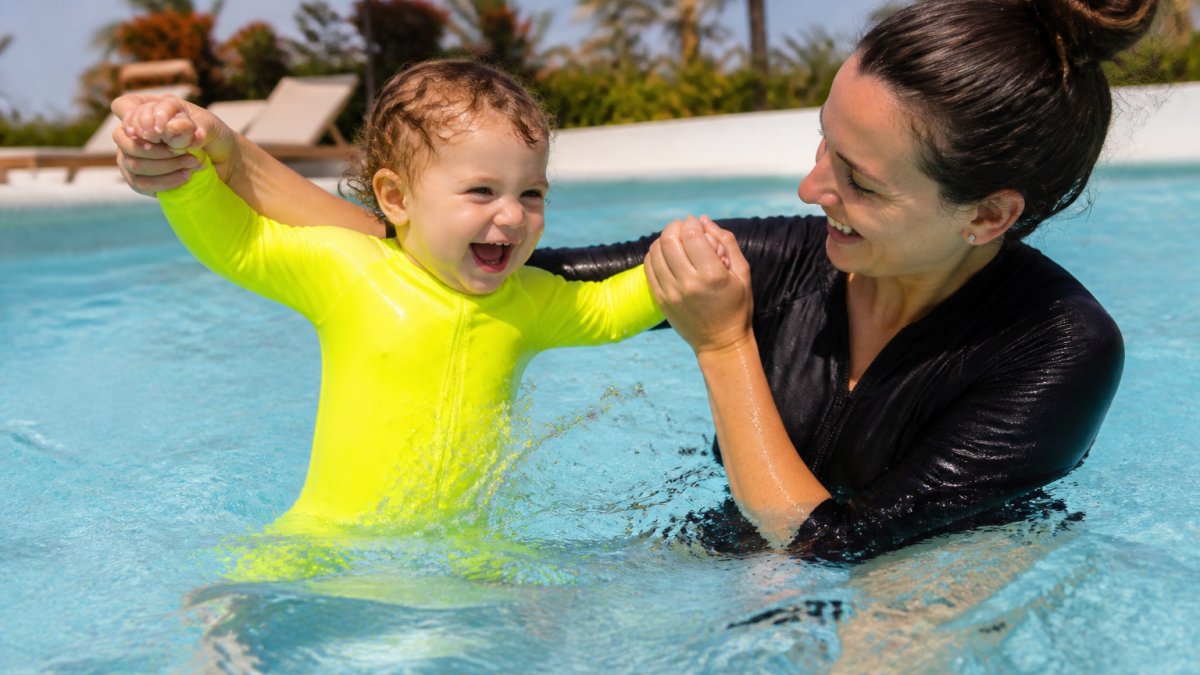
Formal swimming lessons provide structure and professional guidance. A qualified instructor teaches skills in logical progression, offers feedback, and helps your toddler overcome fears. Look for instructors who:
- Have certification in toddler water safety and instruction
- Use positive reinforcement rather than force
- Teach in small groups (2-4 children) or one-on-one
- Focus on water comfort and safety before competitive skills
Many swim schools offer programs for toddlers ages 2-4, focusing on water familiarization, breath control, and basic movement rather than advanced strokes. If you're running a swim school, we offer Wholesale Swim For Swim Schools to outfit your students with quality swimwear.
Home practice between lessons is equally important. Dedicate 15-30 minutes several times per week in a pool, lake, or large bathtub. Keep it playful:
- Play "ring around the rosie" in the shallow end
- Practice floating while singing a favorite song
- Race with kickboards across the shallow end
- Play "submarines" (brief submersion and surfacing)
Combining formal instruction with consistent home practice creates the fastest progress, building both competence and confidence.
Toddler Water Confidence Activities You Can Practice at Home
You don't need a formal pool or instructor to help your toddler develop water confidence.
Water comfort games build positive associations:
- Fill a bathtub or kiddie pool and let your toddler splash freely
- Pour water gently over their shoulders and arms
- Practice blowing bubbles together
- Sing songs while playing
Breath control practice can happen during bath time:
- Blow bubbles together at the water's surface
- Practice holding breath for 1-2 seconds (no pressure)
- Dip nose and mouth in water briefly while holding breath
- Celebrate each attempt, no matter how small
Floating practice in a bathtub or kiddie pool:
- Support your toddler while they practice back floating
- Gradually reduce support as they gain confidence
- Start with a few seconds, then extend the time
- Use a small kickboard or flotation aid for extra support
Kicking practice with a kickboard:
- Hold a kickboard while your toddler practices flutter kicking
- Practice in shallow water where they can stand
- Make it fun with songs or games
- Celebrate effort and improvement
Pop-up breathing practice:
- Practice the bobbing motion in shallow water
- Submerge briefly, blow bubbles, lift head to breathe
- Start with very short submersions (1-2 seconds)
- Increase duration gradually as comfort builds
| Activity | Best Age | Duration | Frequency | Key Benefit |
|---|---|---|---|---|
| Water play & splashing | 2-4 years | 10-15 min | 3-4x/week | Builds comfort & positive associations |
| Breath control games | 2.5-4 years | 5-10 min | 3-4x/week | Teaches breath management |
| Floating practice | 3-5 years | 5-10 min | 2-3x/week | Builds safety skills & confidence |
| Kicking with kickboard | 3-5 years | 10-15 min | 2-3x/week | Develops propulsion & leg strength |
| Pop-up breathing | 3-5 years | 5-10 min | 2-3x/week | Teaches recovery & breathing coordination |
Home practice works best when playful and pressure-free. Your toddler should see water time as fun, not a test. If they resist, pause and return to simpler activities, building confidence takes time, but the investment pays off in water safety and lifelong swimming ability.
Teaching your toddler the essential swimming skills for toddlers to master is one of the most important investments in their safety and lifelong health.
Start with water familiarization and patience. Every toddler develops at their own pace.
When your child is ready for pool time, equip them with quality Swim Accessories that support their learning and safety.
Frequently Asked Questions
What swimming skills should toddlers learn first?
Toddlers should start with water familiarization and comfort, learning to feel safe in the water before progressing to breath control and floating. These foundational skills build confidence and form the basis for all other swimming abilities. Most swim instructors recommend beginning with water acclimation activities, then moving to breath control around ages 2-3, followed by floating and basic propulsion skills.
How can swimming lessons for toddlers help prevent drowning?
Swimming lessons teach toddlers essential survival skills like floating, breath control, and self-rescue awareness. Combined with constant adult supervision and high-visibility gear like bright swimwear, lessons significantly reduce water-related risks. Research shows that formal swim instruction, paired with vigilant supervision, is one of the most effective drowning prevention strategies for young children.
At what age can toddlers start learning to float?
Most toddlers can begin learning floating concepts around 18-24 months with parent support, though independent floating typically develops between ages 3-5 depending on comfort level and practice. Back floats are usually easier to master first because they allow the child to see the sky and feel supported. Consistent practice in a safe, supervised environment accelerates skill development.
What should I do if my toddler is afraid of the water?
Take a patient, gradual approach. Start with shallow water play, let them control the pace, and use positive reinforcement. Never force a child into the water. Playful activities like splashing, pouring water over their hands, and singing songs can build comfort naturally. Some children need more time; this is completely normal and doesn't predict future swimming ability.
How often should toddlers practice swimming skills to make progress?
Consistent practice 2-3 times per week, even for short 15-30 minute sessions, produces better results than sporadic lessons. Regular exposure helps toddlers retain skills and build confidence. Many parents combine formal swim lessons with casual pool or water play at home to reinforce learning and keep the experience fun and pressure-free.