

How to Keep Kids Safe in Public Pools: Essential Guide
Table of Contents
- How to Keep Kids Safe in Public Pools: A Parent's Framework
- How to Supervise Kids at the Pool With Active Attention
- Pool Safety Rules for Kids That Actually Prevent Incidents
- Recognizing Signs of Drowning in Children
- Best Life Jackets for Public Pools and When to Use Them
- Essential Pool Safety Barriers and Drain Entrapment Prevention
- Swimming Lessons and CPR Certification: Your Safety Net
- Sun Safety and Heat Exhaustion at Public Pools
How to Keep Kids Safe in Public Pools: Essential Guide
Last Updated: July 5, 2026
How to Keep Kids Safe in Public Pools: A Parent's Framework
Public swimming environments present unique hazards compared to private settings. The difference between a safe pool visit and a dangerous one comes down to preparation, vigilance, and knowing what to watch for before your kids enter the water.
This guide covers essential strategies that reduce risk significantly: active supervision techniques, recognition of drowning signs, proper use of flotation devices, and specific public pool hazards many parents overlook.
Why Public Pool Safety Requires a Different Approach
Public pools present hazards that private pools don't. Crowded conditions mean fewer eyes on individual children, and lifeguards monitoring dozens of swimmers simultaneously cannot watch specific children. You cannot assume a lifeguard's presence eliminates your responsibility, they're not babysitters for individual children, and a child can slip into trouble in seconds.
Public pools also vary widely in maintenance standards and safety infrastructure. They often have deeper ends, slippery decks, and crowded shallow areas where kids can be jostled or knocked over. Non-swimmers panic faster in chaotic water than in calm conditions.
How to Supervise Kids at the Pool With Active Attention
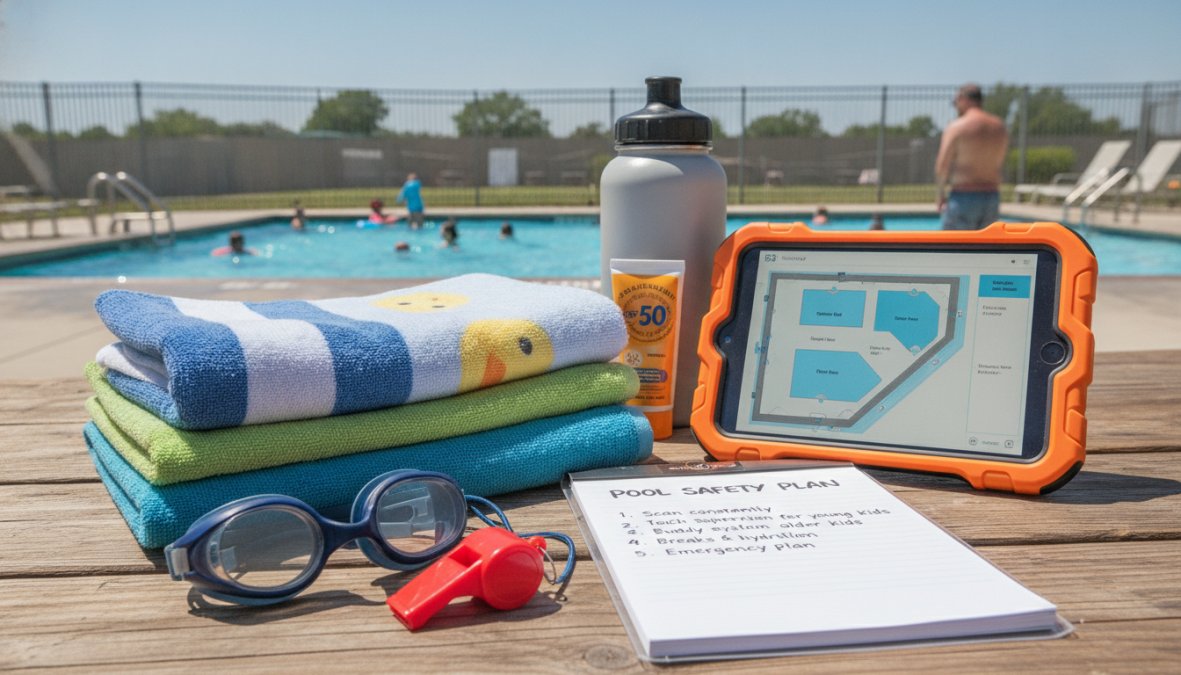
Effective supervision means being physically present and mentally focused on your child at all times, not checking your phone or chatting with other adults while glancing at the water. Your eyes must be on your child every second, and you must be positioned to reach them quickly if needed.
Position yourself where you can see your child's face and body without moving your head more than 45 degrees. If sun creates glare or another swimmer blocks your view, reposition immediately. Dressing your child in best-selling kids' swimsuits with bright, high-visibility colors makes them easier to spot in crowded pool environments.
Touch supervision is essential for non-swimmers and weak swimmers under age six. Maintain physical contact or stay within arm's reach at all times.
The Water Watcher Method
The Water Watcher method designates one adult to watch the water while others socialize or take breaks. This person wears a specific item (whistle, colored wristband, or vest) so everyone knows who's responsible. Every 15-30 minutes, the role rotates to a fresh adult with full attention and no distractions.
This system eliminates the dangerous assumption that someone else is watching. One person has one job: watch the water and nothing else.
Touch Supervision for Non-Swimmers
Non-swimmers should never be in the water without a parent or trusted adult within arm's reach. Position yourself in the water with your child when possible. Watch for signs of discomfort: clinging behavior, hesitation to enter deeper water, or requests to get out.
Pool Safety Rules for Kids That Actually Prevent Incidents
Rules only work when children understand why they exist and adults consistently enforce them. Teach your children these rules before arriving at the pool. When you see a rule violation, stop the behavior immediately and restate the rule.
No Running, Diving, or Horseplay
Running on wet pool decks causes falls resulting in head injuries, broken bones, and spinal damage. Insist that your children walk.
Diving into unknown water depths, near other swimmers, or in shallow areas causes serious injuries, including spinal cord damage. Establish a clear rule: diving only in designated areas when an adult confirms adequate depth and no one else is present.
Horseplay, wrestling, and dunking games can quickly turn dangerous. A child held underwater as a "game" can panic and inhale water. Set a clear expectation that roughhousing stays out of the water.
Buddy System and Designated Meeting Points
The buddy system pairs children so they're responsible for each other's location and safety. This works best for children ages 6 and up who can swim. Assign buddies before entering the water and check in periodically.
Establish a designated meeting point where your family gathers if separated. Pick a specific landmark: the lifeguard stand, entrance gate, or particular tree.
Recognizing Signs of Drowning in Children
Drowning is silent. This is the most critical thing parents misunderstand. Children don't yell for help or wave their arms dramatically. They slip under quietly in seconds.
A drowning child's mouth is at water level. They cannot call out because their mouth is occupied with trying to breathe. Their body goes vertical in the water, not horizontal. Their eyes may be open and glassy. They may appear to be treading water when they're actually drowning.
This is why active supervision is non-negotiable. You cannot rely on hearing your child call for help because they won't.
Silent vs. Vocal Drowning
Silent drowning is most common. The child is underwater or at the surface struggling to breathe but making no sound. Their body is rigid, their face shows panic or blank expression, and their movements are vertical rather than horizontal.
Vocal drowning is rarer but still dangerous. Even when calling for help, the child cannot sustain vocalization while trying to breathe. The window to intervene is seconds, not minutes.
If you see a child who looks uncomfortable, panicked, or unusual in the water, get to them immediately. A false alarm is better than hesitation.
What to Do If You Spot Distress
Get to the child immediately. Move quickly to the edge and enter the water. If close to the edge, pull them out. If farther away, alert the lifeguard and reach them as fast as safely possible.
Once out of the water, check if they're responsive and breathing. If conscious and coughing, they're getting air. Stay calm and keep them warm. If unconscious or not breathing, begin CPR immediately if trained and call 911 simultaneously.
After any near-drowning incident, seek medical evaluation even if the child seems fine. Water inhalation can cause secondary drowning hours later.
Best Life Jackets for Public Pools and When to Use Them
Life jackets (personal flotation devices) are essential safety equipment for weak swimmers and non-swimmers. They keep a child's head above water even if they panic or become exhausted. They're not a replacement for supervision, but they're a critical backup layer.
Choose a US Coast Guard-approved life jacket, not inflatable floaties. Coast Guard approval means the jacket has been tested and meets safety standards. Floaties and inflatable toys are toys, not safety equipment. They can deflate, slip off, or provide insufficient flotation if a child panics.
A properly fitted life jacket should be snug but not restrictive. Test the fit in the water before relying on it.
US Coast Guard Approved vs. Floaties and Inflatable Toys
US Coast Guard-approved Type III jackets are most common for recreational water activities. They keep a child's head above water even if unconscious, critical since an unconscious child in a regular floatie will sink.
Floaties (arm bands, water wings, puddle jumpers) are not approved flotation equipment. They can create false confidence in weak swimmers, who might venture into deeper water thinking they're protected, then panic if the floatie slips or deflates.
Inflatable toys (pool noodles, rings, mats) are fun but not safety devices. They provide flotation only if the child actively holds onto them.
For non-swimmers and weak swimmers under age 12, a US Coast Guard Type III life jacket is appropriate. Pair it with active supervision and swimming lessons.
Essential Pool Safety Barriers and Drain Entrapment Prevention
Before your visit, assess whether the facility has adequate barriers and drain protection. Drain entrapment happens when a child's hair, limbs, or bathing suit gets caught in a pool drain. The suction can hold them underwater. Modern pools have anti-entrapment drain covers and multiple drains to distribute suction.
Barriers around the pool (fencing, gates, latches) prevent unsupervised access. Public pools should have self-closing, self-latching gates.
What to Check Before Your Visit
Look for drain covers. They should be intact, not cracked or loose. Multiple drains are better than a single drain because suction is distributed. If you see damaged drain covers, alert staff.
Check the deck for hazards: broken concrete, sharp edges, or slippery areas. Note lifeguard station locations. Look at water clarity, you should see the bottom clearly, even in the deep end. Confirm the facility has a current inspection certificate. If you can't find one or staff seem reluctant to show you, that's a red flag.
Swimming Lessons and CPR Certification: Your Safety Net
Swimming lessons are one of the most effective drowning prevention tools available. Children who take formal swimming lessons have significantly lower drowning rates than children without instruction. Lessons teach water comfort, breath control, floating, and basic stroke technique.
Start lessons early. Children as young as one year can begin water safety lessons. By age four or five, many children can learn to swim short distances. By age six or seven, competent swimmers can handle most public pool situations with adult supervision.
CPR certification for parents and caregivers is equally important. CPR training teaches you to recognize cardiac arrest and perform chest compressions and rescue breathing. In a drowning situation, CPR administered within minutes dramatically improves survival rates. Take a CPR course every two years to keep your skills current.
Sun Safety and Heat Exhaustion at Public Pools
Sun exposure at public pools is intense. Water reflects sunlight, intensifying UV exposure. Children can burn quickly, even on cloudy days.
Apply broad-spectrum sunscreen (SPF 30 or higher) 15 minutes before entering the water. Reapply every two hours or after swimming.
Heat exhaustion happens when a child's body temperature rises faster than they can cool down. Symptoms include excessive sweating, weakness, dizziness, nausea, and headache. Ensure your child drinks water regularly throughout the pool visit. Bring water bottles and encourage drinking every 15-20 minutes. Avoid sugary drinks and caffeine, which increase dehydration.
Take breaks from the sun. Spend 15-20 minutes in shade every hour. Watch for signs of heat exhaustion: unusual tiredness, dizziness, headache, or red, hot skin. If you see these signs, move to shade, have them drink water, and cool their skin with a wet towel.
Putting It All Together: Your Public Pool Safety Checklist
The strategies in this guide work best when implemented together. No single approach eliminates all risk. The combination of active supervision, swimming skills, proper flotation devices, rule enforcement, and emergency preparedness creates comprehensive protection.
| Safety Component | Key Action | When to Apply |
|---|---|---|
| Active Supervision | Position yourself where you see your child at all times | Every visit, every moment in/near water |
| Water Watcher System | Designate one adult with no distractions to watch the water | When multiple adults are present |
| Swimming Lessons | Enroll child in age-appropriate lessons; progress gradually | Start early; continue through childhood |
| Life Jacket Use | Fit and use Coast Guard-approved jacket for non-swimmers | Non-swimmers and weak swimmers under age 12 |
| Pool Rules | Teach and enforce: no running, diving, or horseplay | Before every visit |
| Drowning Recognition | Learn silent drowning signs; respond immediately to distress | Continuously during visit |
| Drain Safety Check | Inspect drain covers and facility barriers before entering | First visit to new facility; periodically at regular facilities |
| CPR Training | Complete certification; renew every two years | Before your child starts swimming |
| Sun Protection | Apply sunscreen; reapply every two hours; take shade breaks | Every sunny day at the pool |
Review this checklist before pool visits until the habits become automatic.
Making Public Pool Time Safe and Enjoyable
Public pools are wonderful places for children to develop water confidence, exercise, and have fun. Safety doesn't eliminate enjoyment, it enables it. A child who knows the rules, has some swimming ability, and is actively supervised can relax and play.
The strategies in this guide address the specific hazards of public pools: crowds, lifeguard limitations, variable facility standards, and the silent nature of drowning. When you implement these approaches consistently, you reduce risk to the lowest practical level.
Choosing high-visibility boys swimsuits and girls swimsuits complements these safety strategies by making your child more visible to you and lifeguards in crowded water. Pair visible swimwear with active supervision, swimming skills, and the safety practices outlined here for comprehensive protection.
Additional Resources:
According to the CDC's drowning prevention guidelines, supervision and swimming ability are the two most effective drowning prevention strategies for children.
The American Red Cross water safety resources provide detailed information on CPR training, swimming lessons, and water safety education in your area.
For facility-specific safety information, the CPSC's public pool safety standards outline drain entrapment prevention and barrier requirements that public pools must meet.
Frequently Asked Questions
What are the most important pool safety rules for kids at public pools?
The core rules include: no running on wet pool decks, no diving in shallow areas, always using the buddy system, following lifeguard instructions, and staying within designated swim areas. Children should also understand that they must never enter the water without an adult's permission and must tell a grown-up before leaving the pool area. Teaching these rules before your visit helps kids internalize safe behavior.
How can I recognize signs of drowning in children?
Drowning is often silent and happens quickly, children may not call for help. Watch for: head tilted back with mouth at water level, gasping or irregular breathing, inability to move toward safety, glassy eyes, or panic without vocalization. Unlike what movies show, drowning doesn't always look dramatic. Active supervision means keeping eyes on your child constantly, as drowning can occur in seconds.
Are inflatable toys and floaties safe alternatives to US Coast Guard approved life jackets?
No. Inflatable toys, floaties, and puddle jumpers are not safety devices and can deflate unexpectedly. US Coast Guard approved life jackets provide reliable flotation for non-swimmers and weak swimmers. However, life jackets are not substitutes for supervision, they're additional layers of protection. Always combine approved flotation devices with active supervision and swimming lessons for maximum safety.
What should I do if my child struggles in the water at a public pool?
If your child is struggling, alert a lifeguard immediately. If you're in touch supervision range, get your child to safety calmly. Teach your child to stay calm, float on their back if possible, and call for help. Knowing CPR is valuable, consider getting certified so you can respond effectively in emergencies. Having your child take swimming lessons also builds water confidence and survival skills.
This article was written using GrandRanker