

How to Spot a Child in Water: Essential Safety Guide
Table of Contents
- Why Visibility Matters: How to Spot a Child in Water
- Safest Swimsuit Colors for Visibility in Water
- Environmental Lighting Impact on Water Detection
- Active Supervision and the Designated Water Watcher
- Signs of Drowning in Children to Watch For
- Secondary Drowning Symptoms and When to Seek Help
- What to Do After a Near Drowning Incident
- Spotting Children in Different Water Environments
How to Spot a Child in Water: Essential Safety Guide
Last Updated: July 4, 2026
Why Visibility Matters: How to Spot a Child in Water
Understanding how to spot a child in water is one of the most critical skills a parent, guardian, or lifeguard can develop. Every year, drowning remains a leading cause of unintentional injury death for children, and many incidents happen quickly and silently. At Bright & Bold Swimwear, we recognize that visibility is the first line of defense. When a child is easy to see in the water, adults can respond faster to any sign of distress.
Water creates visual deception. A child's head is small relative to the pool surface, and dark-colored swimwear blends into the water itself, especially in deeper areas or outdoor pools where shadows and sunlight create unpredictable contrast.
Below, we'll show you exactly how to spot a child in water by combining the right swimwear choices, active supervision techniques, environmental awareness, and knowledge of what drowning actually looks like.
Safest Swimsuit Colors for Visibility in Water
Swimsuit color is not a minor detail. It is the foundation of visual detection. A child wearing a high-visibility color can be spotted in seconds; a child in dark colors can disappear into the water in moments.
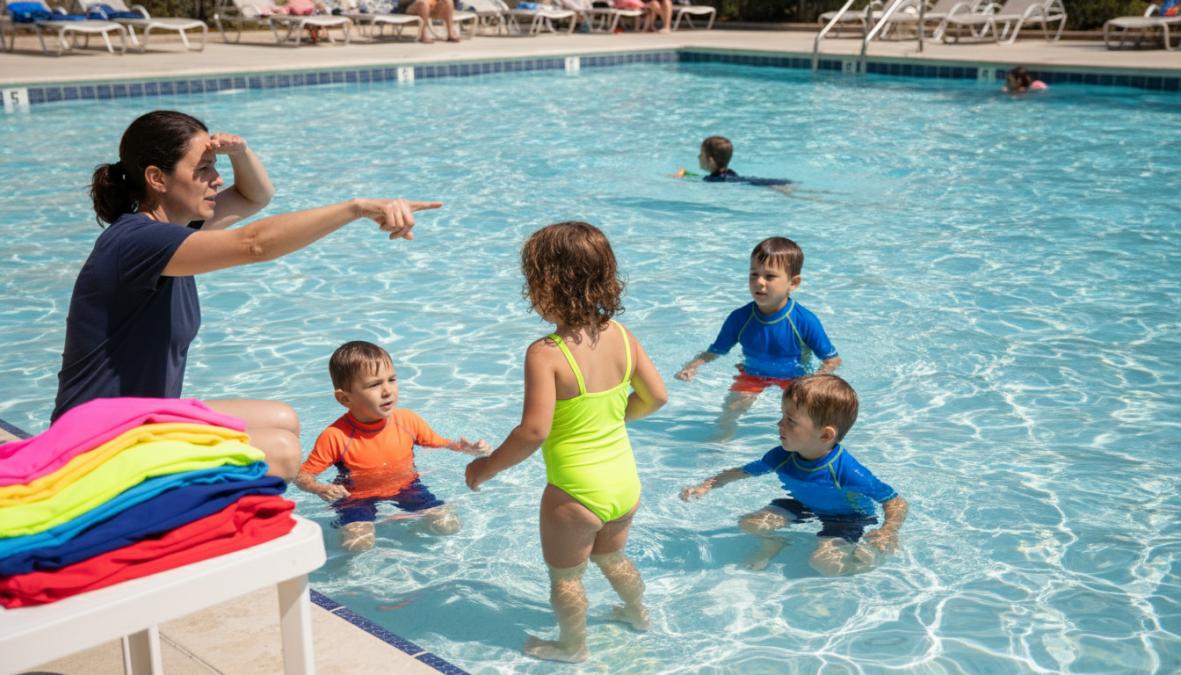
Research confirms that bright, neon colors create the strongest contrast against water. American Red Cross water safety guidelines emphasize visibility as a primary prevention strategy. The principle is simple: the human eye detects contrast. Anything that stands out against the water background is easier to track. When selecting swimwear, choosing from Girls swimsuits and Boys swimsuits in bright, neon colors ensures your child has maximum visibility in the water.
Neon Colors That Stand Out: Pink, Orange, and Yellow
Neon pink, neon orange, and neon yellow are the gold standard for water visibility. These colors reflect light and create immediate visual pop against any water background. Neon pink is particularly effective because it sits outside the natural color spectrum of most water environments. Neon orange performs similarly and is the color used for safety vests and life jackets precisely because human eyes are wired to notice it. Neon yellow offers the same visibility advantage.
:::pro-tip Test swimwear visibility yourself: stand at the edge of a pool and watch a child in different colors. If you have to look hard to find the child, the color isn't working. :::
Why Blue and Dark Colors Are Dangerous
Blue swimwear is the most dangerous choice for water safety, despite being the most popular color. Blue blends into blue water. A child wearing a blue or navy swimsuit becomes nearly invisible in a pool, especially when viewed from above. Dark colors, navy, black, dark purple, dark green, all create the same problem by absorbing light rather than reflecting it.
This isn't opinion. It's physics and human perception. Many drowning prevention organizations now actively discourage dark-colored swimwear for young children.
Lime Green and High-Contrast Options
Lime green (also called neon green or electric green) is nearly as effective as neon pink and orange. High-contrast patterns can also help, though a solid bright color is more reliable than a pattern because patterns can fragment visually in moving water.
Environmental Lighting Impact on Water Detection
Water visibility changes dramatically based on lighting conditions, and caregivers must adjust their supervision strategy accordingly.
Bright sunlight creates reflections and glare on the water surface that can obscure a child's position. Overcast days actually provide better visibility because there are fewer reflections. Early morning and late afternoon sun can create harsh shadows that hide portions of the pool.
Indoor pools with artificial lighting present a different challenge. Fluorescent lights can flatten colors and reduce contrast. Overhead lighting casts shadows that obscure the pool floor. Nighttime swimming requires special consideration and should be avoided with young children or limited to extremely shallow, well-lit areas with multiple adult supervisors.
Active Supervision and the Designated Water Watcher
Visibility of the child is only half the equation. The adult must also be actively watching.
Active supervision means eyes on the water at all times, not phones or conversations with other adults. A designated water watcher is a single adult whose sole responsibility during water time is to watch the child. This person should be positioned where they can see the entire water area, ideally from an elevated position.
The water watcher should know what to look for. A child who is drowning does not look like a child in distress in the movies. There is often no yelling, no waving, no dramatic splashing. Many drowning incidents are silent.
Rotation is important. A single adult cannot maintain perfect attention for hours. If water time extends beyond 15-20 minutes, the designated watcher should rotate with another adult to prevent fatigue and attention drift.
CDC guidelines on preventing unintentional drowning emphasize that supervision is the most effective prevention strategy for children.
Signs of Drowning in Children to Watch For
Drowning is often silent and happens very quickly. A child can slip underwater and lose consciousness in 2-3 minutes without making noise.
A drowning child may have their head tilted back with mouth at water level. Their eyes may be open but glassy. They may be vertical in the water, not horizontal. They may be moving weakly or not moving at all. A child struggling to stay afloat looks different from a child swimming, struggling involves jerky, inefficient movements.
The most dangerous sign is complete silence and stillness. A child who stops moving and stops making noise may be drowning.
Secondary Drowning Symptoms and When to Seek Help
Secondary drowning (also called dry drowning) is a rare but serious condition that can occur after a child has been in the water, even if they seemed fine at the time.
In secondary drowning, water enters the lungs in small amounts and causes inflammation or fluid accumulation. This can happen hours after the water exposure. Symptoms include persistent coughing, difficulty breathing, lethargy, chest pain, or unusual behavior.
If a child has any incident in the water, monitor them closely for several hours. If any respiratory symptoms develop, seek medical attention immediately.
What to Do After a Near Drowning Incident
If a child has experienced a near-drowning or water emergency, immediate response is critical.
First, remove the child from the water and assess responsiveness. If the child is unresponsive and not breathing, begin CPR immediately if trained and call emergency services. If the child is responsive and coughing, position them on their side to allow water to drain from the airway naturally.
Seek medical evaluation even if the child seems to recover quickly. Water aspiration and secondary drowning can develop over hours. After the immediate medical response, inform the child's parents or guardians immediately with details of what happened.
Spotting Children in Different Water Environments
Visibility strategies change based on the water setting.
Visibility in Pools vs. Open Water
In a pool, the water is contained and the background is predictable. A child in a pool can be tracked against the pool bottom and walls. High-visibility swimwear works extremely well in pools because the contrast is clear and consistent.
Open water, lakes, oceans, rivers, presents a different challenge. The water is not contained. There are waves, currents, and variable depth. A child in bright pink swimwear is still visible, but visual tracking is more difficult because the child is moving with the water.
In open water, additional safety measures become essential: a designated watcher positioned where they can see the child at all times, a flotation device or life jacket, and ideally, a buddy system where the child stays close to the caregiver. Swim Accessories such as flotation aids can provide an extra layer of protection in these environments.
Age-Specific Monitoring Strategies
Different ages require different supervision approaches.
Infants and toddlers (under 4 years) should never be out of arm's reach in water. They can slip and go under in seconds. High-visibility swimwear is essential, but it does not replace constant physical contact.
Preschoolers (4-6 years) can be given slightly more independence, but only with constant visual supervision and a designated watcher. Bright swimwear becomes even more important because the child may wander unpredictably.
School-age children (6-10 years) can swim in designated areas under active supervision, but they still cannot be left unsupervised. Drowning can happen to children who have taken swim lessons.
American Academy of Pediatrics recommendations on child water safety provide age-specific guidance emphasizing that supervision requirements do not decrease significantly with age.
Water safety is a system, not a single strategy. High-visibility swimwear makes children easier to spot. Active supervision by a designated watcher creates accountability. Knowledge of drowning signs enables faster response. Together, these layers protect children during water activities. When you combine bright, neon-colored swimwear with vigilant supervision and environmental awareness, you've created the conditions where drowning becomes preventable rather than inevitable.
| Strategy | Purpose | Effectiveness |
|---|---|---|
| Neon pink, orange, yellow swimwear | Creates visual contrast in water | Highest visibility, immediate detection |
| Designated water watcher | Ensures constant adult attention | Prevents lapses in supervision |
| Knowledge of drowning signs | Enables fast recognition of distress | Reduces response time |
| Environmental lighting awareness | Accounts for visibility changes | Prevents false confidence in poor conditions |
| Age-appropriate supervision | Matches caregiver attention to child's ability | Prevents overestimating child's safety skills |
Frequently Asked Questions
What are the silent signs of drowning in children?
Silent drowning is often called the instinctive drowning response. Unlike splashing and yelling, a drowning child may be quiet, with head tilted back, mouth open at water level, eyes glassy, or appearing to be climbing an invisible ladder. They may not call for help. Active supervision and knowing these signs are critical, this is why spotting a child in water requires constant watchfulness, not just listening for noise.
Why is swimsuit color important for water safety?
Swimsuit color directly affects how quickly you can spot a child in water. Neon pink, neon orange, neon yellow, and lime green create strong contrast against water and pool environments, making underwater visibility significantly better. Dark colors like blue, black, and navy blend into water and make children harder to detect. High-visibility swimwear is a proven tool for drowning prevention and helps both parents and lifeguards maintain visual contact.
What should I do if I suspect secondary drowning symptoms after a water incident?
Secondary drowning symptoms, such as difficulty breathing, persistent coughing, lethargy, vomiting, or chest pain, can appear hours after a near drowning incident. Seek immediate medical attention if your child shows any of these signs. Do not wait. Even if your child seemed fine in the water, these delayed symptoms require professional evaluation. Keep emergency contact information readily available and inform caregivers about what happened so they can watch for warning signs.
How can I improve spotting my child in different water environments?
Spotting a child in water depends on the environment. In pools, bright swimsuit colors and designated water watchers work well. In open water (lakes, ocean), visibility is more challenging due to waves and depth variations. Age-specific monitoring is essential, younger children need constant hand-contact supervision, while older children benefit from clear boundary rules and visual check-ins. Combine high-visibility swimwear, active supervision, and environmental awareness for best results.
This article was written using GrandRanker