

Kids Swim Safety Gear Guide: Essential Equipment for Water Confidence
Table of Contents
- Why the Right Kids Swim Safety Gear Matters
- Coast Guard-Approved Life Jackets vs. Floaties: What's the Real Difference?
- Swim Vest vs. Puddle Jumper Safety: Choosing the Right Flotation Device
- UV Protective Swimwear for Children: Sun Safety & Visibility Combined
- Essential Swim Gear for Beginners: Goggles, Caps & Accessories
- Pool Safety for Kids at Home: Beyond Gear to Active Supervision
- How to Choose the Right Size & Fit for Kids Swim Safety Gear
- What to Avoid: Novelty Gear, Hype & Common Mistakes
Kids Swim Safety Gear Guide: Essential Equipment for Water Confidence
Last Updated: July 24, 2026
When it comes to keeping children safe in the water, the right equipment makes all the difference. This kids swim safety gear guide from Bright & Bold Swimwear covers everything parents need to know about selecting, fitting, and using flotation devices, protective gear, and visibility aids that genuinely reduce drowning risk.
Drowning remains a leading cause of unintentional injury death for children. The good news: proper swim safety gear, combined with active supervision, significantly reduces risk. Below, we'll show you exactly how to choose the right equipment for your child's age, swimming ability, and water environment.
Why the Right Kids Swim Safety Gear Matters
Proper swim safety gear serves two essential functions: it provides buoyancy support while a child is learning to swim, and it increases visibility so parents and lifeguards can spot a child quickly. High-visibility swimwear in bright colors, neon orange, hot pink, electric yellow, makes a dramatic difference in spotting from above the water line.
The challenge most parents face is balancing safety with comfort and style. Children won't wear gear that feels uncomfortable or looks "uncool." Bright & Bold Swimwear bridges this gap: vibrant, high-visibility colors that meet safety standards while looking like regular swimwear kids actually want to wear. Whether you're shopping for [boys swimsuits](https://brightboldswim.com/collections/boys-swimsuits), girls swimsuits, or exploring the best sellers, you'll find options designed with both safety and style in mind.
Beyond visibility, the right gear builds water confidence. When a child feels secure in their flotation device and can move freely, they're more likely to practice swimming skills and develop genuine competence in the water.
Coast Guard-Approved Life Jackets vs. Floaties: What's the Real Difference?
Why Coast Guard Approval Matters
A Coast Guard-approved life jacket is engineered to turn an unconscious wearer face-up in the water and maintain their airway above the surface. The U.S. Coast Guard tests and certifies life jackets to rigorous standards, ensuring they perform under real-world conditions, including when a child is tired, panicked, or unconscious.
Floaties, water wings, and puddle jumpers are classified as "water toys" or "swim aids," not safety devices. They provide buoyancy support for learning, but they don't guarantee that a struggling or exhausted child will stay face-up or keep their airway clear.
Floaties, Water Wings & Puddle Jumpers: Why They're Not Substitutes
Water wings and puddle jumpers are excellent tools for building confidence and practicing swimming skills in shallow water with active supervision. But they have real limitations:
- Flotation can shift. Water wings slip and slide, sometimes moving away from where a child needs support most.
- They don't keep airways clear. A tired or panicked child wearing floaties can still slip underwater.
- They create a false sense of security. Parents who believe floaties are equivalent to life jackets may reduce their level of supervision.
- They're not designed for open water. Floaties are appropriate for pools and very shallow water only.
Coast Guard-approved life jackets are designed to work in any water environment: pools, lakes, rivers, and oceans.
Swim Vest vs. Puddle Jumper Safety: Choosing the Right Flotation Device
A swim vest (also called a swim jacket or flotation vest) provides consistent buoyancy around the torso. A puddle jumper is a foam-based flotation device that wraps around the arms and torso, offering similar support.
Swim vests are better for:
- Children who need consistent support across their entire torso
- Transition swimmers moving from floaties toward independence
- Water environments where the child might encounter deeper water suddenly
Puddle jumpers work well for:
- Very young children (2-6 years) in shallow pools
- Children who prefer more freedom of movement
- Short pool sessions where comfort is the priority
Neither is a substitute for a Coast Guard-approved life jacket if you need guaranteed safety in open water or when your child will be in water without constant adult contact. Both are excellent training tools when used alongside active supervision.
When choosing between them, prioritize fit and comfort. A vest or puddle jumper that's too loose will shift and provide uneven support. One that's too tight will restrict movement and make your child reluctant to wear it.
UV Protective Swimwear for Children: Sun Safety & Visibility Combined
How UPF Protection Works
UPF (Ultraviolet Protection Factor) measures how effectively fabric blocks ultraviolet radiation. UPF 50+ blocks 98% of UV rays, while UPF 30 blocks 97%. For children spending extended time in the sun at the beach, pool parties, or summer swim lessons, UV-protective swimwear prevents sunburn and reduces long-term skin damage risk.
The protection works through the fabric itself. Tightly woven materials, darker colors, and specialized coatings all contribute to UV blocking. Unlike sunscreen, which requires reapplication every two hours, UV-protective swimwear provides continuous protection for as long as your child is wearing it.
Bright & Bold Swimwear incorporates UPF 30+ protection into select styles, combining sun safety with the high-visibility colors that make spotting a child in the water significantly easier.
Bright Colors & High Visibility: A Safety Feature, Not Just Style
Neon orange, hot pink, and electric yellow stand out sharply against water and sky. Research on drowning prevention consistently shows that visibility is a critical factor in rapid rescue. A child in a bright-colored swimsuit can be spotted from the pool deck, lifeguard stand, or beach in seconds. A child in navy, black, or muted tones blends into the water and shadows.
High visibility becomes even more critical in chaotic environments: crowded public pools, beaches with waves, or lakes with boat traffic. Combining UV protection with high visibility is the practical approach: your child gets sun safety and spotting advantage in a single garment. This is why Bright & Bold Swimwear prioritizes vibrant, saturated colors, they serve a real safety function while still looking like normal, appealing swimwear.
Essential Swim Gear for Beginners: Goggles, Caps & Accessories
Choosing Anti-Fog Goggles That Fit Right
Goggles protect eyes from chlorine and salt water, and they improve visibility underwater so children can practice proper form and build confidence. Poor-fitting goggles leak, fog up, or cause discomfort, all reasons kids refuse to wear them.
The fit is critical. Goggles should create a seal around the eyes without pressing too hard, sit flush against the face with no gaps, and stay in place during active swimming without slipping.
Anti-fog technology works through hydrophilic (water-loving) coatings that prevent moisture from beading up, or ventilation designs that allow air circulation. Hydrophilic coatings are most common and effective, though they gradually wear off with use (typically after 6-12 months).
When selecting goggles, involve your child in the fitting process. Silicone frames are gentler on young skin than harder plastics. Adjustable straps allow fine-tuning of fit as your child grows. Bright & Bold Swimwear's [swim accessories collection](https://brightboldswim.com/collections/best-swim-accessories-for-kids) includes a range of goggles and other essentials to complete your child's swim kit.
Swimming Caps & Hair Protection
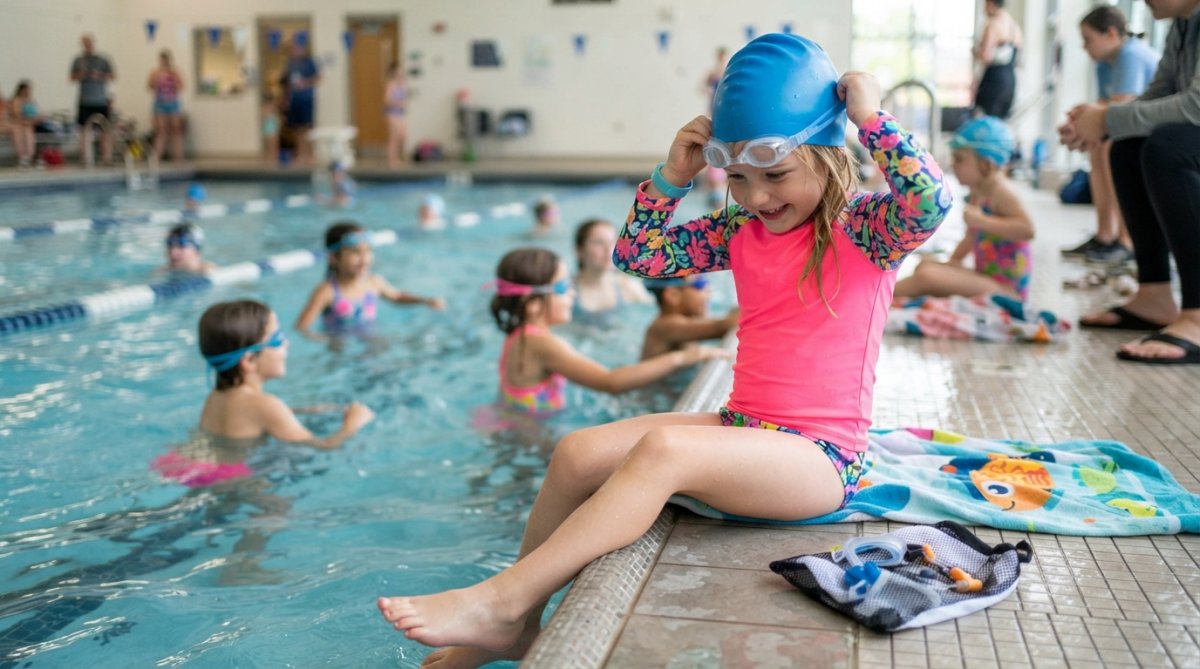
Swimming caps reduce drag, protect hair from chlorine damage, and help keep longer hair out of a child's face during swimming. For children with longer hair, a cap can significantly improve comfort and focus during lessons.
Silicone caps are more durable and easier to put on than latex. They come in fun colors and patterns, which helps kids view them as part of their swim gear rather than an inconvenience. Teaching a child to put on their own cap builds independence and makes the routine feel less like something being done to them.
Pool Safety for Kids at Home: Beyond Gear to Active Supervision
Equipment is essential, but it's only one layer of protection. Active supervision, an adult watching the child continuously, within arm's reach, is the most critical safety measure. This means:
- No phones, books, or distractions while supervising
- Eyes on the child at all times, even during brief trips to the bathroom
- Knowing where your child is and what they're doing in the water
- Establishing clear rules about pool boundaries and when swimming is allowed
Designate a "water watcher" at family gatherings or pool parties. This person has one job: watching the water and the children in it.
CPR training for adults in the household is critical. Even with perfect supervision, accidents happen. Knowing how to perform CPR can mean the difference between a full recovery and a tragedy.
Pool Alarms & Perimeter Safety Systems
Pool alarms add a layer of protection, especially for homes with young children or when supervision lapses. Several types exist:
Surface wave detection alarms sound when they detect the disturbance pattern created by a child falling into the water.
Gate and door alarms alert you when a child opens a gate or door leading to the pool.
Wearable alarms attach to a child's wrist or ankle and sound if the child enters the water.
No alarm replaces supervision. Alarms are backup systems, not primary safety measures. Use alarms alongside active supervision, not instead of it.
How to Choose the Right Size & Fit for Kids Swim Safety Gear
Proper fit is the difference between gear that works and gear that fails. Ill-fitting life jackets, vests, or goggles compromise safety and comfort.
Life jackets and swim vests should fit snugly without restricting arm movement, not ride up over the child's chin when lifted by the straps, and have all straps and closures fastened securely. Check fit regularly, children grow quickly, and a jacket that fit perfectly three months ago may be too loose now.
Goggles should create a seal without leaving red marks around the eyes. If your child complains of discomfort after 30 minutes of wear, the fit is too tight.
Swimsuits, including high-visibility options from Bright & Bold Swimwear, should allow full range of motion. Most children's swimsuits are sized by age and height, but every child is different.
Swim caps should fit snugly enough to stay in place but not so tight that they cause headaches. Silicone caps with adjustable chin straps offer the best fit across a range of head sizes.
| Gear Type | Fit Check | Replacement Timeline |
|---|---|---|
| Life Jacket | Snug, no riding up, all straps secure | When child outgrows size |
| Goggles | Seal around eyes, no red marks | Every 6-12 months (coating wear) |
| Swimsuit | Full range of motion, stays in place | Every 1-2 seasons (growth) |
| Swim Cap | Snug but not tight, stays in place | Every 2-3 seasons |
What to Avoid: Novelty Gear, Hype & Common Mistakes
Several types of gear are marketed as swim safety solutions but don't deliver the protection they promise.
Inflatable arm bands can deflate unexpectedly, shift unpredictably, and create a false sense of security. They're not Coast Guard-approved and should not be relied upon for safety.
Swim rings and floats shaped like animals or characters are toys, not safety equipment. Parents sometimes mistakenly believe these provide safety comparable to life jackets.
Novelty swimwear with pattern or licensed characters may not offer the visibility advantage that solid, bright colors provide. A navy swimsuit with a character design blends into the water far more easily than a solid neon orange suit.
"Drowning-proof" claims should raise red flags. No gear is drowning-proof. Marketing language like this typically indicates a product that doesn't meet Coast Guard standards.
The most common mistake is treating gear as a substitute for supervision. Equipment is a tool, an important one, but it doesn't replace an attentive adult. Another mistake is keeping gear that no longer fits properly, outgrown or damaged equipment should be replaced. Finally, avoid mixing approaches inconsistently. If you decide your child needs a life jacket in open water, use it every time, not just when you remember.
Keeping children safe in the water requires intentional choices about gear, active supervision, and honest assessment of your child's swimming ability. Bright & Bold Swimwear's high-visibility swimsuits are designed specifically to help parents and lifeguards spot children instantly, combining UV protection with the safety advantage of colors that stand out in water. Start by assessing your child's current swimming level, selecting appropriate flotation if needed, and investing in visibility. The confidence you build today creates safer swimmers for life.
Frequently Asked Questions
What is the most important kids swim safety gear to buy first?
A Coast Guard-approved life jacket or swim vest is the most critical piece of kids swim safety gear for beginners. Unlike floaties or puddle jumpers, these devices are designed to keep your child's head above water even if they become unconscious. Pair this with bright-colored, high-visibility swimwear to ensure lifeguards and parents can spot your child quickly in the water. UV protective swimwear adds sun protection as a bonus.
What's the difference between a life jacket, swim vest, and puddle jumper?
A Coast Guard-approved life jacket is a certified flotation device that keeps your child afloat with their head above water. A swim vest offers similar support but may not meet federal certification standards. Puddle jumpers and water wings are swim aids designed to build confidence, not to serve as primary safety devices, they can shift or deflate and should never replace active supervision or approved flotation devices.
How do I choose the right size life jacket or swim vest for my child?
Check the manufacturer's weight and chest measurement guidelines, these are critical for proper fit and function. A life jacket that's too large can slip off; one that's too small won't provide adequate buoyancy. Ensure all straps are snug and the jacket doesn't ride up when your child raises their arms. Always test the fit in calm water before relying on it in a pool or open water setting.
Does high-visibility swimwear actually reduce drowning risk?
High-visibility, bright-colored swimwear makes your child much easier to spot quickly, a critical factor in water safety. While gear alone doesn't prevent drowning, visibility combined with active adult supervision, swimming skills, and proper flotation devices creates layers of protection. The faster a parent or lifeguard can locate your child in water, the faster they can respond to any emergency.
This article was written using GrandRanker