

Safest Swimsuit Colors for Pools: A Parent's Guide
Table of Contents
- Why Safest Swimsuit Colors Matter for Water Safety
- Swimsuit Color Safety for Children: What Parents Need to Know
- The Most Visible Colors for Swimming Pools
- Swimsuit Colors to Avoid in Pools
- Science of Underwater Visibility: How Color and Light Refraction Work
- Lifeguard Recommended Swimsuit Colors and What They Look For
- Beyond Bright Colors: Fabric Durability and Color Fading
- Choosing the Safest Swimsuit Colors for Your Family
Safest Swimsuit Colors for Pools: A Parent's Guide
Last Updated: July 22, 2026
Water safety starts with visibility. When your child is in a pool, every second counts in an emergency, and color choices matter more than most parents realize. According to the CDC's water safety data, drowning remains a leading cause of unintentional injury death for children. This guide breaks down which colors keep your child visible, which ones blend dangerously into pool environments, and the science behind why it matters.
Why Safest Swimsuit Colors Matter for Water Safety
Visibility directly determines response time in water emergencies. When a child slips underwater, a lifeguard has seconds to react. A swimsuit color that blends into the water environment delays detection, and delays cost lives.
Water refraction and light absorption create unique visibility challenges. Blue swimsuits disappear into blue pools. White fades into sunlight glare. Black absorbs light and becomes nearly invisible at depth. The most visible swimsuit colors work because they contrast maximally with typical pool environments: the blue water, white tile, and varying depths. Neon colors, particularly yellow and orange, reflect light in ways that human eyes process quickly, even in peripheral vision where lifeguards often detect problems first.
Swimsuit Color Safety for Children: What Parents Need to Know
How Visibility Reduces Drowning Risk
Drowning often happens silently and quickly. The child doesn't call for help; they slip under and go still. A lifeguard's ability to detect this instantly depends almost entirely on visual contrast.
When a child wears a high-visibility swimsuit, the lifeguard's brain processes the image faster. Bright colors trigger immediate visual recognition. A neon-yellow swimsuit moving in blue water creates a signal that's nearly impossible to miss. Dark or muted swimsuit colors work against drowning prevention by merging with shadows, water depth variations, and pool-bottom coloring.
The Role of Contrast in Water Visibility
Contrast is the fundamental principle behind color visibility in water. Your eyes detect objects by recognizing differences between the object and its background. Remove that difference, and detection fails.
Neon yellow and neon orange work across most standard pools because they contrast with blue water, white tile, and varied depths. Patterned swimsuits create visual confusion. Stripes, prints, and multi-color designs break up the swimsuit's silhouette, making it harder for the brain to process quickly as a single object. A solid, bright color reads as one unified shape, exactly what lifeguards need to spot instantly.
| Color | Contrast with Blue Water | Contrast with Dark Bottom | Visibility in Depth | Recommended |
|---|---|---|---|---|
| Neon Yellow | Excellent | Excellent | Strong | Yes |
| Neon Orange | Excellent | Excellent | Strong | Yes |
| Neon Pink | Good | Good | Moderate | Yes |
| Blue | Poor | Fair | Weak | Avoid |
| White | Good | Poor | Weak | Avoid |
| Black | Poor | Poor | Very Weak | Avoid |
The Most Visible Colors for Swimming Pools
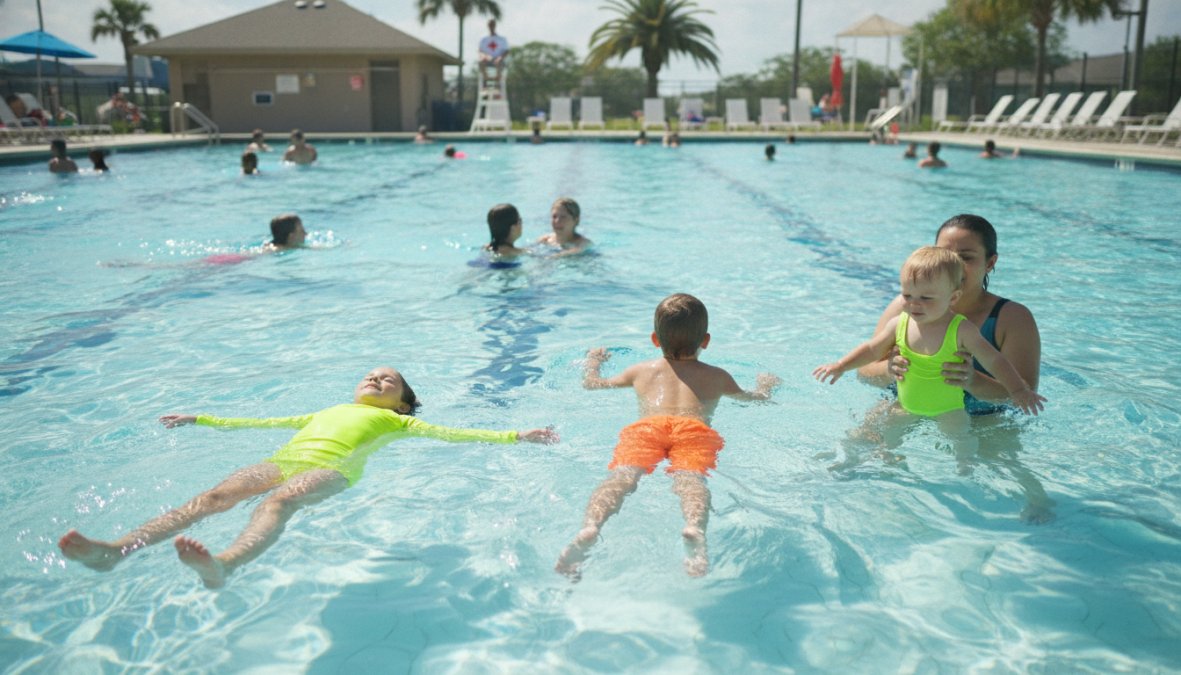
Neon yellow and neon orange dominate lifeguard recommendations because they work. These colors use fluorescent pigments that absorb ultraviolet light and re-emit it as visible light, creating a glow effect that makes the color appear brighter than its actual surface. At 6 feet down, a neon-yellow swimsuit remains clearly visible to a lifeguard scanning from poolside.
Neon Yellow vs. Neon Orange Performance
Neon yellow edges out neon orange in most pool environments, particularly in standard chlorinated pools with blue water. Yellow's shorter light wavelength creates maximum contrast against blue backgrounds. However, neon orange performs equally well in some settings, particularly outdoor pools with bright sunlight. The practical difference between the two is minimal. Both exceed safety standards for high-visibility swimwear and maintain visibility across depth and lighting variations. Choose based on your pool environment and your child's preference. Bright & Bold Swimwear offers both options in their [boys swimsuits](https://brightboldswim.com/collections/boys-swimsuits) and girls swimsuits collections.
Neon Pink and High-Visibility Alternatives
Neon pink provides a solid middle-ground option for parents seeking high-visibility without the intensity of yellow or orange. It contrasts well with blue water, though slightly less dramatically than neon yellow. Pink appeals to children who find bright yellow or orange unappealing, and a neon-pink suit is far better than compromising on visibility with a darker color.
Swimsuit Colors to Avoid in Pools
Why Blue, White, and Black Blend In
Blue swimsuits in blue pools create a visibility disaster. The child becomes part of the water itself. White swimsuits seem visible but aren't, white reflects all light equally, creating glare that makes it harder for eyes to focus. Black swimsuits are perhaps the most dangerous choice for children, absorbing light rather than reflecting it. A child in a black swimsuit at the pool's deep end becomes a dark silhouette against dark water. Gray, navy, dark green, and dark purple all share similar problems.
The Danger of Patterned vs. Solid Color Visibility
Patterned swimsuits break up the visual signal that lifeguards rely on. Stripes, checks, and prints fragment the swimsuit into multiple visual elements, slowing detection time. Solid-color swimsuits present a unified visual shape that the brain recognizes instantly.
Science of Underwater Visibility: How Color and Light Refraction Work
Light behaves differently in water than in air. Water absorbs certain wavelengths while reflecting others. Red light gets absorbed first as water depth increases. Below about 10 feet, red becomes black. Orange fades next, then yellow. Blue and green penetrate deepest.
For pool safety, this explains why certain colors maintain visibility better at depth. Neon yellow works because yellow's wavelength penetrates water effectively. A child in neon yellow remains visible even at the deep end of a standard pool.
How Water Depth Affects Color Perception
At the surface, all colors appear relatively normal. But as depth increases, colors shift. Water acts as a filter, progressively removing warm colors and emphasizing cool tones. At 3-4 feet of depth, red tones darken noticeably. At 6-8 feet, the shift becomes dramatic. Red approaches black. Orange dims significantly. Yellow remains relatively bright.
Most drowning incidents in supervised settings occur at depths between 4-8 feet, deep enough for color filtering to become significant. Choosing a color that maintains visibility in this critical depth range is essential.
The Impact of Pool Bottom Color on Visibility
Pool-bottom color creates the background against which a swimsuit must contrast. Neon yellow works exceptionally well against both light and dark pool bottoms. It contrasts sharply with light backgrounds through its inherent brightness and with dark backgrounds through its luminous properties.
Lifeguard Recommended Swimsuit Colors and What They Look For
Lifeguards are trained to scan pools systematically, looking for changes in the water's visual pattern. High-visibility colors interrupt that pattern instantly. Professional lifeguards consistently recommend neon yellow and neon orange based on thousands of hours of water scanning and documented response-time data.
Lifeguards also look for solid colors over patterns. A solid neon suit creates a clear, unmistakable shape. High-visibility swimwear helps lifeguards maintain focus during long shifts, bright colors stand out even when attention wavers.
Safety Differences Between Pools and Open Water
Pools have defined boundaries, controlled lighting, and consistent water clarity. Open water introduces variables: waves, currents, changing light, murky water, and vast expanses where a child can drift far from starting points. In pools, high-visibility swimsuits provide maximum safety benefit. In open water, they still matter, but additional safety measures become critical. Waves can obscure a child even in bright colors, and currents can carry them away from lifeguards.
Beyond Bright Colors: Fabric Durability and Color Fading
A swimsuit that starts bright but fades after a few washes loses its safety benefit. Neon dyes fade faster than standard dyes because they use different chemical structures to create their fluorescent properties. Chlorine accelerates this fading. Quality matters here, premium high-visibility swimwear uses better dyes and fabric treatments that resist fading.
Keeping High-Visibility Colors Vibrant
Rinse the swimsuit in fresh water immediately after pool use to remove chlorine. Wash swimsuits by hand in cool water rather than machine washing. Avoid bleach-based cleaners entirely, as bleach destroys neon dyes. Store swimsuits in cool, dry places away from direct light. With proper care, a high-quality neon swimsuit maintains its visibility benefit for an entire season or longer.
Night Swimming Visibility Considerations
Night swimming presents unique visibility challenges. Artificial pool lighting creates harsh shadows and glare that can reduce visibility compared to daylight. Neon colors still outperform darker shades, but the advantage is smaller.
Choosing the Safest Swimsuit Colors for Your Family
The decision is straightforward: choose neon yellow or neon orange in solid colors, prioritize fabric quality that resists fading, and replace swimsuits when colors fade noticeably.
For most children and most pools, neon yellow is optimal. Neon orange is an excellent alternative, particularly if your child prefers it aesthetically. Neon pink works well for children who reject yellow or orange. Avoid blue, white, black, and any dark or muted colors. Avoid patterned swimsuits in favor of solid colors.
Consider your child's preferences alongside safety. A child who refuses to wear a neon-yellow suit in favor of a dark color defeats the entire purpose. If your child prefers neon orange or neon pink, those are excellent choices that still provide maximum visibility. For families seeking swimwear that combines high-visibility with durability and style, Bright & Bold Swimwear has designed their collections specifically for this purpose. Their best sellers feature neon colors in solid designs that maintain visibility through multiple seasons.
The investment in high-visibility swimwear is small compared to the safety benefit. A swimsuit costs less than a single swim lesson, yet it provides protection during every pool visit. Making this choice is one of the simplest, most effective steps you can take to reduce drowning risk and keep your child visible to lifeguards and caregivers.
Choosing the right swimsuit color is one decision you can make today that protects your child every day they're in the water. Drowning happens silently and quickly, but visibility changes everything. A neon-yellow or neon-orange swimsuit ensures that lifeguards spot your child instantly, giving them the seconds they need to respond in an emergency. Explore Bright & Bold Swimwear's best sellers collection to find the perfect high-visibility suit for your family's pool time.
Frequently Asked Questions
What swimsuit colors are safest and easiest to see in a pool?
Neon yellow, neon orange, and neon pink are the safest swimsuit colors for pools because they create strong contrast against water and pool environments. These high-visibility colors are recommended by lifeguards and water safety professionals because they remain visible even when submerged or at a distance. For children, these bright colors significantly improve detectability in both light and darker pool settings, reducing drowning risk by helping parents and lifeguards maintain constant visual supervision.
Why does swimsuit color safety matter for children in water?
Swimsuit color directly impacts water safety because visibility is critical for drowning prevention and detection. Bright, high-contrast colors help parents and lifeguards spot children quickly, even when they're partially submerged or in distress. This is especially important for young swimmers who may struggle silently. Studies on drowning prevention emphasize that rapid visual detection is one of the most effective supervision tools available, making color choice a practical safety measure that complements swimming lessons and active supervision.
What swimsuit colors should I avoid in pools?
Avoid blue, white, black, and dark-colored swimsuits in pools because they blend with the water or pool environment, making children harder to spot. Blue especially is problematic since it mirrors the aquatic environment itself. Patterned swimsuits can also reduce visibility compared to solid, bright colors because the patterns break up the silhouette. Dark colors reduce contrast and make it difficult for lifeguards and parents to maintain quick visual acuity, increasing drowning risk during supervision.
How does water depth and pool bottom color affect swimsuit visibility?
Water depth significantly affects color perception because light refraction changes how colors appear underwater. In deeper pools, even bright colors lose visibility more quickly due to light absorption. Pool bottom color also matters, dark pool bottoms make bright swimsuits stand out more, while light-colored bottoms reduce contrast. This is why neon colors are especially effective: they maintain visibility across varying depths and pool conditions. Understanding these factors helps parents choose swimwear that remains visible in their specific pool environment.
This article was written using GrandRanker