

Sun Protection for Active Water Kids: 7 Essential Strategies
Table of Contents
- Why Sun Protection Matters for Active Water Kids
- Understanding UV Rays and Sun Safety for Children
- Best Water-Resistant Sunscreen for Kids: Selection & Application
- UPF Clothing for Swimming: Rash Guards and Sun-Protective Gear
- Sun Safety for Toddlers at the Pool: Age-Specific Protection
- Protective Accessories and Shade: Complete Defense Strategy
- Building Daily Sun-Safe Habits for Active Water Kids
- Conclusion: Year-Round Sun Protection Confidence
Last Updated: July 1, 2026
Why Sun Protection Matters for Active Water Kids
Getting sun protection for active water kids right is non-negotiable. At Bright & Bold Swimwear, we understand that children spending hours in and around water face unique UV exposure challenges. The sun's rays reflect off water surfaces, intensifying exposure by up to 80 percent, which means kids who love swimming, paddleboarding, or playing at the pool need layered defense strategies that standard sunscreen alone cannot provide.
This guide covers the complete toolkit for keeping your active water kids safe from harmful UV radiation: broad-spectrum sunscreen selection, UPF-rated protective clothing, peak sun hour timing, shade strategies, and daily habits that matter most.
Understanding UV Rays and Sun Safety for Children
How UV exposure affects developing skin
Children's skin contains less melanin than adult skin, making it significantly more vulnerable to UV damage. When UV radiation penetrates the skin barrier, it generates free radicals that break down collagen and elastin, accelerating photoaging and increasing skin cancer risk later in life. A single severe sunburn during childhood increases melanoma risk substantially.
Developing skin lacks the protective mechanisms that mature skin has built up over decades. A child's skin barrier is thinner, more permeable, and less efficient at repairing UV-induced damage. Water-based activities make this worse because wet skin absorbs more UV radiation than dry skin, and repeated in-and-out cycles prevent any natural protective response.
Peak sun hours and water activities
The sun's UV index peaks between 10 a.m. and 3 p.m., when UV rays hit Earth at the most direct angle. During these hours, UV exposure intensity can be three to five times higher than in early morning or late afternoon. Yet this is precisely when kids are most likely to be at the pool or beach.
Scheduling water activities outside peak sun hours is one of the simplest protective strategies available. Morning swims before 10 a.m. or evening sessions after 4 p.m. dramatically reduce UV exposure without sacrificing fun. When peak-hour swimming is unavoidable, the other protective layers become even more critical.
Best Water-Resistant Sunscreen for Kids: Selection & Application
Choosing broad-spectrum and SPF 30+ products
Broad-spectrum sunscreen protects against both UVA and UVB rays. UVB rays cause sunburn; UVA rays penetrate deeper and accelerate skin aging and cancer risk. SPF 30 blocks 97 percent of UVB rays, while SPF 50 blocks 98 percent, a marginal difference that doesn't justify extra cost. The bigger variable is whether the sunscreen gets applied in sufficient quantity and reapplied on schedule.
For active water kids, water-resistant formulations are mandatory. "Water-resistant 80 minutes" means the sunscreen maintains its SPF rating after 80 minutes of water exposure. Reef-safe sunscreen formulations, avoiding oxybenzone and octinoxate, protect coral ecosystems while delivering the same UV protection.
Mineral sunscreens containing zinc oxide or titanium dioxide reflect UV rays and are gentler for sensitive skin, while chemical sunscreens absorb into the skin and convert UV energy to heat. Both work; choose based on your child's skin type.
Proper application and reapplication timing
Most parents apply far too little sunscreen. Apply one ounce (roughly a shot glass full) for an adult's entire body; scale down proportionally for children. Apply sunscreen 15 minutes before water exposure to allow it to set. Reapply every 80 minutes if using water-resistant sunscreen, or immediately after toweling off if the label specifies shorter water resistance.
Missed spots, ears, the part in the hair, tops of feet, back of the neck, are where sunburns often start. For kids who hate the feel of sunscreen, spray formulations are faster to apply, though lotions are more effective. Sunscreen sticks work well for faces and ears.
UPF Clothing for Swimming: Rash Guards and Sun-Protective Gear
Why UPF 50 rash guards outperform sunscreen alone
UPF (Ultraviolet Protection Factor) clothing provides continuous, consistent protection without reapplication. A UPF 50 rash guard blocks 98 percent of UV rays, equivalent to SPF 50 sunscreen, but doesn't wash off or require reapplication every 80 minutes.
Rash guards are the foundation of sun-protective clothing for active water kids. Worn over a swimsuit, they cover the torso, shoulders, and upper arms, the areas that receive the most intense UV exposure during water play. The fabric is typically lightweight, quick-drying polyester or nylon blends that don't feel restrictive when wet.
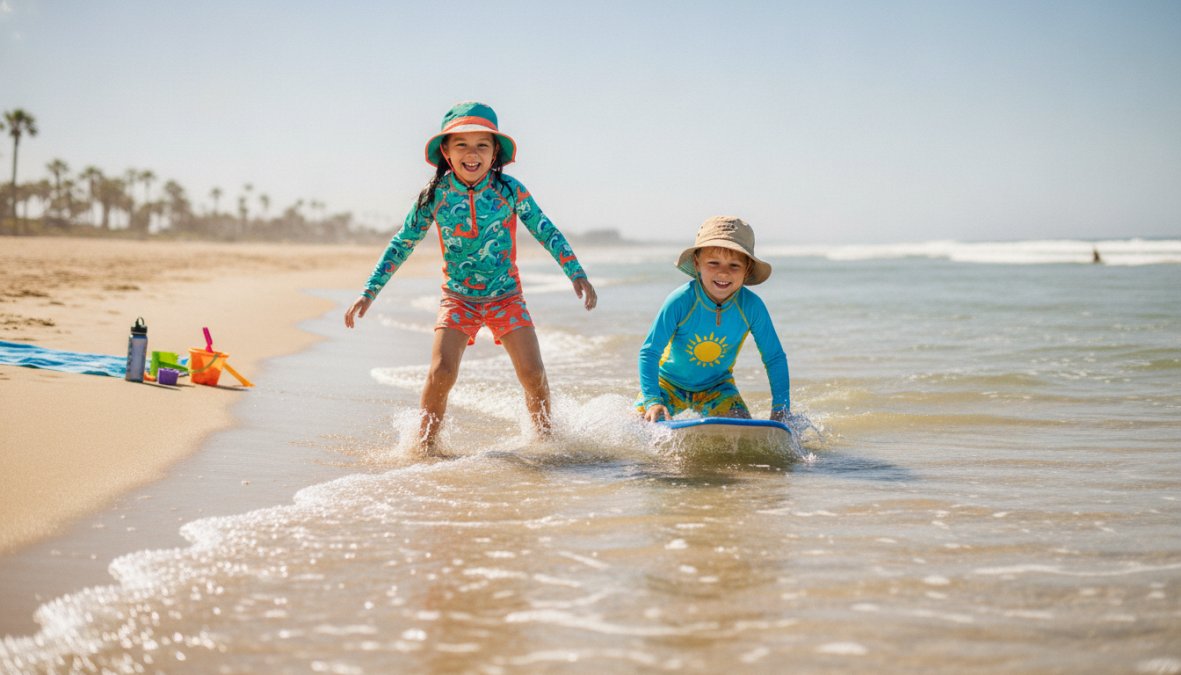
Bright & Bold Swimwear's rash guard collection combines UPF 30+ protection with high-visibility design, so lifeguards and parents can spot kids instantly in the water while their skin stays shielded. Swim shirts extend coverage further, protecting the back and sides with longer sleeves. For extended water sessions or fair-skinned children, swim shirts provide superior protection. Leggings with UPF protection cover the legs, which are often overlooked despite receiving significant sun exposure.
Choosing the right fit and coverage for active play
Rash guards must fit snugly without restricting movement. A loose rash guard rides up during active play, exposing the torso. Length should extend from the shoulders to the hip or slightly below, covering the entire torso without bunching at the waistband.
Sleeves should reach mid-bicep or the elbow. Test the fit in the water before committing to a full season. Look for flatlock seams rather than traditional stitching; flatlock seams lay flat against the skin and don't chafe during extended wear.
Sun Safety for Toddlers at the Pool: Age-Specific Protection
Special considerations for young children's delicate skin
Toddlers' skin is even more delicate than older children's. Their skin barrier is thinner, their sweat glands aren't fully developed, and their ability to thermoregulate in heat is limited. Sunscreen for toddlers should be mineral-based (zinc oxide or titanium dioxide) rather than chemical, as mineral formulations are less likely to irritate sensitive skin.
The American Academy of Pediatrics recommends avoiding direct sun exposure for infants under six months. For toddlers six months to two years, sun protection is essential but requires extra care. Sunscreen designed specifically for babies is gentler and less likely to cause reactions.
Apply sunscreen to toddlers 15 minutes before water exposure, and watch for signs of overheating. Toddlers in full sun-protective gear can overheat more easily than older children. Frequent breaks in the shade and regular hydration are essential.
Shade structures and timing strategies
For toddlers, shade is critical infrastructure. A beach canopy or pop-up tent creates a UV-protected zone where toddlers can cool down, hydrate, and rest. Position the shade structure between the toddler and the sun for better protection during hours when UV rays hit at lower angles.
Schedule toddler water time for early morning (before 10 a.m.) or late afternoon (after 3 p.m.) when UV intensity is lower. A 30-minute water session at 9 a.m. exposes a toddler to far less UV radiation than a 30-minute session at noon, even with identical sun protection measures in place.
Protective Accessories and Shade: Complete Defense Strategy
Hats, sunglasses, and beach cover-ups
A wide-brimmed hat (at least three inches all around) shields the face, ears, scalp, and the back of the neck. For water activities, look for hats with chin straps so they stay in place during swimming. Sunglasses protect the eyes and the delicate skin around them, reducing cataracts risk later in life. Polarized lenses reduce glare from water reflection.
Beach cover-ups, lightweight shirts or wraps, provide quick coverage when kids are out of the water. A cover-up worn over a rash guard adds an extra layer of protection during transitions from water to shade or during snack breaks.
Beach canopies and creating UV-protected zones
A beach canopy or pop-up tent creates a designated UV-protected zone where kids can rest, hydrate, and cool down without direct sun exposure. Look for canopies with UPF-rated fabric rather than standard tent material. Some canopies include side panels that extend protection further.
Shade structures should be sturdy enough to withstand wind and secure enough that kids can't accidentally pull them down. Weighted bases or stakes are essential.
Building Daily Sun-Safe Habits for Active Water Kids
Hydration, after-sun care, and skin recovery
Sun exposure and water activity both accelerate dehydration. Offer water every 15-20 minutes during water activities, not just when kids ask for it.
After swimming, rinse off chlorine and salt water immediately. A cool rinse removes irritants and helps the skin begin recovery. After-sun balm or moisturizer applied while skin is still slightly damp helps lock in hydration. Look for products with aloe, ceramides, or glycerin. If sunburn occurs, cool compresses, hydration, and fragrance-free moisturizer are the first steps. Severe sunburn (blistering, fever, chills) requires medical attention.
Establishing a post-water routine, rinse, moisturize, hydrate, takes five minutes but makes a measurable difference in skin recovery and comfort.
Conclusion: Year-Round Sun Protection Confidence
Protecting active water kids from UV damage requires multiple layers working together. Sunscreen alone doesn't cut it. UPF clothing alone doesn't cover all exposed skin. Timing and shade alone can't accommodate every schedule. But combined, broad-spectrum sunscreen, UPF rash guards, peak-hour avoidance, shade structures, protective accessories, and recovery habits, they create a comprehensive defense system that lets kids play safely.
The most important step is starting now. By establishing sun-safe routines before peak season, you remove the daily friction of protection and make it automatic.
Bright & Bold Swimwear's high-visibility rash guards and swim sets combine UPF 30+ protection with vibrant colors that help lifeguards and parents keep eyes on kids in the water. Designed by a family to protect yours, our collection makes sun-protective clothing something kids actually want to wear. Explore our range of boys and girls swimsuits, along with swim accessories that complete your sun-safety toolkit. Shop Best Sellers today and give your family the confidence that comes from knowing your kids are protected while they play.
| Protection Layer | Best For | Duration | Reapplication |
|---|---|---|---|
| Broad-spectrum SPF 30+ sunscreen | All exposed skin | 80 minutes (water-resistant) | Every 80 minutes or after toweling |
| UPF 50 rash guard | Torso, shoulders, upper arms | All day | None required |
| Wide-brimmed hat | Face, ears, scalp, neck | All day | Secure with chin strap |
| Beach canopy | Extended shade breaks | All day | Reposition as sun moves |
| Timing adjustment | Peak UV reduction | 10 a.m.-3 p.m. avoidance | Schedule accordingly |
| After-sun care | Skin barrier recovery | Post-water routine | Daily after swimming |
Sources & Further Reading:
According to the American Academy of Pediatrics sun safety guidelines, children's skin requires comprehensive UV protection strategies that go beyond sunscreen alone, particularly during water activities where UV reflection intensifies exposure.
Research from the Skin Cancer Foundation's photoprotection recommendations shows that UPF-rated clothing combined with sunscreen provides superior protection compared to either method used independently.
The CDC's guidelines on preventing skin cancer emphasize that establishing sun-safe habits during childhood reduces melanoma risk significantly in adulthood, making prevention during active water play a critical health investment.
Frequently Asked Questions
What is the best sun protection for kids who swim all day?
The most effective approach combines multiple layers: broad-spectrum, water-resistant sunscreen (SPF 30+) applied generously and reapplied every 80 minutes or after toweling off, plus UPF 50 rash guards or swim shirts for continuous coverage. Add a wide-brimmed hat, UV-blocking sunglasses, and shade structures like beach canopies during peak sun hours (10 am-3 pm). This multi-method approach protects against both UVA and UVB rays while your child stays active.
How often should I reapply sunscreen on kids in the water?
Reapply water-resistant sunscreen every 80 minutes, or immediately after your child exits the water and dries off with a towel. Even water-resistant formulas lose effectiveness through sweating, friction, and extended water exposure. Set a timer on your phone to help you stay on schedule, especially during extended beach or pool days. Don't skip reapplication, consistent reapplication is essential for maintaining sun protection factor efficacy.
Are rash guards better than sunscreen for kids?
Rash guards and sunscreen serve complementary roles, neither replaces the other. UPF 50 rash guards provide consistent, uninterrupted protection without reapplication and are ideal for active water kids who move constantly. However, sunscreen covers exposed areas like the face, ears, and hands that clothing doesn't protect. The best strategy combines both: rash guards for the torso and limbs, broad-spectrum sunscreen for exposed skin, and accessories like hats and sunglasses for complete photoprotection.
How do I choose water-resistant sunscreen for children?
Look for broad-spectrum, water-resistant formulas labeled SPF 30 or higher. Check that the product is dermatologist-recommended and suitable for sensitive, developing skin. Water-resistant sunscreens maintain efficacy for 80 minutes in water; check the label for this duration. Avoid products with oxybenzone or octinoxate if you prefer reef-safe options. Test a small amount on your child's skin first to ensure no irritation, and reapply consistently after water exposure and toweling off.
This article was written using GrandRanker