

Swim Safety Tips for Grandparents: 7 Essential Strategies
Table of Contents
- Swim Safety Tips for Grandparents: Why Active Supervision Matters Most
- Pool Supervision Best Practices for Grandparents
- Water Watcher Tags and Visibility: Making Children Easy to Spot
- Are Floaties Safe for Toddlers? Understanding Flotation Devices
- Essential Safety Barriers and Pool Maintenance
- Recognizing Drowning Signs and Emergency Response
- Beyond the Pool: Water Safety for Non-Pool Environments
- Addressing Physical Limitations and Family Communication
Swim Safety Tips for Grandparents: 7 Essential Strategies
Last Updated: July 10, 2026
When grandchildren visit, pool time is often the highlight of the day. Water safety requires constant attention and goes far beyond basic supervision. At Bright & Bold Swimwear, we understand the unique challenges grandparents face when keeping children safe in and around water. The difference between a fun afternoon and a dangerous situation often comes down to preparation, visibility, and knowing what to watch for.
Swim Safety Tips for Grandparents: Why Active Supervision Matters Most
Active supervision is the foundation of water safety. This means keeping your full attention on the water and children in it, without distraction. A child can slip underwater silently in seconds, and without your eyes directly on them, you won't know until it's too late.
The concept of a "water watcher" has gained recognition among safety professionals for good reason. Your role is to maintain constant visual contact with every child in the water at all times.
Understanding Your Role as a Water Watcher
Being a water watcher means you are the lifeguard for your grandchildren. You're responsible for knowing where each child is, what they're doing, and whether they're showing signs of distress. This role cannot be shared or delegated without clear agreement about who is watching at any given time.
Your physical position matters. Sit where you have an unobstructed view of the entire pool or water area. Avoid sitting in the shade if it means you can't see clearly. Stand if necessary.
Arm's Reach Supervision: The Gold Standard
Arm's reach supervision means you can reach your grandchild within one arm's length at all times. For very young children or weak swimmers, this is the gold standard of safety. Position yourself in the water with them, or directly at the pool's edge within immediate reach.
Pool Supervision Best Practices for Grandparents
Effective pool supervision requires a system that accounts for multiple children, distractions, and physical limitations. When you have a clear plan before entering the water, you're far more likely to catch problems before they become emergencies.
Designating a Water Watcher Role
If multiple adults are present, designate one person as the primary water watcher at any given time. This person has one job: watch the water. They do not cook, talk on the phone, read, or scroll through their phone.
Rotate this role if supervising for an extended period. A 30-minute shift works well for most adults; attention naturally drifts after that. Make the designation explicit. Say it out loud: "I'm the water watcher for the next 30 minutes."
Eliminating Distractions During Pool Time
Distractions are the number-one enemy of water safety. When you're the water watcher, your phone stays inside or in your pocket, completely out of reach. Many drowning incidents happen in groups because everyone assumes someone else is watching.
Eliminate these distractions:
- Cooking or food preparation while supervising
- Sustained conversations with other adults
- Watching other children who are not in the water
- Alcoholic beverages (never supervise after drinking)
Water Watcher Tags and Visibility: Making Children Easy to Spot
Even with perfect attention, spotting a child quickly in a busy pool becomes harder as the water gets darker or more crowded. High-visibility swimwear eliminates this challenge. A child in a bright, vibrant swimsuit is far easier to track visually than one in dark or muted colors.
Why High-Visibility Swimwear Matters
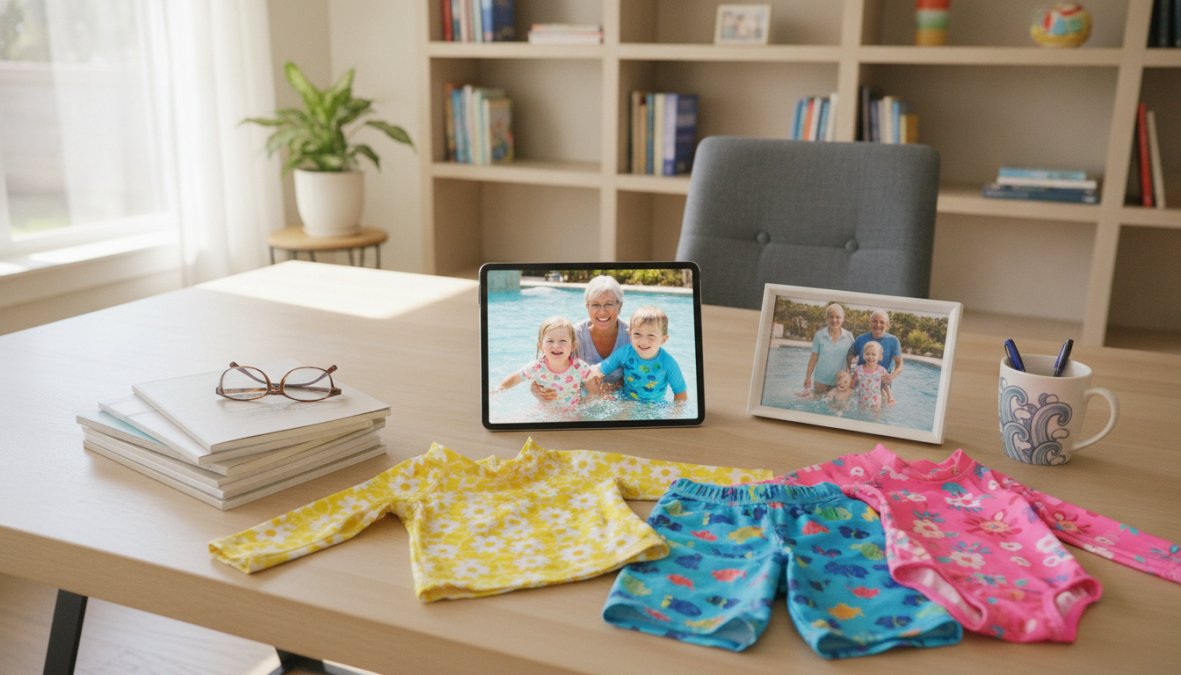
High-visibility swimwear serves a critical safety function. Bright colors, neon yellow, orange, pink, or lime green, create contrast against the water, making your grandchild stand out instantly. This is especially important in larger pools, at beaches, or where multiple children are in the water.
Research on visual attention shows that the human eye naturally gravitates toward high-contrast, bright objects. When your grandchild wears a high-visibility swimsuit, they become the focal point of your attention, even if your gaze drifts momentarily. This split-second advantage can make the difference in catching a problem early.
Bright & Bold Swimwear specializes in high-visibility swimsuits designed specifically for this purpose, featuring vibrant colors and UPF 30+ protection. Whether you're shopping for boys swimsuits, girls swimsuits, or exploring our best sellers, the bright patterns aren't just for style; they're functional safety equipment.
Additional Visibility Tools and Equipment
Water watcher bracelets or wristbands in bright colors help you track a child's location, especially in open water like lakes or beaches. Swim caps in bright colors also help significantly, since a child's head is the easiest part to spot in water. You can find additional visibility support through swim accessories designed to enhance safety.
Are Floaties Safe for Toddlers? Understanding Flotation Devices
Many grandparents rely on floaties, water wings, or inflatable vests to keep young children safe. These devices have a place in water safety, but they come with important limitations. A floatie is not a substitute for supervision; it's a supplementary tool used alongside active supervision and swimming ability.
Types of Flotation Devices and Their Limitations
Water wings and arm floaties are popular but offer false security. They can slip off, deflate, or position a child's body in ways that make swimming harder. A child wearing water wings may feel confident enough to venture into deeper water, creating danger if the floatie fails.
US Coast Guard-approved life jackets are the most reliable flotation device. They're designed to keep a child's head above water even if unconscious. A properly fitted life jacket provides genuine safety benefit when combined with supervision.
| Flotation Device | Safety Level | Best Use | Key Limitation |
|---|---|---|---|
| Water Wings | Low | Comfort/confidence only | Can slip off or deflate |
| Puddle Jumper | Medium | Weak swimmers in shallow water | Not foolproof; child can slip out |
| US Coast Guard Life Jacket | High | All situations | Must fit properly; requires active supervision |
| Pool Noodle | Low | Assist/play only | Not designed for safety |
Combining Flotation with Swim Lessons
The most effective approach combines appropriate flotation with actual swimming lessons. A child who learns to swim properly needs less reliance on flotation devices. A child who cannot swim should wear a US Coast Guard-approved life jacket and never be left without arm's-reach supervision.
Essential Safety Barriers and Pool Maintenance
Supervision is your primary defense, but physical barriers add a critical second layer of protection. A properly installed pool fence, gate with a working latch, and maintained pool alarms prevent unsupervised access to the water.
Pool Fencing, Gates, and Latches
A four-sided pool fence separates the pool from the rest of the yard. The fence should be at least four feet tall with narrow gaps between boards. The gate is the most critical component, it must latch automatically and close securely every time someone passes through. Check your gate regularly to ensure it closes and latches smoothly.
If you're visiting a grandchild's home and the pool lacks proper fencing, talk to the parents about installing one. This is a basic safety requirement.
Pool Alarms and Drain Safety
Pool alarms alert you to unauthorized entry into the water. Some detect motion in the water itself; others alert you if someone opens a gate or door leading to the pool. These are particularly useful at night or when you're inside the house.
Drain safety is another critical barrier. Modern pools are required to have anti-entrapment drains. If you're supervising at an older pool, verify that it has current drain safety equipment.
Recognizing Drowning Signs and Emergency Response
Drowning often looks nothing like what you see in movies. There's no splashing, no screaming, no dramatic struggle. Real drowning is often silent and quick.
What Real Drowning Looks Like
A drowning child may have their mouth at water level, unable to call for help. Their head may be tilted back or forward. Their body may be vertical in the water. Their eyes may be open but unfocused. These signs can last only 20-60 seconds before the child goes under.
Other warning signs include:
- Sudden quiet after normal play
- Unusual body position in water
- Gasping or irregular breathing
- Inability to move toward the side or shallow area
- Glazed or unfocused eyes
If you see any of these signs, get to the child immediately. Don't wait.
CPR Certification and First Aid Readiness
CPR certification is essential for any grandparent who supervises children around water. CPR can restart a child's breathing and heartbeat if they've stopped responding. The difference between survival and tragedy often comes down to whether CPR was started immediately.
Certification courses are widely available through the Red Cross and take just a few hours. Renew your certification every two years, as CPR guidelines change.
Keep a first aid kit poolside with bandages, antibiotic ointment, pain relievers, and any medications your grandchild might need. Know where the nearest phone is and have emergency numbers readily available.
Beyond the Pool: Water Safety for Non-Pool Environments
Water safety extends far beyond swimming pools. Grandchildren encounter water at beaches, lakes, rivers, bathtubs, and buckets. Each environment presents different hazards and requires adapted safety strategies.
Beaches, Lakes, and Open Water Safety
Open water is more dangerous than pools because you have less control over conditions. Currents, waves, temperature, and visibility all change constantly. Supervision becomes even more critical.
At beaches, position yourself where you can see your grandchild at all times. Ocean waves create visual obstacles; a child can disappear behind a wave. Enter the water with your grandchild if they're young or a weak swimmer.
Lakes present different challenges. Temperature can be cold even in summer, causing shock or hypothermia. Visibility is often poor. Never let a child wade into a lake without your direct supervision and physical proximity.
Rivers and moving water are particularly hazardous. Never allow young children near rivers or streams without constant arm's-reach supervision. Current can be deceptively strong.
Wear a life jacket yourself at open water. This keeps you safe if you slip and models water safety for your grandchild.
Bathtub and Water Play Safety
Drowning can happen in inches of water. Never leave a young child alone in a bathtub, even for seconds. Keep one hand on them at all times while they're in the water.
Small inflatable pools in the yard are also hazard zones. Drain them completely when not in use. A child can drown in standing water just a few inches deep. Even a bucket of water presents a drowning risk for toddlers.
Addressing Physical Limitations and Family Communication
Many grandparents face physical challenges, arthritis, reduced mobility, hearing loss, or vision changes, that complicate water supervision. These limitations are real and important to acknowledge. The solution is adaptation, not avoidance.
Adapting Supervision When You Have Mobility Challenges
If you have limited mobility, you can still supervise effectively. Position yourself in a chair or on a bench where you have full visibility of the pool or water area. Use binoculars if your vision isn't sharp. Ask a younger adult to be in the water with the child while you supervise from a stable position.
Don't pretend you can do something you can't. If you cannot move quickly or reach a child in arm's length, plan accordingly. Have another adult in the water or nearby. Use high-visibility swimwear so you can track your grandchild visually from a distance.
Navigating Family Conflict Over Safety Rules
Sometimes parents have different safety standards than grandparents. These conversations are difficult but necessary. Frame the discussion around the child's safety, not criticism of parenting. Use specific language: "I want to make sure [child] is as safe as possible. I'd like to use a life jacket when we're at the pool together. What are your thoughts?"
If parents refuse reasonable safety measures, you have the right to set boundaries. You might say, "I'm not comfortable supervising at the pool without a life jacket for [child]. Let's find another activity we can do together."
Document your safety practices. If you're the primary caregiver for extended periods, have written agreements about supervision rules, emergency contacts, and medical information.
Water safety for grandchildren requires vigilance, preparation, and honesty about your own limitations. Active supervision, high-visibility swimwear, appropriate flotation, physical barriers, and CPR readiness work together to create comprehensive protection. Bright & Bold Swimwear's high-visibility collection makes supervision easier by ensuring your grandchild is always visible in the water. When you combine their vibrant, protective swimwear with the supervision and safety practices outlined here, you create an environment where children can enjoy water safely.
Frequently Asked Questions
What are the most important swim safety tips for grandparents watching young children?
The most critical strategy is active, arm's-reach supervision, staying close enough to touch your grandchild at all times. Designate yourself as the water watcher and eliminate distractions like phones. Ensure children wear US Coast Guard-approved flotation devices if they're weak swimmers, enroll them in swim lessons, and maintain awareness of drowning signs, which are often silent and quick. Use high-visibility swimwear to keep children easy to spot in the water.
Are floaties and water wings safe alternatives to supervision?
No. Floaties, water wings, and inflatable devices are not safety devices, they can deflate, shift, or provide false confidence. They should never replace active supervision or certified life jackets. US Coast Guard-approved life jackets are far more reliable. Floaties work best as training tools alongside swim lessons, not as replacements for your watchful eye and arm's reach supervision during water time.
How can I use a water watcher tag to improve pool safety?
A water watcher tag is a visual reminder for all caregivers about who is actively supervising. One adult wears the tag during a set time period, making it clear that person is responsible for active supervision, not distracted by conversations or phones. When supervision responsibility shifts, the tag moves to the next adult. Pair this system with high-visibility swimwear on children so they're easy to spot, and maintain arm's reach at all times for maximum drowning prevention.
What should I do if I notice my grandchild is drowning?
Real drowning is often silent, there's no splashing or calling for help. If a child appears to be struggling, panicked, or unresponsive in water, remove them immediately and check for breathing. Call 911 right away. If trained in CPR, begin rescue breathing or compressions while waiting for emergency responders. Having CPR certification before supervising water activities is essential. Even if you're unsure, it's always better to act quickly than to wait.
This article was written using GrandRanker