

Why Neon Colors Are Safer: The Science Behind Visibility
Table of Contents
- Why Neon Colors Are Safer: Understanding High-Visibility Fundamentals
- High Visibility Clothing Benefits in Water Environments
- Fluorescent vs Neon Safety: What's the Real Difference?
- Best Colors for Visibility at Night and Beyond Water
- Drowning Prevention Swimsuit Colors: Why They Matter
- Beyond Water: Neon Colors in Industrial, Cycling, and Running Safety
- How to Choose and Care for Neon Safety Gear
- Conclusion: Why Neon Colors Remain the Gold Standard for Safety
Why Neon Colors Are Safer: The Science Behind Visibility
Last Updated: July 19, 2026
Understanding why neon colors are safer starts with a simple truth: visibility saves lives. When a child wears a neon swimsuit in the water, that brightness is a deliberate safety choice backed by how human vision and light physics work together. At Bright & Bold Swimwear, we've designed our collection around this principle because spotting a child quickly in any water environment can mean the difference between a fun day and a tragedy.
Why Neon Colors Are Safer: Understanding High-Visibility Fundamentals
Neon pigments absorb light across a wide spectrum and re-emit it at specific wavelengths that our eyes detect as intensely bright. This fluorescent property means neon colors don't just reflect light, they generate their own visual intensity, making them visible even in challenging water conditions where regular colors fade into the background.
Consider a child in a standard light blue swimsuit versus one in neon yellow. The light blue blends with the water's natural tones, especially on overcast days or in deeper sections. The neon yellow creates a stark visual boundary that your brain registers immediately as "different" and "important."
How Light Absorption and Wavelengths Create Safety
Visible light ranges from about 380 nanometers (violet) to 750 nanometers (red). Human eyes are most sensitive to light around 555 nanometers, which falls in the yellow-green range. This is why neon yellow and neon orange perform so well for visibility: they're naturally aligned with peak human visual sensitivity.
Fluorescent materials achieve their brightness through Stokes shift. When ultraviolet light hits a fluorescent dye, it absorbs that energy and re-emits it at a longer wavelength as visible light. Standard dyes simply reflect light; fluorescent dyes add energy to the light they emit. This fundamental difference explains why a neon swimsuit catches your eye faster than a pastel one.
Water absorbs light selectively, with red wavelengths disappearing first as depth increases. By 10 feet underwater, reds and oranges become nearly invisible. Yellows and greens persist longer. This is why lifeguards consistently recommend neon yellow and neon green for maximum visibility across different water depths and conditions.
The Psychological Impact of Attention-Grabbing Colors
Beyond the physics, neon colors trigger a psychological response. Bright, saturated colors signal urgency and demand attention. Your brain has been conditioned to treat neon colors as important signals requiring immediate attention.
When a parent scans a crowded pool, their eyes naturally lock onto movement and color contrast. A neon-colored swimsuit reduces the cognitive load of searching. In a moment where seconds matter, this psychological advantage becomes a practical safety tool.
High Visibility Clothing Benefits in Water Environments
The primary benefit of high-visibility clothing is reduced search time. In an emergency, every second counts. A lifeguard scanning a pool with dozens of children can locate a child in neon yellow in under a second. The same child in a dark or muted color might take 5-10 seconds to locate, time that matters when someone is struggling in the water.
High-visibility clothing also benefits supervision in busy environments. A neon swimsuit creates a visual anchor that parents and caregivers can track without conscious effort, reducing the cognitive burden of active supervision.
Visibility in Pools, Lakes, and Oceans
Pools offer the most controlled setting, with clear water and consistent lighting. A neon swimsuit creates maximum contrast against the water's blue tone and the pool deck's concrete or tile.
Lakes introduce variables: water clarity varies by season and location, and shadows create dark zones. A neon-colored swimsuit maintains visibility across these changing conditions because its brightness isn't dependent on light reflection alone.
Oceans present the most challenging environment. Waves and foam make spotting individuals difficult. Neon colors become critical in these conditions, creating a visual signal that cuts through the visual noise of waves and whitecaps.
Child Safety and Drowning Prevention Through Contrast
Drowning is the leading cause of unintentional injury death for children ages 1-4. Most drowning incidents happen quickly and silently. In these moments, visibility becomes the primary defense.
Contrast is the mechanism that makes visibility work. When a child's swimsuit contrasts sharply with the surrounding water and pool environment, spotting them becomes automatic. A neon swimsuit creates the strongest possible edge against water, making it the easiest target for rapid visual detection.
The contrast advantage extends to different lighting conditions. In bright sunlight, neon colors maintain visibility because they're inherently bright. In overcast conditions or early morning, fluorescent materials still glow noticeably because they're re-emitting light rather than relying on reflection.
Fluorescent vs Neon Safety: What's the Real Difference?
Fluorescent refers to materials that absorb ultraviolet light and re-emit visible light. Fluorescent dyes are used in clothing, paint, and safety equipment. Most high-visibility swimwear uses fluorescent pigments because they deliver strong visibility without the complexity of true neon technology.
Neon, technically, refers to ionized neon gas in glass tubes. However, in casual conversation, "neon colors" typically means the bright, saturated colors achieved through fluorescent pigments. For practical purposes in swimwear, fluorescent technology delivers the safety benefits we associate with "neon" colors.
Specific Neon Colors and Their Effectiveness
Different neon colors perform differently in water environments.
Neon Yellow stands at the peak of human eye sensitivity. It's the most visible color across all lighting conditions and water types. Lifeguards consistently identify neon yellow as the most effective choice for water safety.
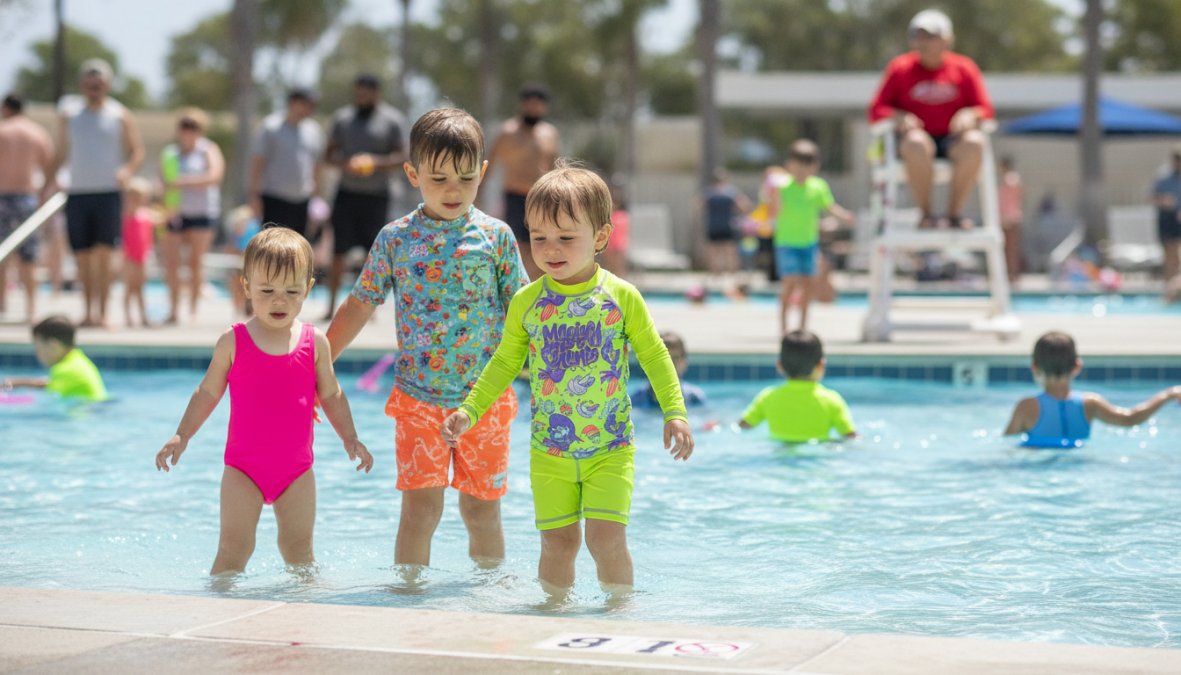
Neon Orange ranks close behind yellow in effectiveness. It's particularly effective in ocean settings where the orange-to-blue contrast is striking.
Neon Pink and Neon Green offer strong visibility but with slightly different performance profiles. Neon pink creates excellent contrast in blue-water environments. Neon green performs well in lakes and natural water settings. Both are significantly more visible than standard colors but slightly less visible than yellow or orange under all conditions.
If you have the choice, neon yellow or orange provides the strongest visibility guarantee. If a child prefers pink or green, those colors still deliver substantially better safety than standard colors. Our Girls swimsuits and Boys swimsuits collections feature all these high-visibility options to ensure every child can find a neon color they'll actually wear.
How Neon Colors Compare to White, Light Blue, and Dark Colors
White is bright but lacks the saturation that creates strong visual contrast in water. Light blue blends with the water itself, making it nearly invisible in certain conditions. Dark colors disappear quickly in deeper water or overcast conditions.
A child in a neon yellow swimsuit is visible in conditions where a child in white is barely noticeable. A child in light blue becomes nearly invisible at a pool's deep end.
| Color | Pool Visibility | Lake Visibility | Ocean Visibility | Overcast Visibility |
|---|---|---|---|---|
| Neon Yellow | Excellent | Excellent | Excellent | Excellent |
| Neon Orange | Excellent | Excellent | Very Good | Excellent |
| Neon Pink | Very Good | Good | Very Good | Very Good |
| White | Good | Fair | Fair | Fair |
| Light Blue | Fair | Poor | Poor | Poor |
| Dark Colors | Poor | Very Poor | Very Poor | Very Poor |
Neon colors maintain a safety advantage universally. Regular colors fail in specific scenarios; neon colors persist across all conditions.
Best Colors for Visibility at Night and Beyond Water
Neon colors excel in low-light conditions because they're inherently bright. A child wearing a neon swimsuit during evening beach time remains visible to parents and lifeguards. This visibility advantage extends to other scenarios: a cyclist in neon gear is visible to drivers at dusk, a runner in neon clothing is spotted by traffic at night.
The consistency is remarkable. Whether it's daylight, overcast conditions, dusk, or artificial lighting, neon colors maintain visibility because the brightness doesn't depend on external light reflection alone.
Reflectivity and UV Light: The Science Behind Nighttime Safety
Reflectivity refers to how much light bounces off a surface. Traditional reflective materials work by bouncing light from a light source back toward the source. This is effective but limited: if there's no direct light source, there's no reflection.
Fluorescent materials work differently. They absorb ultraviolet light (present even on overcast days and during twilight) and re-emit visible light. This means they're generating brightness rather than just bouncing it. UV light is present throughout the day, even when the sun is low or clouds are heavy. Fluorescent materials absorb this UV energy and convert it to visible light.
For true nighttime visibility in complete darkness, reflective elements become necessary. However, for dusk, dawn, and overcast conditions, the times when most water activities happen, fluorescent neon colors outperform reflective materials significantly.
Drowning Prevention Swimsuit Colors: Why They Matter
The connection between swimsuit color and drowning prevention is direct. Drowning prevention depends on supervision, rescue capability, and rapid response. Swimsuit color directly impacts supervision and response.
A highly visible swimsuit enables better supervision because the child is easier to track. Parents and lifeguards can maintain visual contact with less effort. Rapid response depends on rapid detection. When a child is in distress, the first step is spotting them. A neon swimsuit reduces the time between "something is wrong" and "I see the child."
How to Choose and Care for Neon Safety Gear
Selecting neon swimwear requires attention to both safety and practicality. The most visible color is neon yellow, but if a child will refuse to wear yellow, neon orange or pink still provides substantial safety advantage over standard colors. A swimsuit the child will actually wear is better than an ideal color the child rejects.
Fit matters for visibility. A well-fitting neon swimsuit maximizes the bright color visible to supervising adults.
Maintaining Vibrancy: Color Durability and Longevity
Neon colors fade with exposure to sunlight and chlorine. Rinsing the swimsuit with fresh water immediately after pool use reduces chlorine exposure and extends color vibrancy. Air-drying in shade rather than direct sunlight slows fading.
Despite fading, a neon swimsuit that's lost some brightness remains more visible than a standard-colored swimsuit in its original condition. However, replacing neon swimwear annually or every 18 months ensures optimal visibility for critical safety purposes.
Quality matters for durability. Well-constructed neon swimwear maintains color and construction integrity better than budget options.
Conclusion: Why Neon Colors Remain the Gold Standard for Safety
The science is clear: neon colors are safer because they align with how human eyes perceive light and how our brains process visual information. The physics of fluorescence, the biology of visual sensitivity, and the psychology of attention combine to make neon colors uniquely effective for water safety.
Water safety depends on visibility, and visibility depends on color choice. Bright & Bold Swimwear was created by a family to protect other families, and our collection of high-visibility swimsuits reflects this commitment. Our neon yellow, orange, and pink options feature vibrant fluorescent colors designed to keep children easily spotted in any water environment. When you choose a neon swimsuit, you're choosing the color science has proven most effective for preventing drowning and ensuring rapid response in water emergencies.
Frequently Asked Questions
What makes neon colors so visible in water?
Neon colors are safer because they reflect and absorb light differently than standard colors. Fluorescent neon pigments absorb UV light and re-emit it as visible light, creating an intense glow that stands out dramatically against water backgrounds. This high-visibility effect works in pools, lakes, and oceans because neon colors create strong contrast, whether against blue water or darker surroundings. The wavelengths of neon yellow, orange, and pink are naturally eye-catching to the human visual system, making them ideal for drowning prevention and child safety.
Are neon colors safer at night or during the day?
Neon colors excel in both conditions but work differently. During the day, their inherent brightness and fluorescent properties make them highly visible through light reflection and absorption. At night, reflective neon materials become critical, they bounce light from flashlights, headlights, or emergency lighting back to the source, creating visibility even in darkness. For best colors for visibility at night, neon yellow and bright orange perform exceptionally well because their wavelengths are naturally more visible to human eyes in low-light conditions. The best safety approach combines both daytime fluorescent properties and nighttime reflectivity.
What's the difference between fluorescent and neon colors for safety?
Fluorescent and neon are often used interchangeably, but there are subtle differences. Fluorescent colors absorb invisible UV light and re-emit it as visible light, creating brightness that appears to glow. True neon involves inert gas and mercury inside tubes, which is impractical for swimwear. In safety applications like high-visibility swimsuits, 'neon' typically refers to fluorescent pigments that mimic the visual effect. Both fluorescent vs neon safety approaches prioritize contrast and attention-grabbing properties. For drowning prevention swimsuit colors, fluorescent pigments are the practical standard because they're durable, washable, and maintain vibrancy through regular use.
How do neon colors compare to regular swimsuit colors for child safety?
Neon colors create dramatically better contrast against water than standard colors. White, light blue, and pastels blend into water or sky, making children harder to spot during supervision. Dark colors absorb light and can disappear in shadows or deeper water. Neon yellow, orange, pink, and green stand out because they're inherently high-visibility and create psychological impact, they signal urgency and grab attention instantly. For child safety and drowning prevention, high-visibility clothing benefits include faster recognition by parents and lifeguards, reducing response time in emergencies. Studies in aquatic safety support neon swimwear as a practical tool alongside swim lessons and active supervision.
This article was written using GrandRanker