

Do Bright Swimsuits Prevent Drowning? The Real Facts
Table of Contents
- Do Bright Swimsuits Actually Prevent Drowning Accidents?
- The Science of Color Visibility in Water
- Best Swimsuit Colors for Pool Safety
- The False Sense of Security Trap
- Drowning Prevention Tips for Parents Beyond Swimsuit Color
- Water Safety for Children: A Layered Approach
- How to Choose High-Visibility Swimwear That Works
- Frequently Asked Questions
Last Updated: August 31, 2026
Do Bright Swimsuits Actually Prevent Drowning Accidents?
Drowning remains one of the leading causes of unintentional injury death among children (the CDC). The honest answer is: bright swimsuits are a powerful visibility tool, but they're not a substitute for active supervision. At Bright & Bold Swimwear, we design high-visibility swimwear because visibility matters in water safety, but we always emphasize that color is one layer in a comprehensive safety approach, not the entire solution.
A neon swimsuit makes a child easier to spot in a pool or at the beach, which can reduce response time if something goes wrong. But visibility alone doesn't prevent drowning. What actually prevents drowning is a combination of active supervision, swim competency, and safety infrastructure working together. Bright swimwear accelerates the supervision part, the moment when a parent or lifeguard can quickly locate a child in an emergency.
Below, we'll explore what the science tells us about color visibility in water, which swimsuit colors genuinely stand out, and how to layer bright swimwear into a complete water safety strategy.
The Science of Color Visibility in Water
Water absorbs certain wavelengths of light while reflecting others. Red light is absorbed first as you go deeper, which is why red disappears quickly underwater. Blue and green light penetrate further but blend with the water itself, making blue and green swimsuits nearly invisible against a blue pool.
Neon and fluorescent colors work differently. They absorb ultraviolet light and re-emit it as visible light, making them appear to glow even in natural sunlight (peer-reviewed research). Neon yellow, neon orange, and bright lime green stand out against water because they don't blend with the blue and green tones that dominate aquatic environments.
The effectiveness of a swimsuit color depends on water clarity, lighting conditions, pool surface color, and observer distance. In a clear pool with good lighting, a neon color is visible from across the pool deck. In murky water or at dusk, even bright colors lose some advantage, but they still perform better than standard colors.
This is why high-visibility swimwear exists. The color choice is physics-based. When Bright & Bold Swimwear designs swimsuits, every color is selected because it stands out against the most common water environments: chlorinated pools, lakes, and ocean water.
Best Swimsuit Colors for Pool Safety
Why Neon and Fluorescent Colors Stand Out
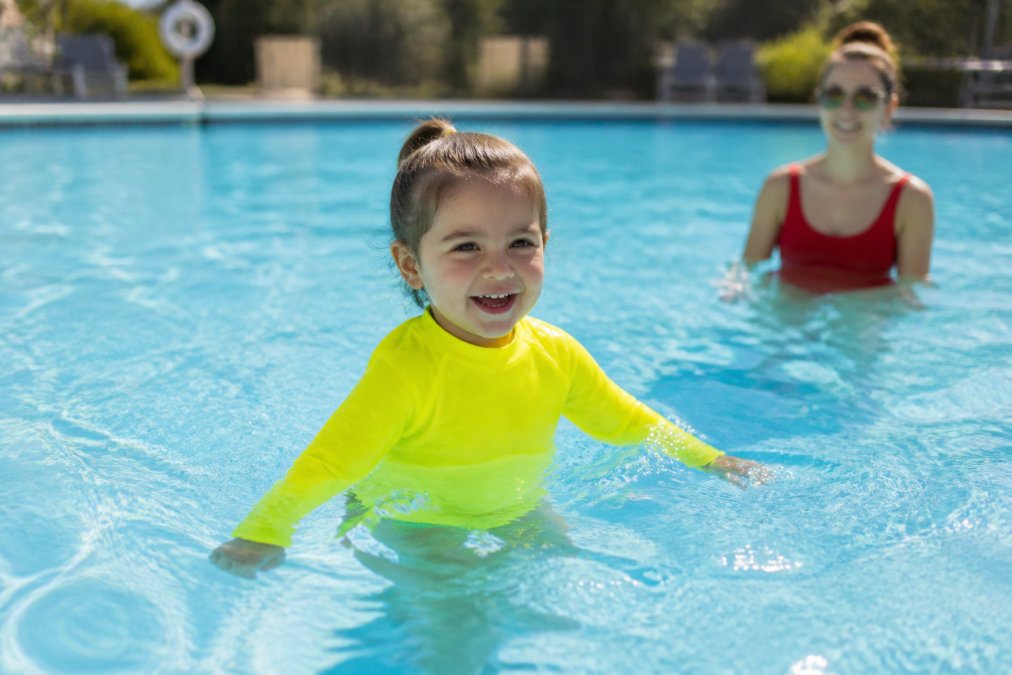
Neon yellow is the single most visible color in water across most lighting conditions. It stands out against blue pools, green lakes, and sandy beaches. Neon orange performs similarly, offering excellent contrast. Bright lime green rounds out the top tier.
These colors work because of their wavelength and light-reflecting properties. A child in neon yellow is identifiable by color alone, even if you can't see fine details.
Patterns also matter. A solid neon color is visible. A neon color with contrasting patterns (stripes, checkers, geometric designs) is even more visible because the pattern breaks up the water's surface reflection and creates additional visual landmarks.
The Girls Sleeveless One Piece Swimsuit with UPF 30+ & High-Visibility Neon and Boys Short Sleeve Rash Guard Swim Set from Bright & Bold Swimwear use neon and patterned designs specifically for this visibility advantage.


Colors to Avoid in Water
Blue swimsuits are the most dangerous choice for visibility. Blue blends with blue water, making a child nearly invisible. Green and teal swimsuits have the same problem. Darker colors (navy, black, dark purple) lose visibility quickly as water depth increases or lighting changes.
White and light colors offer some contrast in blue water but don't perform as well as neon. They also show dirt and staining more quickly, which degrades their visibility over time.
Avoid colors that match or blend with water. Choose colors that contrast sharply with blue and green environments.
The False Sense of Security Trap
Bright swimsuits can create a false sense of security. A parent sees their child in a neon swimsuit and thinks, "Now I don't have to watch as closely." This is the trap. Bright swimwear makes visibility easier, but it doesn't replace active supervision.
Drowning happens fast, often silently and without the struggle most people imagine. A child can slip underwater in seconds. If a parent is distracted or assuming the bright color means they can relax their attention, the swimsuit provides no protection.
The visibility advantage of bright swimwear only works if someone is actively watching. If no one is looking, the color doesn't matter. Bright swimsuits improve the odds of a parent or lifeguard spotting a child in trouble, but only if that adult is paying attention.
This is why drowning prevention experts emphasize that visibility is one layer, not the entire system. A bright swimsuit without active supervision is just a bright swimsuit. A bright swimsuit combined with constant, focused supervision becomes a meaningful safety tool. hi-vis fabric properties.
Drowning Prevention Tips for Parents Beyond Swimsuit Color
Active Supervision and Lifeguard Awareness
Active supervision means eyes on the child at all times. Not glancing occasionally. Not assuming other adults are watching. Constant visual contact. This is the single most effective drowning prevention strategy.
Effective supervision requires positioning. A supervising adult should be close enough to reach a child within seconds and have a clear line of sight with minimal obstructions. They should avoid distractions, phones, conversations, activities that pull attention away from the water.
Lifeguards provide an additional layer. A trained lifeguard is positioned to scan the entire water area and respond quickly. A child in a neon swimsuit is easier for a lifeguard to track across a crowded pool or beach, reducing response time if something goes wrong.
Swim Lessons and Water Competency
Swim lessons are the second pillar of drowning prevention. A child who can swim, understands water dynamics, can stay afloat, and can move toward safety is far less likely to drown if an accident occurs.
Swim competency means genuine comfort in water, understanding of personal limitations, and the ability to respond to unexpected situations. A child who has practiced floating, treading water, and exiting the pool is better equipped to survive an unexpected fall or slip.
Swim lessons should start early, ideally by age 3 or 4, and should be consistent (the CDC). Water competency requires ongoing practice and reinforcement.
Water Safety for Children: A Layered Approach
Visibility Across Different Water Environments
Visibility challenges change depending on the water environment. A chlorinated pool with clear water and good lighting is the easiest environment for visibility. Open water, lakes, rivers, and oceans, presents different challenges. Water clarity varies dramatically, and neon still performs better than standard colors even in murky conditions.
Dusk and nighttime swimming present extreme visibility challenges. Even neon colors lose their advantage in low light. This is why supervision becomes even more critical in these conditions. A bright swimsuit is helpful, but it's not a substitute for proper lighting and active supervision.
In a clear pool with good lighting, bright swimwear provides significant visibility advantage. In murky or low-light conditions, visibility is only one part of a broader safety approach.
Material and Pattern Considerations
The material of a swimsuit affects visibility almost as much as the color. A matte-finish neon fabric is more visible than a shiny, reflective fabric that creates glare. Patterns break up the visual field and make a child easier to track.
High-visibility swimwear should use materials specifically chosen for visibility. The Girls Long Sleeve Crop Top Rash Guard Set with UPF 30+ Protection and Boys Long Sleeve Rash Guard Swim Set combine neon colors with rash guard materials that maintain visibility while providing sun protection.

A solid neon color is visible. A neon color with contrasting stripes or checks is more visible because the pattern creates visual interest and breaks up water reflections. Quality high-visibility swimwear maintains its color through repeated washing and chlorine exposure, ensuring the visibility benefit persists throughout the season.
How to Choose High-Visibility Swimwear That Works
Choosing the right high-visibility swimsuit requires balancing visibility, fit, comfort, and durability:
1. Prioritize neon or fluorescent colors. Yellow, orange, and lime green are your best options. Avoid blue, green, and dark colors entirely.
2. Look for contrasting patterns. Solid colors work, but patterns increase visibility further. Stripes, checkers, or geometric designs create additional visual landmarks.
3. Ensure proper fit. A swimsuit that's too loose or too tight will be uncomfortable and your child may refuse to wear it.
4. Check for UV protection. High-visibility swimwear should include UPF 30+ protection for sun safety.
5. Verify durability. A swimsuit that fades after a few washes loses its visibility advantage. Quality materials maintain their neon brightness through an entire season.
6. Consider your specific environment. If you primarily use a clear pool, neon visibility is your main advantage. If you frequent lakes or beaches, consider rash guard sets that provide additional coverage and visibility.
The Bright & Bold Swimwear collection is designed around these principles. Every color is selected for visibility. Every pattern is chosen to enhance contrast. Every suit includes UPF protection. A child in Bright & Bold Swimwear is visible. That visibility buys parents and lifeguards critical seconds in an emergency.
| Factor | What to Look For | Why It Matters |
|---|---|---|
| Color | Neon yellow, orange, or lime green | Maximum contrast against blue/green water |
| Pattern | Contrasting stripes or geometric designs | Increases visibility and breaks water reflections |
| Material | Matte finish, quality nylon/polyester blend | Maintains color vibrancy through repeated use |
| UV Protection | UPF 30+ minimum | Prevents sun damage while providing visibility |
| Fit | Snug but comfortable, no gaps | Ensures child will wear it and move freely |
| Durability | Chlorine and fade-resistant | Maintains visibility throughout the season |
Bright swimsuits reduce drowning risk by making children easier to spot. But they're one layer in a comprehensive safety system. Active supervision, swim lessons, water competency, and proper safety protocols work together to protect children. A bright swimsuit without supervision is just clothing. A bright swimsuit combined with constant, focused attention becomes a meaningful safety advantage.
The best approach is layered. Bright, high-visibility swimwear from Bright & Bold Swimwear makes it easier for parents and lifeguards to keep eyes on children. Swim lessons build water competency. Active supervision ensures someone is always watching. Together, these elements create a genuine safety advantage. Shop our best sellers to find high-visibility swimwear designed specifically for keeping your child visible and safe in the water.
Frequently Asked Questions
Q: Do bright swimsuits actually prevent drowning, or do they just make kids easier to spot?
A: Bright swimsuits don't prevent drowning by themselves, but they're an important visibility tool. High-visibility swimwear makes children easier for parents and lifeguards to locate quickly in the water, which supports faster response times if a child gets into distress. However, swimsuit color is just one layer of a comprehensive water safety strategy that must include active supervision, swim instruction, and proper pool protocols. Drowning prevention depends on multiple factors working together.
Q: What are the best swimsuit colors for water safety?
A: Neon and fluorescent colors, bright yellows, oranges, pinks, and greens, offer the highest visibility against water. These colors stand out because they reflect light differently than pastels or dark shades. High-contrast patterns also enhance visibility. Avoid blues, teals, greens, and dark colors that blend into the water itself. The goal is maximum contrast between the child's swimwear and the water environment.
Q: Can bright swimsuits replace the need for adult supervision?
A: No. While high-visibility swimwear helps you spot children faster, it cannot replace active, attentive supervision. Drowning can happen silently and in seconds, even in shallow water. Parents and caregivers must maintain constant visual contact, stay within arm's reach of young children, and avoid distractions like phones. Bright swimsuits are a supplementary safety tool that works best when combined with vigilant supervision, swim instruction, and understanding of drowning risk factors.
Q: How does swimsuit color affect visibility in different water environments?
A: Visibility varies significantly depending on water conditions. In clear pools, neon colors stand out immediately. In murky lakes or ocean water with waves, the same bright colors may be harder to spot. Water clarity, depth, lighting, and surface reflections all affect how well you can see a child. This is why high-visibility swimwear works best when paired with active supervision, you're relying on multiple ways to keep track of your child, not just color alone. Test visibility in your specific water environment before relying solely on swimsuit color.
This article was written using GrandRanker