

Child Water Safety Bracelet: Reviews & Buying Guide
Table of Contents
- How Water Alarm Bracelets Work
- Key Features to Look for in a Water Safety Bracelet
- Best Swimming Gear for Toddlers: Visibility Meets Wearable Alerts
- Why Multiple Layers of Protection Matter
- Water Safety Tips for Parents: Building a Complete Safety Plan
- Battery Life, Maintenance, and Fit
- Do Anti-Drowning Bracelets Actually Prevent Drowning?
- Conclusion
- Frequently Asked Questions
Last Updated: September 18, 2026
How Water Alarm Bracelets Work
A child water safety bracelet is a wearable device that detects when a child becomes submerged and sends an alert to a caregiver's receiver. At Bright & Bold Swimwear, we think of it as one more set of eyes when yours can't be everywhere at once.
Water-Activated Sensors and Immersion Detection
The core of any water safety bracelet is its water-activated sensor. These sensors watch for continuous contact with water, not just a splash.
- Immersion detection: The sensor triggers when it stays wet for a set number of seconds
- Submersion alarm: Some models react to depth, not just moisture
- Water-activated sensor: The most common design, sensitive to any sustained water contact
Wireless Receivers and Alert Range
The wristband talks to a wireless receiver, usually a portable monitor the parent clips to a belt or keeps poolside. Signal range varies by model, and so does alert volume.
Key Features to Look for in a Water Safety Bracelet
The best water safety bracelet for your family balances sensitivity, comfort, and reliability. No single feature matters more than the others, but a few of them do more work than the rest.
Look for these essentials:
- Adjustable sensitivity to reduce false alarms from splashing
- Quick-release buckle for safety and comfort
- Waterproof rating appropriate for continuous wear
- Audible alert loud enough to hear over pool noise
- Strobe light alert for noisy or crowded environments
- Battery-operated design with a clear low-battery warning
- Tamper-proof clasp so a curious child can't remove it
Adjustable Sensitivity and False Alarm Mitigation
Adjustable sensitivity is the single most important feature for reducing false alarms. A bracelet that goes off every time your child splashes will get ignored, and an ignored alarm is not a safety tool.
A few real-world triggers to plan around:
- Sprinklers and rain. A wrist that stays wet for several seconds can trip the sensor. Have your child remove the bracelet during water play that isn't swimming.
- Handwashing and dish duty. Sustained contact at the sink is a common false trigger. Take the bracelet off before chores.
- Splashing at the pool edge. Kids who sit on the steps and slap the water can set off a sensitive unit repeatedly.
Waterproof Ratings and What They Actually Mean
Waterproof depth ratings are not all the same. A bracelet rated for splashes is not the same as one rated for continuous submersion. Look for a rating that matches how your child actually uses it.
- Splash-resistant units handle rain and handwashing but should not go underwater.
- Submersion-rated units are built for continuous wear in the pool and are the right choice for swimmers.
- Saltwater and chlorinated water both wear on seals over time. Rinse the wristband after every session to extend the life of the seal.
Alert Volume, Range, and Tamper-Resistance
Alert volume matters more than most parents expect. Pool pumps, splashing, and conversation can drown out a quiet alarm. Test the volume in your own backyard before you rely on it, and consider a model with a strobe light for noisy or crowded settings.
Best Swimming Gear for Toddlers: Visibility Meets Wearable Alerts
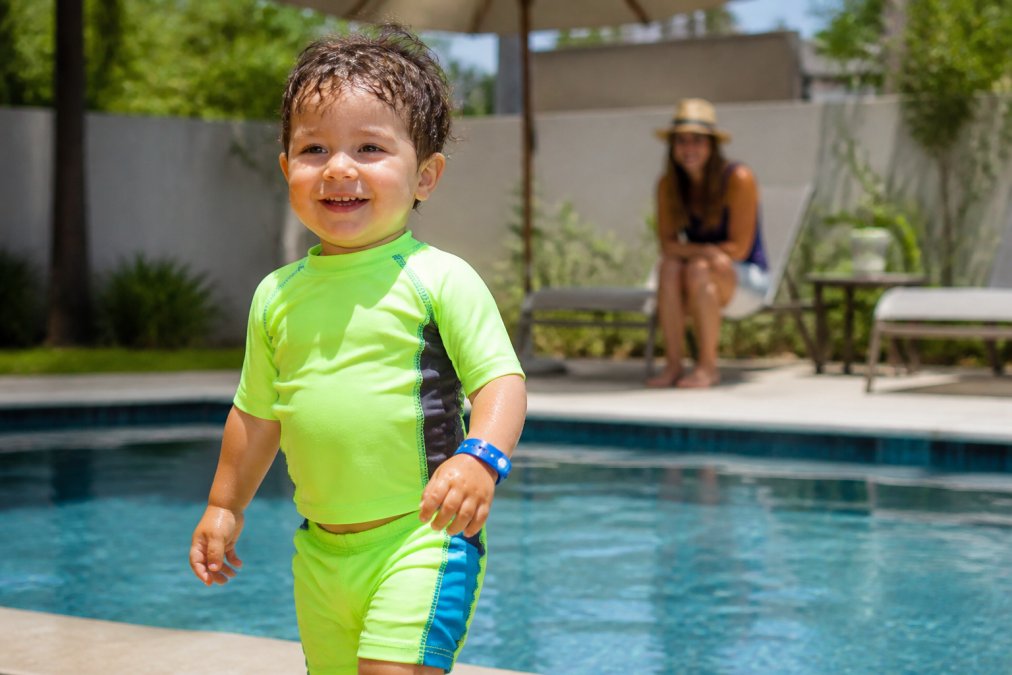
A water safety bracelet works best alongside high-visibility swimwear, not instead of it. The bracelet alerts you to trouble. Bright swimwear helps you spot it before trouble starts.

Why Multiple Layers of Protection Matter
No single device prevents drowning on its own. Multiple layers of protection are how water safety actually works.
The layers stack:
- Active supervision by a designated adult
- High-visibility swimwear for faster spotting
- Water safety bracelets for immersion alerts
- Barriers like pool fences and covers
- Swim lessons to build real skills
Integrating Alarms With Smart Home Systems
Some newer water safety bracelets connect to smart home systems. This lets you route alerts to a phone, a smart speaker, or a hub.
Water Safety Tips for Parents: Building a Complete Safety Plan
Water safety tips for parents come down to one principle: assign the job. "Everyone is watching" means no one is watching.
Build your plan around these habits:
Boys Short Sleeve Rash Guard Swim Set →
- Designate one water watcher. Rotate every 15 minutes at gatherings.
- Put the phone down. Supervision means eyes on the water, not the screen.
- Fit the bracelet before swim time. Check the buckle and battery.
- Test alert range. Walk to the far side of the pool and confirm you hear it.
- Pair visibility with alerts. Neon swimwear plus a bracelet covers more ground.
- Rehearse what to do. Every adult should know how to respond to an alert.
Age-Appropriate Usage Guidelines
Water safety bracelets suit different ages differently. For children aged 2 to 4, the bracelet is a backup to arm's-length supervision. At this age, a caregiver should be within touching distance at all times.
Battery Life, Maintenance, and Fit
Battery life varies widely by model, so check the manufacturer's spec before you buy. A dead bracelet is worse than no bracelet, because it creates false confidence. The fix is a routine, not a reminder.
A Maintenance Cadence That Actually Holds Up
Most practitioners find that a simple schedule beats good intentions. Pick a cadence and stick to it:
- Before every swim session. Press the test button and confirm the alert fires on the receiver. This takes ten seconds and catches a dead battery or a loose seal before anyone gets in the water.
- Weekly. Wipe the sensor with a damp cloth and check the wristband for cracks, stretching, or wear at the buckle.
- After every pool or saltwater session. Rinse the wristband in fresh water and dry it with a soft cloth. Chlorine and salt both degrade seals and straps over time.
- On a set calendar date. Replace or recharge batteries on a fixed schedule, not when they die. A monthly reminder on your phone works better than waiting for a low-battery chirp you might not hear.
Testing the Alert Before You Trust It
A bracelet you have never tested is an assumption, not a safety layer. Build a two-minute pre-swim check into your routine:
- Fit check. Slide one finger under the strap. It should be snug but not pinching. A bracelet that leaves a red mark will come off; one that slides over the hand will not stay on.
- Buckle check. Tug gently on the clasp. If it releases with light pressure, it will release in the water.
- Sensor test. Wet your finger and press it against the sensor for the number of seconds your model requires. Confirm the receiver alarms.
- Range check. Walk to the farthest point of your pool area with the receiver. If you cannot hear or see the alert, move the receiver closer or choose a different model.
Fit and Comfort for Different Ages
Wristband comfort matters more than most parents expect. A bracelet that pinches or rubs will come off, and a bracelet that comes off is not protecting anyone.
- Ages 2 to 4. Small wrists need the smallest adjustable setting, and the clasp should be tamper-resistant. Check the fit every time, because toddlers grow and wiggle.
- Ages 5 to 7. Kids this age can manage a quick-release buckle themselves, which is a safety feature, not a flaw. Teach them to leave it on during swim time and to hand it to you when they get out.
- Older children. Comfort and low profile matter more, because a bulky bracelet gets left in the swim bag. A slim, submersion-rated unit is more likely to stay on.
Storage Between Sessions
Where the bracelet lives between swims matters too. Keep the receiver and the wristband together in a dedicated spot near the pool, so the pre-swim check becomes automatic. Store the bracelet dry, with the strap unbuckled, to prevent the seal from compressing and the strap from taking a set. If you store it in a pool bag, keep it out of the same pocket as wet towels, which can keep the sensor damp and drain the battery.
Do Anti-Drowning Bracelets Actually Prevent Drowning?
Anti-drowning bracelets do not prevent drowning by themselves. They alert you faster, which gives you more time to respond. That distinction matters.
What the technology does well:
- Alerts you the moment a child goes under
- Reaches you when your eyes are elsewhere
- Adds a safety net during crowded swim days
What it doesn't do:
- Replace active supervision
- Work reliably if the battery is dead
- Eliminate false alarms entirely
Conclusion
The hardest part of water safety is that you can't watch everything at once. A water safety bracelet helps close that gap, alerting you when your eyes can't.
Frequently Asked Questions
Do anti-drowning bracelets actually work?
Water safety bracelets or immersion alarms are designed to alert caregivers when a child enters the water unexpectedly. They work by detecting water contact and sending a signal to a wireless receiver. However, they are not a substitute for active supervision. The CDC and other safety organizations emphasize that alarms are one layer of protection and should be used alongside barriers, supervision, and swim lessons. No device can replace a watchful adult.
What features should I look for in a child water safety bracelet?
Key features include adjustable sensitivity to reduce false alarms, a waterproof rating suitable for swimming, a comfortable quick-release buckle, and a reliable signal range between the wristband and receiver. Look for battery-operated models with long battery life, audible and visual alerts like a strobe light, and a tamper-proof design. Also check that the bracelet is sized appropriately for your child's wrist and that the alarm volume is loud enough to hear over pool noise.
How do water safety bracelets integrate with other pool safety measures?
Water safety bracelets work best as part of a layered protection system. Combine them with pool fences, self-closing gates, pool covers, and active supervision. Some models can integrate with smart home systems to send notifications to your phone or trigger other alerts. Remember that bracelets are an early warning tool, not a replacement for barriers or adult supervision. Always ensure multiple safeguards are in place.
What is the difference between a GPS tracker and a water immersion alarm?
A GPS tracker uses satellite technology to show a child's location on a map, which is helpful for finding a missing child outdoors. A water immersion alarm, like a water safety bracelet, detects when the wristband contacts water and immediately alerts a caregiver via a wireless receiver. They serve different purposes: GPS tracks location, while immersion alarms provide real-time alert of water entry. For drowning prevention, immersion alarms are more directly relevant.
Are wearable pool alarms effective for toddlers?
Wearable pool alarms can be effective for toddlers when used correctly and as part of a comprehensive safety plan. They provide an additional layer of protection by alerting you if your toddler enters the water. However, they should never replace direct supervision. Toddlers are naturally curious and fast, so alarms give you a critical extra moment to respond. Choose a model with adjustable sensitivity and a comfortable fit to ensure your child wears it consistently.