

Dark Colored Clothing UV Protection: What Works
Table of Contents
- How UV Radiation Interacts With Fabric
- Does Dark Colored Clothing Offer Better UV Protection?
- UPF Rating Explained: What the Numbers Actually Mean
- Does Wet Clothing Lose UV Protection?
- Fabric Density, Weave Tightness, and Fiber Composition
- The Heat-Stress Trade-Off: Staying Cool in Dark Colors
- How to Choose Sun Protective Swimwear for Kids
- Frequently Asked Questions
Last Updated: September 20, 2026
How UV Radiation Interacts With Fabric
Ultraviolet radiation damages skin cells, and fabric stops it in two ways: by absorbing UV energy into the fibers, or by blocking it at the surface.
When sunlight hits a garment, some UV rays bounce off, some are absorbed by fibers and dyes, and the rest passes through to your skin. That last portion, transmission, is what a UPF rating measures.
Absorbance vs. Transmission in Everyday Fabrics
Absorbance is how much UV energy a fabric soaks up and dissipates as heat; transmission is how much slips through to your skin. High absorbance and low transmission means the fabric is doing its job.
Absorption and transmission change with moisture, stretch, and wear.
Does Dark Colored Clothing Offer Better UV Protection?
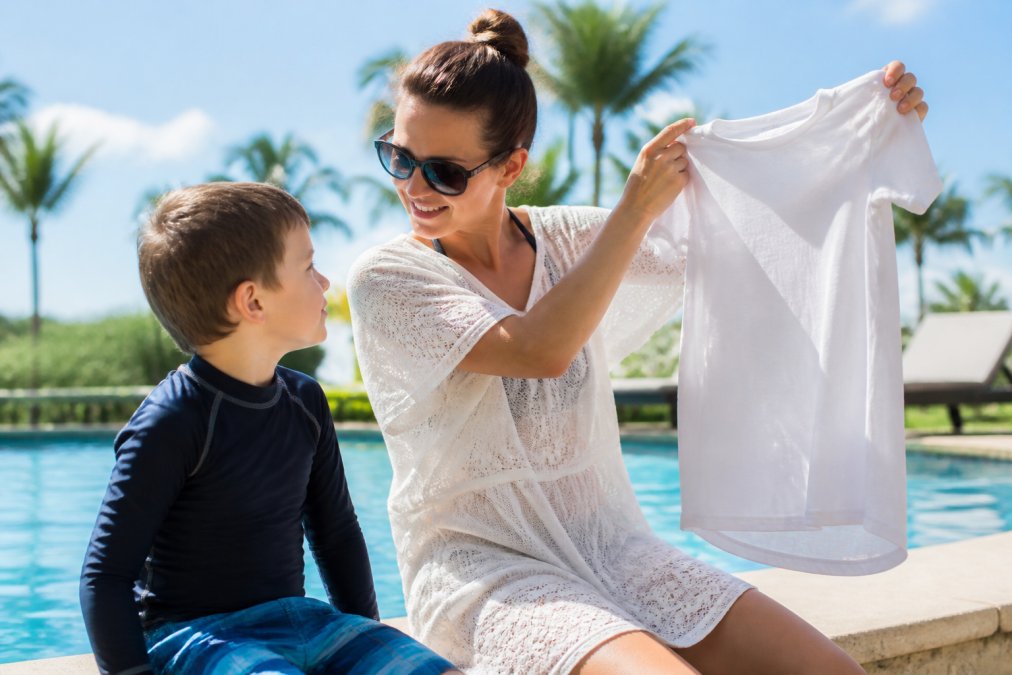
Yes. Dark colored clothing generally offers better UV protection than light colored clothing of the same fabric, because darker dyes absorb more ultraviolet radiation before it reaches your skin. The catch is that the same property that blocks UV also absorbs heat, a trade-off that matters for kids who swim all afternoon.
The Role of Color in UV Absorption
Darker, more saturated dyes absorb a wider band of the light spectrum, including ultraviolet, and re-emit that energy as heat.
Dark vs. Light Colors for Sun Protection
The gap between a dark and light garment of identical construction is real but often overstated: a tightly woven light fabric can outperform a loosely woven dark one.
What actually decides the outcome:
- Fiber composition determines baseline UV behavior
- Weave tightness controls how much light slips between threads
- Dye saturation adds absorption on top of the fabric's natural blocking
- Moisture and stretch can shift performance in either direction
Treat color as one lever, not the whole machine.
UPF Rating Explained: What the Numbers Actually Mean
A UPF rating is the Ultraviolet Protection Factor, a standardized measure of how much UV radiation passes through a fabric to your skin. A UPF 30 garment allows roughly 1/30th of UV radiation through, while UPF 50 allows about 1/50th.
UPF vs. SPF: Two Different Numbers
UPF and SPF are not interchangeable, and mixing them up leads to real gaps in protection.
- SPF measures how long sunscreen delays a sunburn on exposed skin, and it depends on how much you apply and how often you reapply.
- UPF measures how much UV radiation passes through a fabric. It is a property of the material, not a behavior.
How UPF Is Tested
Fabric UPF is measured in a lab by passing UV radiation through a sample and recording how much transmits. Testing covers both UVA and UVB, and the reported number reflects the lowest performance across the spectrum, not an average, which is why a fabric can look impressive on a label but underperform once stretched, wet, or worn thin.
What the Rating Tiers Mean
- UPF 15-24: Good protection. Blocks roughly 93-96% of UV radiation.
- UPF 25-39: Very good protection. Blocks roughly 96-97.5%.
- UPF 40-50+: Excellent protection. Blocks roughly 97.5-98% or more.
Notice how the percentages compress at the top. The jump from UPF 30 to UPF 50 is real, but smaller than the jump from no protection to UPF 30. Coverage and fit usually move the needle more than chasing the highest number on the tag.
Why Ratings Drift Over Time
A UPF rating describes a garment when it is new and tested under lab conditions. Repeated washing, chlorine exposure, and stretching affect how tightly the fibers sit together, and a suit that has gone baggy or see-through has usually lost some blocking ability. Treat the rating as a starting point, not a permanent guarantee.
Does Wet Clothing Lose UV Protection?
Wet clothing can lose UV protection, and the amount depends almost entirely on the fiber, a point that matters most for swimwear spending the afternoon in the water.
Girls Long Sleeve Rash Guard Set — Full →
Fabric Density, Weave Tightness, and Fiber Composition
Fabric density and weave tightness determine how much UV radiation reaches your skin, and fiber composition sets the baseline. Hold a fabric up to a bright window: visible points of light mean UV is getting through too.
The Light Test and Other Quick Checks
You do not need a lab to judge most garments. A few simple checks tell you a lot:
- The window test: Hold the fabric up to bright sunlight. Visible pinpricks of light mean UV is passing through.
- The stretch test: Gently pull the fabric across its width. If the weave opens noticeably, protection drops when the garment is worn snug.
- The hand test: Densely woven fabric feels substantial and resists light pressure. Thin, flimsy fabric usually lets more through.
Synthetic vs. Natural Fibers
Synthetic fibers generally outperform natural ones for UV blocking. Polyester and nylon have tighter molecular structures that absorb and scatter UV radiation more effectively than cotton or rayon.
Porosity and Garment Construction
Porosity is the amount of open space in a fabric and the single biggest driver of UV penetration. Tightly woven or densely knit fabrics leave less room for light to pass through.
Dye Longevity and Wash Cycles
A dark garment's UV advantage depends on the dye staying put. Every wash cycle, chlorine exposure, and hot dryer session gradually breaks down dye molecules and lifts pigment out of the fibers. As color fades, so does some of the absorption that made the dark fabric effective.
A few habits slow the fade:
- Rinse in cool water after every swim to remove chlorine and salt.
- Skip the hot dryer. Heat and tumbling stress both dye and fiber structure.
- Wash less aggressively. Frequent hot washes and harsh detergents strip color faster than gentle cycles.
- Retire see-through or baggy suits. Once fabric thins or stretches, the rating no longer reflects reality.
Putting It Together
Fiber composition sets the baseline, weave tightness controls how much light slips between threads, and dye saturation adds absorption on top. For a child in and out of the water all day, prioritize a tightly knit synthetic fabric with good coverage, then let color and dye quality do their part.
The Heat-Stress Trade-Off: Staying Cool in Dark Colors
Dark colors absorb more UV, and they also absorb more heat. That's the trade-off that makes some parents hesitate to put a child in a dark suit for a full day outside.
- Choose moisture-wicking synthetics that move sweat away from skin instead of holding it
- Pick loose, breathable fits that allow airflow without stretching the weave open
- Add shade and hydration breaks during peak solar intensity, roughly late morning through mid-afternoon
- Layer smart so a dark outer piece can come off when the sun eases
How to Choose Sun Protective Swimwear for Kids
Choosing sun protective swimwear for kids comes down to coverage, fabric, and fit, in that order. A garment that covers more skin with a tightly knit synthetic fabric and stays in place will outperform a higher-rated piece that rides up or stretches out.
Run through this checklist before you buy:
- Coverage: long sleeves and full torso coverage beat short sleeves and exposed midriffs
- Fabric: synthetic knit, not cotton, for anything that gets wet
- UPF rating: UPF 30 or higher, with the rating on the garment, not just the label
- Fit: snug enough to stay put, loose enough not to stretch the weave
- Visibility: high-contrast colors that stand out against pool, lake, and ocean water
- Durability: color and shape that hold up after repeated washing and chlorine exposure
Layering Strategies for Full-Day Sun Exposure
Layering extends protection across a long day without overheating. Start with a long-sleeve rash guard as the base layer, since it covers the arms and shoulders where children burn fastest.
Frequently Asked Questions
What color clothing is best for sun protection?
Dark or vivid colors generally absorb more ultraviolet radiation than pale shades, so they block more UV before it reaches your skin. However, color alone does not determine protection. A tightly woven dark fabric with a high UPF rating will outperform a loosely knit light fabric every time. For swimwear, look for a labeled UPF 30+ or higher, like the long-sleeve rash guard sets from Bright & Bold Swimwear, which block UVA and UVB rays whether the fabric is wet or dry.
Can you get sunburned through a T-shirt?
Yes. A standard white cotton t-shirt typically provides only UPF 5 to 10, which means a significant amount of UV radiation passes through. When the fabric gets wet or stretched, protection drops further. Darker, denser fabrics block more UV, but the most reliable option is clothing tested and labeled with a UPF rating. For children who spend hours in the water, a dedicated sun-protective swim shirt removes the guesswork entirely.
Does wet clothing lose UV protection?
Wet fabric can lose some UV protection because water reduces the scattering of UV radiation within the fabric structure. The effect varies by fiber type and weave. Many modern swim fabrics, including those used in UPF 30+ rash guards, are engineered to maintain their rated protection whether wet or dry. If you are relying on an everyday t-shirt for sun protection at the pool or beach, assume its protection drops when soaked and plan accordingly.
How do I choose sun protective swimwear for my child?
Start with the UPF rating: UPF 30 blocks about 97% of UV radiation, and UPF 50 blocks about 98%. Look for long sleeves and full torso coverage, since arms and shoulders burn fastest. Choose a snug but comfortable fit, because stretched fabric lets more UV through. High-visibility colors add a water-safety benefit by helping you and lifeguards spot your child in a crowded pool. Bright & Bold Swimwear offers UPF 30+ long-sleeve sets in neon colorways designed for exactly this purpose.