

Full Bottom Coverage Swimsuits: A 2026 Guide for Kids
Table of Contents
- Why Full Bottom Coverage Matters for Little Swimmers
- High-Visibility Swimsuits for Children: Seeing Is Supervising
- Sun Protective Clothing for Toddlers: UPF 30+ and Full Coverage
- Full Coverage Swimwear Options for Every Swim Day
- How to Choose a Full Bottom Coverage Swimsuit That Stays Put
- Caring for Your Full Coverage Swimsuit: Durability Tips
- Conclusion: Confidence and Safety in Every Splash
- Frequently Asked Questions
Last Updated: September 11, 2026
Why Full Bottom Coverage Matters for Little Swimmers
A full bottom coverage swimsuit is designed so the fabric fully covers a child's bottom rather than sitting high on the hips like a classic bikini cut. For kids aged 2 to 7, that extra fabric keeps them comfortable during constant movement and removes the wardrobe adjustments that pull a parent's eyes away from the water.
This guide from Bright & Bold Swimwear covers what to look for, how to measure, and which styles hold up through lessons and lake days.
Here's the part most guides skip: coverage isn't just about modesty or sun protection. A suit that rides up forces a child to stop and tug at it, and it forces you to look away from the water to help. The American Academy of Pediatrics drowning prevention guidance is blunt on this point: active supervision means watching constantly and without distraction. A suit that stays put supports that. A suit that doesn't works against it.
High-Visibility Swimsuits for Children: Seeing Is Supervising
High-visibility swimsuits for children use neon and high-contrast colors chosen to stand out against pool blue, lake green, and ocean gray. The point is simple: you can't supervise what you can't see. In a crowded pool, dozens of kids wear similar blues and pinks, a child in neon green or bright yellow is a different story.
Color choice is one of the few safety variables parents fully control. You can't control water clarity, crowd size, or how fast another child moves, but you can control whether your child's suit separates them from the background.
Bright & Bold Swimwear builds its entire collection around this idea. Every colorway, from Green Lightning to Pink Smiley, was selected for contrast against aquatic environments rather than trend appeal. Bright & Bold Swimwear's mission is to reduce drowning risk by making children easier to spot.
Sun Protective Clothing for Toddlers: UPF 30+ and Full Coverage
Sun protective clothing for toddlers works differently than sunscreen. UPF-rated fabric blocks UV rays at the material level, so protection doesn't wash off, sweat off, or need reapplying every two hours. The CDC guidance on sun protection recommends a combination of shade, sunscreen, and protective clothing, and swim shirts are specifically called out as a practical layer for young children.
Coverage and sun protection overlap more than people expect. A full bottom coverage swimsuit with long sleeves covers the arms, shoulders, and torso, the areas where children burn fastest. Short sleeves cover less; a standard one-piece covers less still.
Bright & Bold's lineup splits along that line:
- Long sleeve one-piece with full zip: maximum coverage, UPF 30+, shoulder to wrist
- Long sleeve rash guard set: full-length top from collar to waist, plus full-coverage bottoms
- Short sleeve zip-up one-piece: shoulder and upper arm coverage with a full-coverage bottom
- Sleeveless one-piece: freedom of movement for serious swimmers, still fully lined
All of them carry UPF 30+ protection that holds whether the fabric is wet or dry.

Full Coverage Swimwear Options for Every Swim Day
The right full coverage swimwear depends on where you're swimming and how long you'll be out. Indoor lessons call for movement and quick changes. A full day at the lake calls for maximum skin coverage and a suit that won't shift after the tenth cannonball.
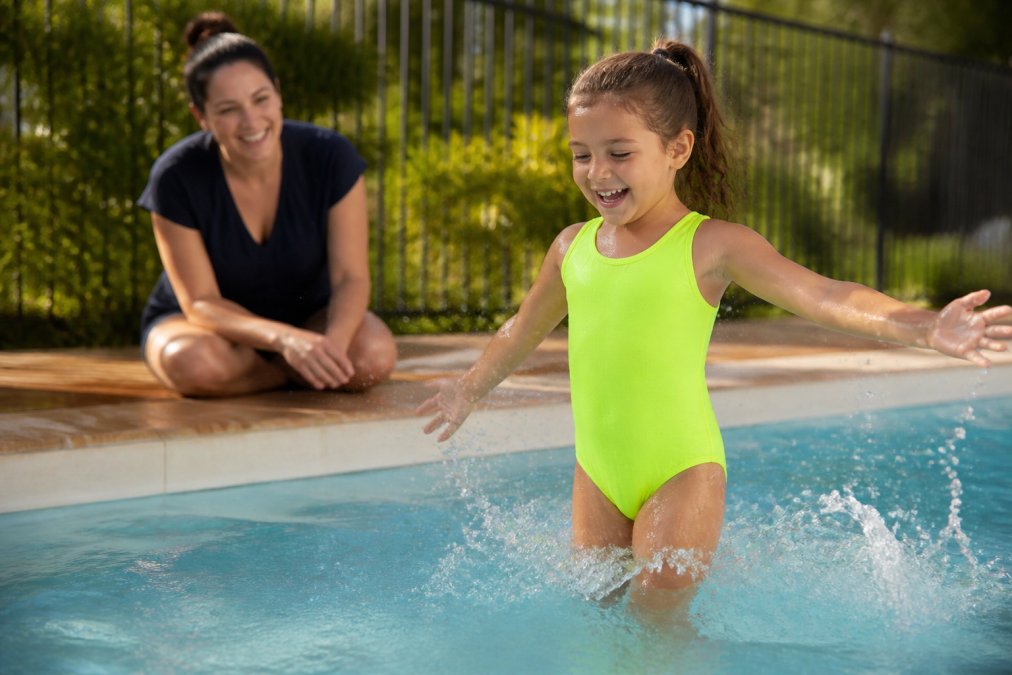
Two silhouettes do most of the work here, and both appear throughout the Bright & Bold collection.
One-Piece Swimsuits with Full Bottom Coverage
A one-piece with full bottom coverage eliminates the gap problem entirely: no waistband to shift, no top to ride up, no midriff exposed when a child stretches or dives. For kids who spend hours in the water, it's the lowest-maintenance option available.
The detail that separates good one-pieces from frustrating ones is the closure. Front zippers let you get a wiggly toddler dressed in seconds, even with wet fabric; back zippers work well for older kids who dress themselves. Bright & Bold's one-piece lineup runs $45.99 to $49.99 depending on style, with sizes from 2T through 6/7 and, on the Magical Friends print, 12/18 months through 12/14.
Rash Guard Sets with Full-Coverage Bottoms
A rash guard set pairs a long or short sleeve top with full-coverage bottoms. It's the better choice when you want two-piece convenience without sacrificing coverage, or when your child prefers bathroom breaks without wrestling out of a full suit.
The distinction that matters: a full-length rash guard top covers from collar to waist with no exposed midriff, while a crop top leaves a gap above the bottoms. If your goal is uninterrupted coverage, pick the full-length top. Bright & Bold's rash guard sets are priced at $45.99.
| Style | Coverage | Best For | Price |
|---|---|---|---|
| Long sleeve zip one-piece | Shoulder to wrist, full bottom | Beach and lake days, fair skin | $45.99 |
| Long sleeve rash guard set | Collar to waist, full bottom | All-day outdoor swim, easy bathroom breaks | $45.99 |
| Short sleeve zip one-piece | Shoulder and upper arm, full bottom | Swim lessons, pool parties | $45.99 |
| Sleeveless one-piece | Full bottom, unrestricted arms | Competitive lessons, indoor pools | $45.99 |
| Magical Friends one-piece | Full one-piece, flutter sleeves | Kids who want a favorite character print | $49.99 |
How to Choose a Full Bottom Coverage Swimsuit That Stays Put
Fit is the single biggest factor in whether a full bottom coverage swimsuit actually stays in place. A well-fitted suit moves with your child instead of against them and doesn't require mid-swim adjustments. Three things determine whether a suit stays put: accurate measurements, a shape that matches your child's build, and construction details that resist ride-up.

Measure at home before you order
- Chest: measure around the fullest part, keeping the tape level
- Waist: measure at the natural waistline, above the hip bone
- Hips: measure around the fullest part of the bottom
- Torso: measure from the shoulder, down through the crotch, and back up to the same shoulder
Then match to the brand's size chart rather than your child's age, kids the same age vary enormously in build, and age-based sizing is where most fit problems start. If measurements land in two different sizes, trust the torso and hip numbers over the chest; those determine whether a one-piece will pull or gap at the bottom.
Match the cut to your child's build
Generic size charts assume an average body, but real kids aren't average, the same suit can fit two children of identical height completely differently. Here's how common builds interact with full coverage cuts:
- Longer torso: A one-piece that fits everywhere else will pull down at the shoulders and ride up at the leg openings. Look for adjustable straps or a rash guard set, which lets the top and bottom size independently.
- Shorter torso: Fabric bunches at the waist and creates folds that trap water and shift during movement. A one-piece with a front zipper lets you adjust the neckline without pulling the bottom up.
- Rounder belly: A suit that's snug at the waist will roll down when your child bends or sits. A full-length rash guard top that extends past the waistband keeps the bottom anchored.
- Narrower hips: Full coverage bottoms can gap at the leg openings because there's less surface area for the fabric to grip. Fully lined bottoms with seamless leg openings hold better here than unlined styles.
- Broader shoulders: Straps dig in and the torso rides up. Adjustable straps or a zip-front one-piece distribute tension more evenly.
Parents often buy for the chest and shoulders, then wonder why the bottom won't stay put. The bottom is governed by torso and hip measurements, get those right first.
Troubleshoot the two most common fit problems
Riding up. This happens when the suit is too loose at the leg openings or too short in the torso, so movement pushes the fabric upward. The fix is usually a smaller size, more torso length, or a two-piece set that lets you size the bottom separately. If the suit fits everywhere except the leg openings, seamless construction at the leg can help, bulky seams catch on the skin and start the ride-up cycle.
Digging in. The opposite problem: the suit is too tight at the waist or leg openings, and the elastic leaves marks. Sizing up usually makes it worse, because a larger suit gaps elsewhere and shifts. The better fix is a different cut, a rash guard set with a full-length top, or a one-piece with a relaxed leg opening.
Construction details that predict whether a suit stays put
- Fully lined bottoms: lining adds structure and stops fabric from clinging and creeping
- Seamless construction at the leg openings: bulky seams catch and pull, which starts the ride-up cycle
- Adjustable straps on two-piece styles, so you can fine-tune the fit as your child grows
- Flatlock or bonded seams on rash guard tops, which lie flat against the skin and reduce drag
If your child is between sizes, size down rather than up, swim fabric relaxes slightly in water, so a suit that fits snugly on dry land fits correctly once wet.
Caring for Your Full Coverage Swimsuit: Durability Tips
Chlorine and sunlight destroy swimwear fastest, and both are unavoidable at the pool. What you do after the swim, and what the suit is made of, determines whether it lasts one season or three.
What the fabric is actually doing
Most performance swimwear blends polyester and spandex (often branded Lycra or elastane). Polyester provides chlorine resistance and colorfastness; spandex provides stretch and shape recovery. Chlorine attacks the spandex first, which is why a suit that still looks fine can suddenly feel loose and baggy, the color holds, but the stretch doesn't.
That's the mechanism behind the classic complaint: "It fit great in June and by August it was falling off." The fabric didn't shrink, the elastic fibers degraded. Rinsing immediately after every swim slows that more than any other habit.
Chlorine resistance: what to look for and what to avoid
Not all swim fabrics resist chlorine equally. Higher polyester content (typically 70% or more) resists chlorine breakdown better than nylon-dominant blends. If your child swims more than twice a week, a polyester-rich suit will outlast a nylon one by a wide margin.
A few habits that extend the life of high-visibility color specifically:
- Wash within an hour of swimming when possible
- Keep the suit out of direct sun when drying, since UV fades neon faster than anything else
- Rotate between two suits if your child swims daily, giving each fabric time to recover its shape
- Check zippers for grit and rinse them out, since sand is the most common cause of zipper failure
UPF protection: does it wash out?
Does UPF-rated fabric lose protection over time? The rating is built into the fabric structure, not applied as a coating, so it doesn't wash off like sunscreen. What degrades is the fabric itself, once a suit becomes stretched thin, pilled, or see-through when held to light, its UV protection has dropped, even if the label still says UPF 30+.
That's why the care routine matters for sun protection, not just appearance: a suit that's rinsed and air-dried keeps its density and UPF rating longer, while one that's been through the dryer repeatedly will thin out and lose both.
The care routine that actually works
Rinse the suit in cool fresh water immediately after every swim. Chlorine continues breaking down elastic and color even after the suit is off, so a quick rinse before the suit dries makes a real difference. Skip the washing machine for regular maintenance; the agitation is hard on stretch fabric and zippers.
For deeper cleaning, hand wash with a little mild detergent and lay flat to dry in the shade. Never wring, never tumble dry, and never leave a wet suit balled up in a swim bag.
The Pool & Hot Tub Alliance guidance on pool chemicals notes that chlorine levels in properly maintained pools are designed to sanitize, not to preserve fabric. That's the whole reason post-swim rinsing matters so much.
When to replace a suit
Even with perfect care, swimwear has a lifespan. Replace a suit when:
- The fabric feels thin or looks see-through when held up to light
- The suit no longer springs back after stretching
- Elastic at the waist or leg openings has lost its snap
- Zippers stick or skip teeth
With proper care, swimwear has a lifespan. Rotating two suits extends the lifespan of both.
Conclusion: Confidence and Safety in Every Splash
Keeping eyes on a fast-moving child in a crowded pool is genuinely hard, and the gear you choose either helps or gets in the way. A full bottom coverage swimsuit that stays put, holds its color, and stands out against the water removes one more distraction from your day.
Bright & Bold Swimwear was created by a family to protect yours, and the collection reflects that: high-visibility neon colors chosen for contrast, UPF 30+ protection on select items, front and back zippers for fast changes, and fully lined full-coverage bottoms across the lineup. Sizes run from 12/18 months through 12/14, with boys swimsuits and girls swimsuits to match.
Get started with Bright & Bold Swimwear and give your little swimmer a suit that's as easy to spot as it is to love.
Frequently Asked Questions
What are the best full coverage bathing suit bottoms?
The best full coverage bathing suit bottoms are those that stay put and cover the entire bottom area. Look for high-rise or classic cuts with a secure fit, like the full-coverage bottoms in Bright & Bold Swimwear's rash guard sets. These bottoms are designed to prevent riding up during active water play, so kids can swim and splash without constant adjustments.
What are full coverage swimsuits called?
Full coverage swimsuits are often called modest swimwear, high-coverage swimsuits, or full-bottom swimsuits. For children, they may be labeled as full-coverage one-pieces or rash guard sets with full-coverage bottoms. The key is that they provide more skin coverage than standard bikinis or brief-style bottoms, which helps with sun protection and comfort.
How do I choose a swimsuit that provides full coverage?
Choose a swimsuit with a high-rise or classic cut that fully covers the bottom. Check for adjustable straps and a stay-put design to prevent riding up. For sun protection, look for UPF 30+ fabric on select items. Bright & Bold Swimwear offers one-piece and two-piece options with full-coverage bottoms, so you can find a style that fits your child's body type and activity level.
Do high-visibility swimsuits for children really help with supervision?
Yes. High-visibility swimsuits for children use neon colors that stand out against pool, lake, or ocean water. This makes it easier for parents and lifeguards to spot a child quickly in a crowded area. Bright & Bold Swimwear designs every suit with this in mind, combining full bottom coverage with bright, contrasting colors to support active supervision.