

How to Keep Toddlers Visible in Public Pools
Table of Contents
- Why Visibility Matters: Understanding the Drowning Prevention Challenge
- Active Supervision at Public Pools: The Foundation of Water Safety
- High-Visibility Swimwear for Kids: Color Psychology and Practical Design
- Physical Barriers and Pool Perimeter Safety
- Toddler Water Safety Tips: Teaching Skills and Building Confidence
- Recognizing Drowning Signs and Emergency Response
- Creating Your Public Pool Safety Plan
- Conclusion
Last Updated: August 26, 2026
Why Visibility Matters: Understanding the Drowning Prevention Challenge
Drowning happens silently and quickly, often in seconds with little warning. A child can slip underwater while parents are distracted, and by the time anyone notices, it's too late. This is why visibility in public pools matters so much. When your toddler wears high-visibility swimwear, you and lifeguards can spot them instantly, even in crowded pools.
Standard swimsuits blend into the water. Blues, purples, and dark colors disappear against the pool backdrop. Bright neon colors, yellows, oranges, and greens, cut through that visual clutter. Research from the American Red Cross water safety guidelines emphasizes that supervision depends on being able to see your child at all times. High-visibility swimwear removes one major obstacle: you can actually find them quickly.
At Bright & Bold Swimwear, we've designed our collection around this single principle: you can't protect what you can't see. Every color choice is intentional. This guide walks you through the practical strategies that matter most when keeping toddlers safe at public pools.
Active Supervision at Public Pools: The Foundation of Water Safety
Active supervision means constant, focused attention on your child, not distracted glances between phone checks or conversations with other adults. At public pools, this becomes harder because there are more distractions, more people, and more visual clutter.
Arm's-reach supervision is the gold standard, staying close enough to touch your toddler at any moment. At public pools, maintain direct, uninterrupted visual contact. Your eyes should track your child's movement constantly.
Common mistakes parents make include assuming lifeguards are watching your child specifically (they're scanning the entire pool), taking breaks to check your phone, relying on other adults to watch, and positioning yourself where glare makes seeing your child difficult.
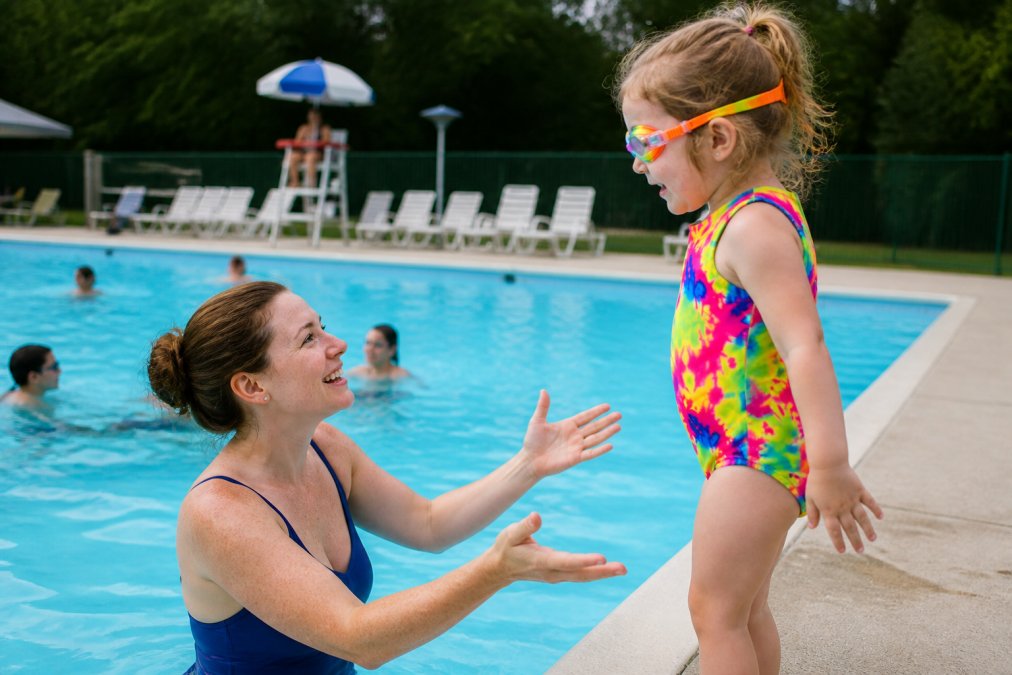
According to the CDC's water safety fact sheet, unintentional drowning is the leading cause of unintentional injury death for children ages 1-4. Most drowning incidents happen in public pools during summer months. The common factor in preventable drowning cases isn't lack of supervision, it's distracted supervision.
Designate yourself as the designated water watcher for your child's entire pool session. This means no phone use while your child is in the water, no extended conversations with other adults, positioning yourself where you have clear sightlines, staying alert for signs of struggle, and keeping your child in high-visibility swimwear so you can track them instantly.
High-Visibility Swimwear for Kids: Color Psychology and Practical Design
High-visibility swimwear works because of color contrast and human visual perception. Your brain processes bright colors faster than dark colors. Neon yellows, oranges, and greens stand out against blue water because they occupy opposite positions on the color spectrum.
When you're scanning a pool, your eyes naturally catch bright, contrasting colors first. A child in a standard blue or purple swimsuit blends into the water. A child in neon yellow or bright orange pops out immediately. This matters most in crowded public pools where visual clutter is highest.
Why Neon Colors Work
Neon colors are effective because they have high luminance and saturation. They reflect light differently than standard dyes. Under underwater lighting and natural sunlight, neon fabrics create strong contrast against water.
The most effective colors for pool visibility are neon yellow (highest contrast against blue water), bright orange (strong visibility in most lighting conditions), lime green (excellent contrast, visible even in partial shade), and hot pink (stands out well, though slightly less visible than yellow or orange in deep water). Standard swimsuit colors like navy, purple, turquoise, and black blend into the water or create minimal contrast.
Beyond Color: Coverage and Fit
Color alone isn't enough. Rash guards with long or short sleeves provide more surface area for visibility than one-piece suits. Two-piece swim sets maximize the visible area of bright fabric in the water.
Coverage also provides UV protection. Many high-visibility swimwear options include UPF 30+ sun protection, crucial for toddlers spending extended time at public pools. Bright & Bold Swimwear's collection features both one-piece options and rash guard sets with UPF 30+ protection built in.
Fit matters for comfort and safety. A swimsuit that's too loose can shift in the water, reducing visibility. A suit that's too tight restricts movement. Proper fit ensures your child stays comfortable enough to focus on learning water skills.
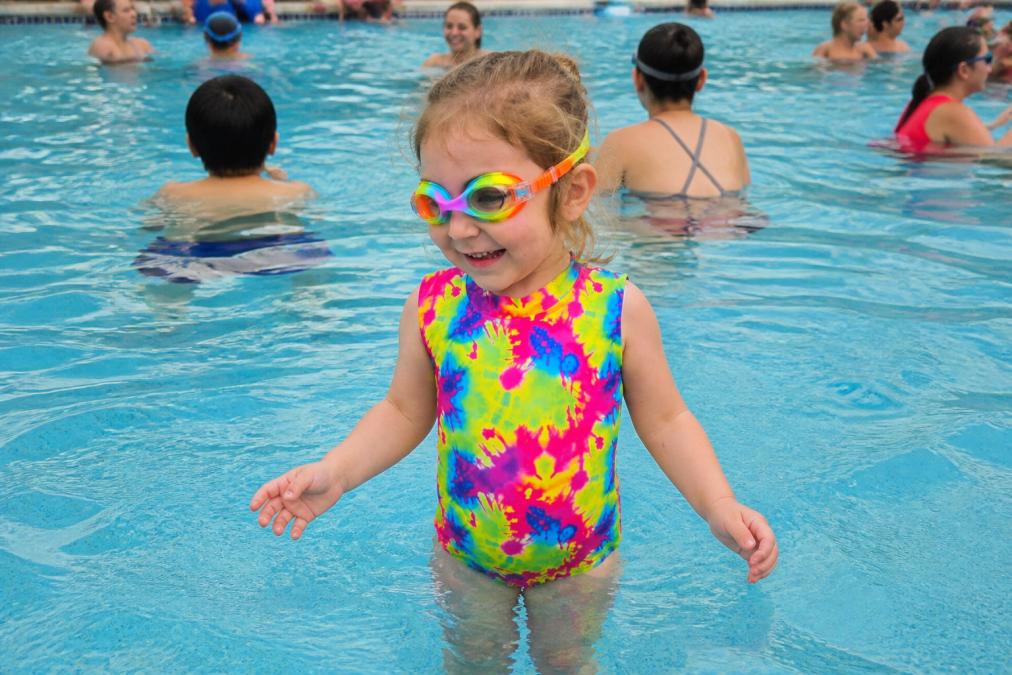
The Girls Long Sleeve Crop Top Rash Guard Set and Boys Short Sleeve Rash Guard Swim Set from Bright & Bold Swimwear are designed with this balance in mind, bright enough to spot instantly, comfortable enough for active play, and protective enough for all-day pool time.


Physical Barriers and Pool Perimeter Safety
Physical barriers prevent unauthorized access to pools and reduce the risk of accidental drowning. At public pools, barriers are typically managed by the facility. Understanding how they work helps you assess whether a pool meets basic safety standards.
Proper pool fencing should include four-sided isolation fencing, self-closing and self-latching gates that lock automatically, gates that open away from the pool, fencing at least 4 feet high, and minimal gaps between fence sections (no more than 4 inches).
Before you bring your toddler to a new public pool, walk the perimeter and assess the barriers. Are gates locked? Are there gaps in the fencing? Are there unsupervised access points?
For public pools specifically, you can't control the barriers, but you can control your supervision and your child's visibility. This is why high-visibility swimwear becomes even more important at public facilities, the physical barriers may be inadequate, so visibility and active supervision are your primary defenses.
Toddler Water Safety Tips: Teaching Skills and Building Confidence
Water safety skills reduce drowning risk significantly. Teaching your toddler to be comfortable in water and to understand basic safety rules creates layers of protection.
Effective water safety skills for toddlers include floating on their back (a critical survival skill), understanding that they should not go near water without an adult, recognizing the difference between supervised and unsupervised water, building comfort with water entry and submersion, and learning to call for help if they're struggling.
Swim lessons are valuable, but they're not a substitute for supervision. A child who's taken swim lessons still needs constant active supervision at public pools. Lessons build skills and confidence, but they don't make a toddler "drown-proof."
When choosing a swim school or program, look for instructors who emphasize water safety alongside swimming technique. Research from the American Academy of Pediatrics guidance on swim instruction indicates that early exposure to water in a structured setting reduces fear and builds foundational skills.
Combine lessons with consistent practice at public pools. When you're at the pool with your child, spend time in the water with them. Show them how to float, how to move safely, and how to respond to your instructions. The goal is building confidence and comfort, not perfecting technique.
:::tip After swim lessons, practice the skills you learned in a familiar public pool setting. Regular practice reinforces what they've learned.
Recognizing Drowning Signs and Emergency Response
Drowning doesn't look like what most people expect. It's not dramatic splashing or calling for help. In most cases, a drowning child is silent because they're focused on trying to breathe.
Signs of drowning include head tilted back with mouth at or just above water level, eyes glassy or unfocused, vertical position in water, little to no movement of limbs, rapid or gasping breathing, and inability to respond to verbal cues.
If you suspect your child is drowning: remove them from the water immediately, check for responsiveness and breathing, call 911, begin CPR if trained and if the child is unresponsive and not breathing normally, and continue CPR until emergency responders arrive.
CPR certification is valuable for any adult supervising children around water. Many communities offer CPR courses specifically for parents. Knowing CPR gives you the ability to respond effectively in an emergency.
Prevention is always better than emergency response. Active supervision, high-visibility swimwear, water safety skills, and physical barriers all reduce the likelihood that you'll ever need to use emergency response skills.
Creating Your Public Pool Safety Plan
A safety plan is a written or mental checklist you work through before each pool visit. It ensures you're not relying on memory or assumptions about safety.
Your public pool safety plan should include designated water watcher (who is watching, for how long, when do they rotate), visibility check (is your child wearing high-visibility swimwear, can you see them clearly), supervision position (where will you stand to maintain visual contact), exit strategy (where are the exits, how will you respond if your child needs to leave quickly), emergency contact (do you know where the nearest lifeguard station is), skill level (what water safety skills does your child have), and time limit (how long will you stay).
Before your next public pool visit, write out this plan and share it with any other adults who will be supervising your child. This takes five minutes and creates a framework that keeps safety top-of-mind.
Bright & Bold Swimwear's collection is designed to make the visibility portion of your safety plan automatic. When your child is wearing high-visibility neon swimwear, you don't have to think about whether you can see them, you can.
Water safety is built on layers. No single strategy prevents drowning completely. Active supervision is the foundation. High-visibility swimwear makes supervision easier and more effective. Water safety skills give your child tools to respond if something goes wrong. Physical barriers provide additional protection. Emergency response training ensures you can help if needed.
When you combine these strategies, you create a comprehensive approach to keeping your toddler safe at public pools. Start with high-visibility swimwear that makes your child instantly recognizable in the water. Pair that with focused, distraction-free supervision and consistent water safety practice. Your child's safety depends on your visibility and attention, and high-visibility swimwear makes both significantly easier.
Bright & Bold Swimwear's high-visibility collection is built for exactly this purpose. Every suit is designed with vibrant neon colors, comfortable fit, and UPF protection. Your child stays visible, protected, and comfortable, so you can focus on what matters most: keeping them safe. Shop our best sellers and find the perfect high-visibility suit for your toddler's next pool adventure.
| Safety Strategy | Primary Benefit | Implementation |
|---|---|---|
| Active supervision | Immediate detection of problems | Constant visual contact, no distractions |
| High-visibility swimwear | Faster spotting in crowds | Neon colors that contrast with water |
| Water safety skills | Child's ability to respond | Swim lessons plus regular practice |
| Physical barriers | Unauthorized access prevention | Proper fencing and locked gates |
| CPR knowledge | Emergency response capability | Certification course training |
Frequently Asked Questions
Q: What is the arm's-reach supervision rule for toddlers in water?
A: Arm's-reach supervision means staying close enough to touch your child at all times, typically within an arm's length. This rule applies to children under 5 and is the most effective way to prevent drowning. At public pools, position yourself between your toddler and deeper water, and keep your hands free to respond quickly if needed. Never rely solely on flotation devices or lifeguards; your direct physical proximity is the primary safety layer.
Q: How does high-visibility swimwear help prevent drowning?
A: High-visibility swimwear uses neon and bright colors that contrast sharply against blue and green water, making it easier for you and lifeguards to track your child's location instantly. When combined with active supervision, high-visibility gear reinforces your ability to keep your toddler in your line of sight at all times.
Q: What should I look for in a safe public pool for my toddler?
A: Check for certified lifeguards on duty, clear water visibility, self-closing and self-locking gates around the pool perimeter, and shallow areas with gradual depth transitions. Ask about their drowning prevention policies and supervision ratios. Visit during less crowded times when staff can monitor swimmers more effectively, and always verify that your toddler's swim skills match the pool's depth zones.
Q: How can I teach my toddler water safety at a young age?
A: Start with water confidence building in shallow areas, teaching your child to float and move toward the edge. Enroll in swim lessons designed for toddlers aged 2-7, focusing on breath control and basic water awareness rather than advanced strokes. Practice the 'touch supervision' rule consistently, always staying within arm's reach. Use positive language about water safety, avoid fear-based messaging, and model safe behaviors yourself. Regular, supervised water exposure builds comfort and reduces panic if accidental submersion occurs.
This article was written using GrandRanker