

High Visibility Swimsuits for Toddlers: A Safety Guide
Table of Contents
- Why High Visibility Swimsuits for Toddlers Matter
- Best Colors for Bright Colored Toddler Swimsuits
- UPF 50+ Toddler Swimwear and Sun Protection
- Toddler Swim Safety: Styles and Features That Work
- Best Toddler Swim Brands: What Sets Quality Apart
- Care and Maintenance for Long-Lasting Visibility
- High Visibility Swimsuits Across Different Water Environments
- Conclusion
High Visibility Swimsuits for Toddlers: A Safety Guide
Last Updated: July 18, 2026
When a toddler enters the water, seconds matter. According to the Centers for Disease Control and Prevention water safety data, drowning is the leading cause of unintentional injury death for children ages 1-4. High visibility swimsuits for toddlers are more than colorful clothing, they're a critical safety tool that helps parents, lifeguards, and caregivers spot children instantly in aquatic environments. This guide covers what makes high visibility swimsuits effective, which colors work best, and how to choose the right suit for your family's needs.
Why High Visibility Swimsuits for Toddlers Matter
A child wearing a bright, contrasting swimsuit stands out against the water's surface, making them easier to spot from poolside, across a beach, or in a lake. This visibility gap, the difference between a child in a standard navy suit versus one in neon, can mean the difference between a caregiver noticing a problem in seconds or missing it entirely.
Water Safety and Drowning Prevention
Drowning happens silently and quickly. Unlike dramatic movie portrayals, a child in distress often doesn't call out or splash loudly. Research from aquatic safety organizations and lifeguard training standards emphasizes that active supervision combined with environmental safeguards, like high-visibility clothing, creates multiple layers of protection. High visibility swimsuits serve as a visual anchor, helping supervising adults maintain constant awareness of their child's location.
The color contrast is the key mechanism. When a toddler wears neon yellow, orange, or hot pink against blue water, their location becomes immediately apparent. A caregiver scanning the water can account for their child within a fraction of a second, critical when the window for intervention in a water emergency is extremely narrow.
Active Supervision and Spotting Children
Active supervision means knowing exactly where your child is in the water at every moment. High-visibility swimsuits make this easier by creating an instant visual reference point. Instead of scanning through multiple children trying to identify yours by face, you can instantly locate the bright yellow or neon pink suit.
When multiple children are swimming together, at group lessons, family gatherings, or public pools, the ability to quickly spot your child reduces anxiety and increases safety. A child in a standard-colored suit can blend into the water or become visually confused with other swimmers. A child in a high-visibility suit remains distinct.
Best Colors for Bright Colored Toddler Swimsuits
Not all bright colors perform equally in water. The most effective colors have been tested across different water environments and consistently outperform others.
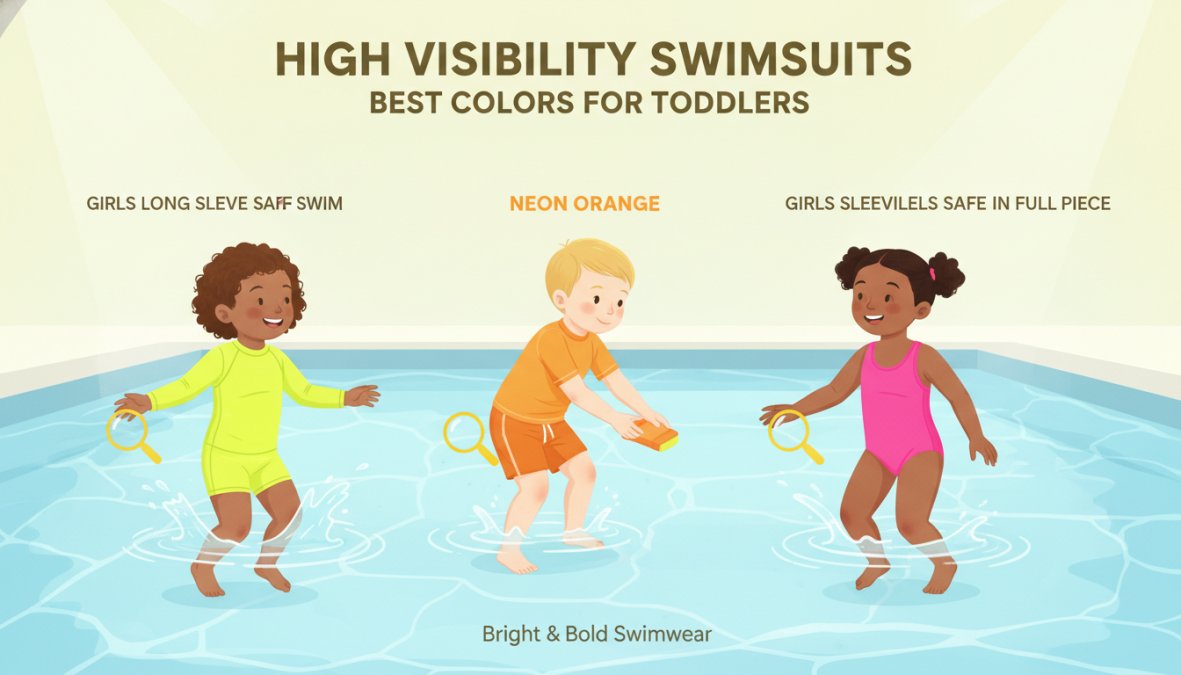
Neon Yellow, Orange, Green, and Pink
Neon yellow is the gold standard for water visibility, providing maximum contrast against both blue and green water environments. Lifeguards and aquatic safety professionals consistently identify neon yellow as the most visible option in nearly all conditions.
Neon orange ranks close behind yellow, offering excellent visibility with a slightly warmer tone. Neon green works exceptionally well in lakes and natural water environments where it contrasts sharply against green-tinted water. Hot pink has gained popularity because children are more willing to wear suits they find visually appealing, increasing the likelihood of consistent use.
The key principle is contrast. These colors stand out because they're rarely found naturally in water environments, making them immediately recognizable as distinct objects.
Colors to Avoid in Water Environments
Blues, teals, and greens blend into water. A toddler in a blue or teal swimsuit becomes visually merged with the water itself. Navy is particularly problematic because it can be nearly invisible against deeper water.
Pastels, light pink, pale yellow, and mint green lack sufficient contrast. White and cream can work in some conditions but are inconsistent, bright sunlight reflecting off water can wash them out, while overcast conditions make them less distinctive. For reliability across different times of day and weather, neon colors outperform light neutrals.
UPF 50+ Toddler Swimwear and Sun Protection
High visibility is only one layer of protection. Sun protection through UPF (Ultraviolet Protection Factor) is equally important for toddlers, whose skin is particularly vulnerable to UV damage.
Understanding UVA/UVB Ray Protection
UPF 50+ fabric blocks 98% of UVA and UVB rays. Toddlers spend time in intense sun at the beach or pool, often during peak UV hours. A single severe sunburn in childhood increases skin cancer risk later in life. Fabrics with UPF 50+ protection provide a physical barrier that prevents most UV rays from reaching the skin.
Many high-visibility swimsuits for toddlers now come with integrated UPF protection, combining visibility with sun safety. This dual function addresses two critical safety concerns simultaneously without sacrificing comfort or practicality.
Full-Body Coverage and Comfort Balance
Full-body coverage, rash guards, long-sleeve suits, or sunsuits provide maximum sun protection. However, some toddlers resist wearing full-coverage options in warm weather, finding them restrictive.
The solution is finding the right balance for your child. Some families use full-coverage rash guards for beach days but lighter options for pool time. The best approach is trying different styles to see what your child will actually wear consistently. Exploring options like Girls swimsuits and [Boys swimsuits](https://brightboldswim.com/collections/boys-swimsuits) can help you find styles that combine visibility, sun protection, and comfort for your toddler.
Toddler Swim Safety: Styles and Features That Work
Different swimwear styles serve different purposes. Understanding the options helps you choose what fits your family's water activities.
Rash Guards, One-Pieces, and Sunsuits
Rash guards are short-sleeve or long-sleeve shirts worn over swim trunks or a one-piece. They're lightweight, quick-drying, and popular with active toddlers. Many include neon colors and UPF 50+ protection.
One-piece swimsuits provide full-body coverage in a single garment. For toddlers, one-pieces are practical because there's no separation between top and bottom, eliminating gaps where sun exposure occurs.
Sunsuits are full-coverage options designed specifically for sun protection, typically extending from shoulders to knees. The choice depends on your child's comfort level and your family's primary water environment.
Practical Features: Zippers, Flatlock Seams, and Tagless Design
Quality high-visibility swimwear includes several practical features that improve usability and comfort.
Zippers make dressing and undressing faster, a significant advantage with impatient toddlers. Flatlock seams sit flat against the skin rather than creating ridges that irritate sensitive skin. Tagless design eliminates the label at the back of the neck, preventing constant complaints about discomfort.
These features aren't luxuries; they're practical improvements that make your child more comfortable and more likely to wear the suit without complaint.
Best Toddler Swim Brands: What Sets Quality Apart
When evaluating high-visibility swimsuits for toddlers, several factors distinguish quality options from basic alternatives.
Chlorine-Resistant and Quick-Drying Fabrics
Chlorine-resistant fabrics maintain their color and elasticity through repeated pool exposure. Standard swimsuit fabrics fade quickly in chlorinated water, losing their visibility advantage. Chlorine-resistant materials are engineered to withstand chemical exposure without degradation.
Quick-drying fabrics are practical for families with multiple water outings. Microfiber and other advanced synthetic materials dry faster than traditional fabrics, reducing the time your child spends in a wet suit.
Bright & Bold Swimwear prioritizes both chlorine resistance and quick-dry performance, ensuring that high visibility remains effective through an entire season of regular use. A faded suit provides no visibility advantage, making fabric quality a core component of safety.
Durability and Stretch for Active Toddlers
Toddlers are rough on clothing. Swimwear needs to withstand climbing, running, and constant movement without losing shape or developing tears. High-quality fabrics include stretch components that allow movement while maintaining structural integrity.
Look for suits with reinforced seams in high-stress areas: armholes, leg openings, and the crotch area. Durability extends the usable life of the suit, providing better value when investing in quality high-visibility options.
Care and Maintenance for Long-Lasting Visibility
Your investment in high-visibility swimwear only pays off if the suit maintains its color and protective qualities.
Rinse immediately after swimming in fresh water to remove chlorine and salt. Wash in cold water with mild detergent, hot water breaks down elastic fibers. Avoid bleach, which damages both fabric and bright dyes. Air dry completely in a shaded area before storing in a cool, dry place away from heat sources.
| Care Step | Timing | Impact |
|---|---|---|
| Rinse in fresh water | Immediately after swimming | Removes chlorine/salt, prevents fading |
| Wash in cold water | Within 24 hours | Preserves elastic and dye integrity |
| Air dry completely | Before storing | Prevents mildew and odor |
| Store in cool, dry place | Off-season | Maintains color and elasticity |
High Visibility Swimsuits Across Different Water Environments
Visibility effectiveness varies depending on water type and lighting conditions.
Pools, Lakes, and Oceans: Where Contrast Matters Most
In chlorinated pools, neon yellow and orange perform exceptionally well against blue water. Lakes with green-tinted water benefit from neon green, which contrasts against the water's natural color. Ocean water varies by location; neon colors all perform well in clear tropical waters, while yellow and orange maintain an advantage in murkier coastal waters.
If your family uses multiple water environments, neon yellow provides the most consistent visibility across all conditions. If you primarily use one environment, you can optimize for that specific setting.
Water safety starts with visibility. High visibility swimsuits for toddlers create an immediate visual advantage that helps you keep constant track of your child in aquatic environments. Bright & Bold Swimwear combines neon visibility with UPF 50+ sun protection, chlorine-resistant fabrics, and practical features like flatlock seams and quick-dry materials. When you choose a high-visibility suit designed specifically for toddler safety, you're investing in a tool that works every single time your child enters the water.
Frequently Asked Questions
What makes a swimsuit truly high visibility for water safety?
High visibility swimsuits combine bright neon colors, yellow, orange, green, or pink, with design elements that create maximum contrast against water environments. These colors make it easier for parents and lifeguards to spot children quickly. Beyond color, quality high visibility swimsuits include UPF 50+ sun protection, secure fits with features like flatlock seams and zippers, and durable fabrics that maintain their brightness through multiple seasons of use and washing.
Do high visibility swimsuits actually reduce drowning risk?
While high visibility swimsuits are not a substitute for active supervision and swim lessons, they are an important layer of water safety. Neon colors and bright designs significantly improve spotting children in pools, lakes, and oceans, especially in busy environments or when children are partially submerged. Combined with constant adult supervision and proper swim training, high visibility swimwear helps reduce response time in emergencies and supports drowning prevention efforts.
How do I choose between rash guards, one-pieces, and sunsuits for my toddler?
Rash guards offer upper-body protection and pair with swim trunks for flexibility. One-piece swimsuits provide full-body coverage in a single garment, making them convenient for quick changes. Sunsuits combine high-visibility colors with extended coverage and are specifically designed for all-day water activities. Choose based on your toddler's comfort preference, your climate, and how much time they spend in water. Quality UPF 50+ toddler swimwear in any style will protect against UVA/UVB rays while maintaining visibility.
Will bright swimsuit colors fade after washing, and how do I keep them vibrant?
High-quality bright colored toddler swimsuits from reputable brands are designed to resist fading through proper care. Rinse with fresh water immediately after pool or ocean use to remove chlorine and salt, which accelerate fading. Wash in cool water with mild detergent, avoid bleach, and air-dry away from direct sunlight. Choosing chlorine-resistant fabrics from established toddler swim brands helps preserve the neon yellow, orange, green, and pink colors that make high visibility swimwear effective season after season.
This article was written using GrandRanker