

How Long Should Toddler Swim Lessons Last
Table of Contents
- The Ideal Length for Toddler Swim Lessons
- 15-Minute Swim Lessons for Toddlers: Are They Enough?
- How Often Should Toddlers Take Swim Lessons
- How Long Does It Take a Toddler to Learn to Swim
- Toddler Swim Lesson Safety and Supervision
- Making the Most of Every Lesson
- Conclusion
- Frequently Asked Questions
Last Updated: October 15, 2026
The Ideal Length for Toddler Swim Lessons
When planning your child's first swim lessons, a practical question comes up fast: how long should toddler swim lessons last? Young swimmers have short attention spans, tire quickly in the water, and learn best in focused, energetic bursts.
Most swim schools offer lessons ranging from 15 to 45 minutes. For toddlers aged 2 to 5, the sweet spot falls between 20 and 30 minutes. This window gives instructors enough time to build water comfort and practice basic skills without overwhelming your child or losing their focus.
Why Shorter Sessions Work Better for Young Learners
Toddlers aren't small adults. Their bodies fatigue faster in water, and a toddler's attention span typically peaks at around 15 to 20 minutes for a single focused activity. Beyond that, engagement drops sharply.
Water is exhausting for young children. Even floating and kicking demand energy their bodies haven't fully developed yet. A 15-minute lesson lets your toddler work hard, learn something real, and exit feeling successful rather than drained, and kids who leave energized want to come back.
Short, consistent sessions also reduce anxiety. A nervous toddler who knows the lesson ends in 20 minutes feels safer than one facing an open-ended 45-minute session.
Adjusting Duration by Age
Within the toddler years, age makes a real difference in what works.
Ages 2 to 3: Fifteen-minute lessons work best. Your child is still building basic water comfort, so the goal isn't swimming but getting used to being in water without fear.
Ages 3 to 4: Twenty to 25 minutes becomes appropriate.
Ages 4 to 5: Thirty-minute lessons fit well. Older toddlers have better body control and longer attention spans.
These aren't hard rules. Some children thrive with longer sessions earlier; others need more time to build confidence. A good instructor watches your child's energy and adjusts.
15-Minute Swim Lessons for Toddlers: Are They Enough?
Fifteen-minute lessons often feel too short to parents. The reality is more nuanced.
A focused 15-minute lesson with a qualified instructor delivers more value than a distracted 30-minute session. In 15 minutes, an experienced teacher can introduce one skill, practice it multiple times, and end on a positive note.
That said, 15 minutes works best for the youngest toddlers (2 to 3 years old) or for children just starting swim lessons.
The real question isn't whether 15 minutes is enough, it's whether it matches your child's current stage. As skills build, duration can grow naturally.
How Often Should Toddlers Take Swim Lessons
Frequency and duration work together. Toddlers learn through repetition spaced close enough together that the last lesson is still fresh.
Most swim schools recommend once-weekly lessons for toddlers learning basic skills, which fits most families well. Some choose twice-weekly lessons during a focused stretch to accelerate progress.
A useful way to think about it is total minutes in the water per month, not minutes per lesson. Four 20-minute lessons a month gives 80 minutes of guided practice; two 45-minute lessons gives 90 minutes but in long blocks that may exceed your child's attention span.
Matching Frequency to Your Child's Stage
Ages 2 to 3: Once weekly is usually plenty. The goal is comfort and routine, not skill acquisition speed, and a second weekly lesson rarely helps a child still adjusting to water without a parent.
Ages 3 to 4: Once weekly remains the standard, but a short second session can help if your child is eager and the instructor agrees. Watch for over-scheduling signs like resistance before lessons or fatigue that carries into the next day.
Ages 4 to 5: Once or twice weekly works well. Older toddlers can handle more repetition and often benefit from the momentum of two sessions close together.
Consistency Between Lessons
What happens between lessons matters as much as the lessons themselves. Even 5 to 10 minutes of water play at home, bathtub, splash pad, or backyard kiddie pool, reinforces what the instructor introduced. You're not teaching new skills; you're giving your child more chances to feel comfortable and repeat a motion.
Keep the tone playful. A toddler who thinks they are splashing with a parent will practice blowing bubbles, kicking, and floating without realizing it. Formal at-home instruction often backfires because it adds pressure to something that should feel like play.
How Long Does It Take a Toddler to Learn to Swim
This is a different question from how long a single lesson should last. Lesson length is measured in minutes; learning to swim is measured in months of consistent practice. Confusing the two leads to unrealistic expectations.
There is no fixed number of lessons after which a toddler suddenly "knows how to swim." Pediatric and water-safety guidance consistently emphasizes that swimming competence is a gradual process built on comfort, repetition, and supervision. Most practitioners find toddlers need roughly 20 to 30 lessons to develop basic water comfort and foundational skills such as floating, kicking, and safe water entry. Some progress faster; others take longer.
What Progress Actually Looks Like
Instead of counting lessons toward a finish line, watch for these stages:
- Early lessons: Your child enters the water without clinging, accepts support from the instructor, and tolerates water on the face.
- Building comfort: Your child floats briefly with support, kicks purposefully, and follows simple cues like "blow bubbles."
- Foundational skills: Your child floats with less support, moves toward a wall or instructor, and recovers to a standing position in shallow water.
- Emerging independence: Your child travels short distances with supervision and can follow safety routines like waiting for an adult before entering.
Each stage can take weeks or months. A toddler who spends two months on the first stage is not behind; they're building the comfort that makes later skills possible.
Factors That Affect Learning Speed
Starting age: Toddlers who begin lessons around 2.5 to 3 years old often progress steadily because they can follow simple instructions.
Prior water exposure: Kids who have spent time in baths, splash pads, or backyard pools often start lessons with more comfort.
Practice between lessons: Toddlers whose families reinforce skills at home tend to advance faster. Even short, playful water time helps.
Lesson quality: A skilled instructor who understands early childhood development will help your child progress. Look for instructors trained in infant and toddler water safety and CPR.
Individual temperament: Some children are naturally water-confident; others need more time to trust the water. Neither pace is wrong.
A Note on Evidence and Expectations
Formal recommendations from pediatric and water-safety organizations focus on supervision, readiness, and skill-building rather than a specific lesson count. Treat any single number as a rough guide, not a guarantee, and ask your instructor what progress looks like for your child specifically.
Toddler Swim Lesson Safety and Supervision
The safest swim lesson is one where an attentive adult watches the entire time.
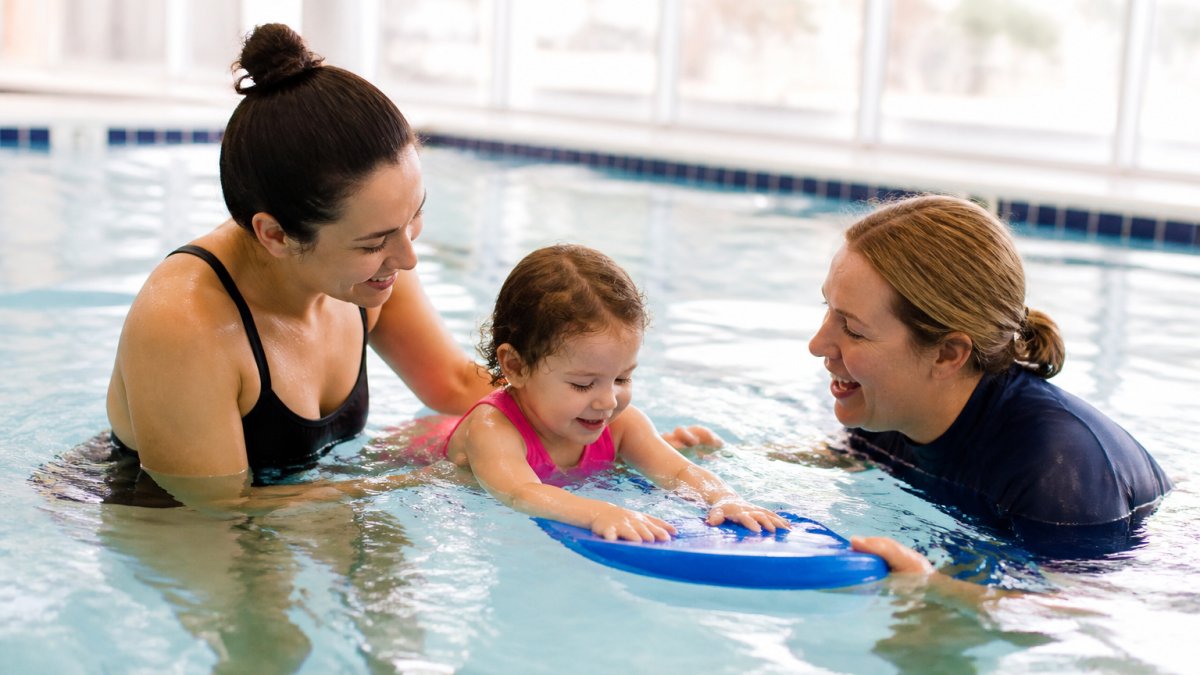
Your presence serves multiple purposes: you're there if your child becomes distressed, you can reinforce what the instructor teaches, and you model that water is safe and fun.
Choose an instructor certified in CPR and trained in infant and toddler water safety, and ask about their credentials.
Watch the class-to-instructor ratio. For toddlers, a 4:1 ratio (four children per instructor) is reasonable. Smaller groups mean more individual attention and faster progress.
Recognizing When Your Child Needs a Break
Not every lesson should run the full scheduled time. Watch for signs that your toddler is done:
- Shivering or goosebumps (cold, not just from water)
- Clinging to you or the instructor
- Loss of interest in activities
- Difficulty following directions
- Crying or extreme fussiness
When you see these signs, it's okay to end early. A toddler who leaves the pool happy will want to return. One who's pushed too hard may develop water anxiety.
Talk to your instructor about your child's signals. A good teacher watches for the same cues and adjusts lesson length on the fly, which builds confidence and keeps learning on track.
Making the Most of Every Lesson
A quality 20 to 25-minute lesson covers one or two skills well. Your instructor might focus on water entry one week, floating the next. This focused approach works better than trying to pack too much into one session.
Ask your instructor what skill they're working on so you can reinforce it at home. If they're practicing breath control, you can do the same in the bath or shower.
Dress your child in high-visibility swimwear that makes them easy to spot in the water. Bright & Bold Swimwear offers swim sets designed specifically for toddlers, with bold neon colors and UPF 30+ sun protection.
What to Practice Between Sessions
Home practice accelerates progress dramatically. You don't need a pool, a bathtub, splash pad, or backyard kiddie pool works.
For water comfort: Pour water gently over your child's head. Let them splash and play. Make it fun, not instructional.
For floating: Support your child horizontally in shallow water and gradually reduce pressure. Let them feel what floating feels like.
For kicking: Have your child lie on their back in shallow water and kick. Celebrate the splashes they make.
For breath control: Play blowing games. Blow bubbles together in the water.
Keep practice sessions short, 5 to 10 minutes. End on a positive note before your child loses interest.
Conclusion
The ideal length for toddler swim lessons is 20 to 30 minutes, depending on your child's age and experience. Shorter, frequent sessions build skills faster than longer, sporadic ones. Consistency matters more than duration. Most toddlers need 20 to 30 lessons to develop basic water comfort and foundational swimming skills, with progress accelerating when you practice at home.
At Bright & Bold Swimwear, we know that safe, confident swimmers start with the right combination of instruction, practice, and visibility. Shop our best sellers for toddler swim gear and discover how vibrant, protective swimwear makes pool time safer for your whole family.
| Toddler Age | Ideal Lesson Length | Recommended Frequency | Focus Skills |
|---|---|---|---|
| 2-3 years | 15 minutes | Once weekly | Water comfort, basic floating |
| 3-4 years | 20-25 minutes | Once weekly | Kicking, breath control, water entry |
| 4-5 years | 25-30 minutes | Once weekly | Directional swimming, independence |
Frequently Asked Questions
Is 15 minutes long enough for a toddler swim lesson?
Yes, 15-minute swim lessons for toddlers can be effective, especially for very young learners aged 2-3 who have shorter attention spans. Fifteen minutes allows instructors to introduce water comfort, basic floating, and water safety habits without overwhelming your child. Many toddlers retain skills better with frequent, shorter sessions rather than longer, less frequent ones. Consistency matters more than duration at this age.
How often should toddlers take swim lessons to learn effectively?
Toddlers learn best with consistent, frequent lessons. Weekly lessons work if that's your schedule, but spacing them too far apart can slow progress. The key is maintaining regular practice so your child builds comfort and remembers what they've learned. Consistency helps toddlers develop water safety habits and confidence faster than sporadic lessons.
How long does it take a toddler to learn to swim?
Most toddlers need 20 to 30 lessons to develop basic swimming skills and water comfort, though this varies widely. Some children progress faster, while others take longer depending on their confidence level, previous water exposure, and comfort with their instructor. Learning timelines also depend on lesson frequency and how much practice happens outside formal lessons. Patience and consistency are more important than rushing the process.
What should I watch for to know if my toddler is tired or overwhelmed during swim lessons?
Signs your toddler needs a break include excessive crying, refusing to enter the water, shivering, loss of interest in activities, or becoming uncooperative. Some fatigue is normal, but persistent resistance signals your child may need a shorter session, a pause in lessons, or a change in approach. Talk with your swim instructor about adjusting lesson length or intensity. A qualified instructor can help you find the right balance between challenging your child and keeping lessons enjoyable.