

How to Conduct Pool Emergency Drills: A Step-by-Step Guide
Table of Contents
- Why Pool Emergency Drills Matter for Water Safety
- Building Your Pool Emergency Action Plan
- Assigning Roles and Responsibilities for Emergency Response
- Planning Pool Rescue Scenarios That Work
- Conducting Lifeguard Emergency Drills: Step-by-Step
- Using a Pool Emergency Drill Checklist for Consistency
- Evaluating Drill Performance and Identifying Gaps
- Frequency, Practice, and Continuous Improvement
- Frequently Asked Questions
Last Updated: October 17, 2026
Why Pool Emergency Drills Matter for Water Safety
Drowning remains a leading cause of unintentional injury death for children (the CDC). The best defense is preparation. At Bright & Bold Swimwear, we know that pool emergency drills aren't just a box to check, they're the difference between a calm, coordinated response and chaos when seconds count.
A well-executed drill teaches your team exactly what to do before an actual emergency happens. Staff members know their roles. Communication lines are clear. Everyone moves with purpose, not panic. When you practice these scenarios regularly, your facility becomes safer for every child in the water.
This guide walks you through how to conduct pool emergency drills that actually work. We'll show you how to build a realistic plan, assign clear responsibilities, run effective practice sessions, and measure whether your drills are truly preparing your team for real-world incidents.
Building Your Pool Emergency Action Plan
Your emergency action plan is the foundation of every drill. Without it, you're practicing in circles. With it, every drill has direction and purpose.
Start by documenting exactly what happens in different types of water emergencies. A swimmer in distress looks different from a drowning victim. A medical emergency poolside requires different steps than a missing child. Your plan needs to address each scenario clearly.
Write down the specific steps your team will take in order. Don't assume people know what to do, write it. Include who calls 911, what information they provide, where the emergency services entrance is located, and how staff will guide paramedics to the pool.
Key Elements Every Plan Should Include
Your pool emergency action plan must contain these core pieces:
- Communication protocol: How staff alert each other (whistle signals, radio codes, verbal calls)
- Emergency services contact information: 911 access, non-emergency numbers, facility address and GPS coordinates
- Staff roles during an emergency: Who evacuates the pool, who performs first aid, who directs emergency responders
- First aid and CPR response: Where the AED is located, who is trained and certified, how to access medical supplies
- Evacuation procedures: How to clear the pool safely, where swimmers gather, how to account for everyone
- Special considerations: Procedures for children with special needs, communication with parents, incident documentation
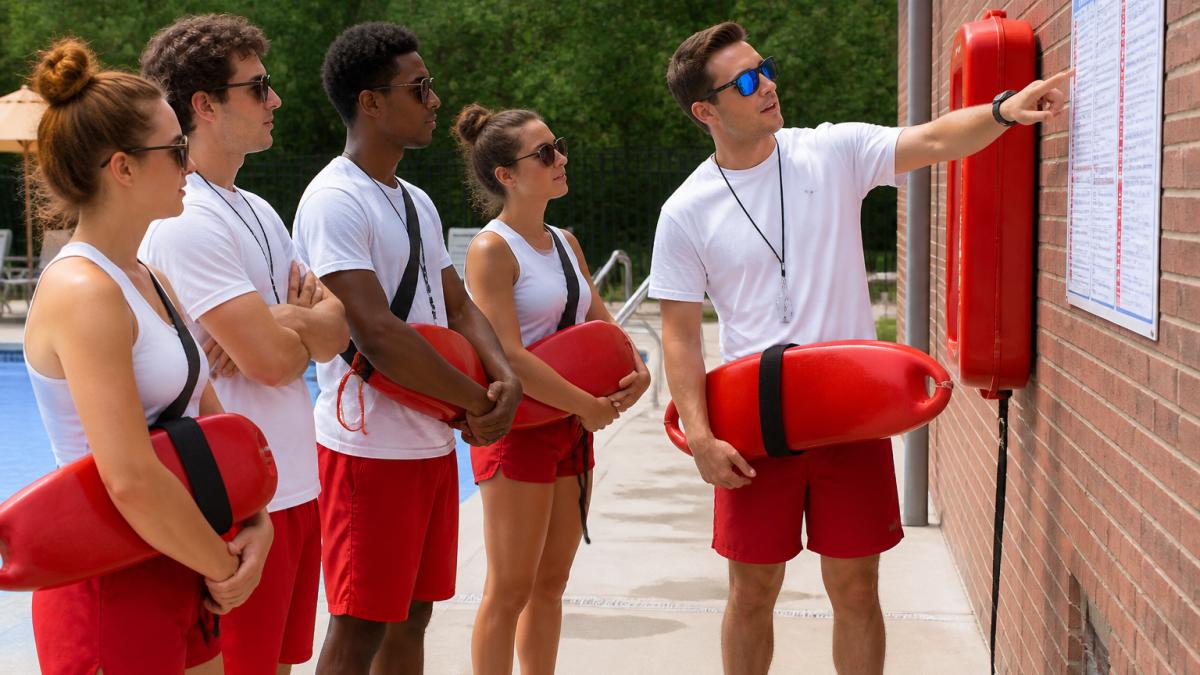
Post this plan where staff can see it regularly. Review it at the start of each swim season and whenever staff changes occur. Make it accessible, not buried in a filing cabinet.
Assigning Roles and Responsibilities for Emergency Response
Clarity saves lives. When an emergency happens, people freeze if they don't know what they're supposed to do. Your job is to eliminate that uncertainty before the emergency occurs.
Assign specific roles to specific people. Don't say "someone will call 911", say "Sarah calls 911 and provides the facility address and the nature of the emergency." Don't say "staff will perform CPR", say "Marcus is certified in CPR and will begin compressions if needed."
Consider these key positions:
- Emergency coordinator: Takes charge, directs other staff, communicates with emergency responders
- Water rescuer: Enters the water if needed, performs rescue techniques safely
- First aid responder: Provides CPR, first aid, or AED operation on deck
- Communication specialist: Calls 911, relays information, keeps communication clear
- Crowd control: Keeps other swimmers and visitors away from the incident, maintains order
- Documentation: Records what happened, times, actions taken, and outcomes
Rotate these roles during drills so multiple staff members can step into each position. Cross-training means your facility isn't dependent on one person being present.
Planning Pool Rescue Scenarios That Work
Generic drills don't prepare people for real situations. Specific scenarios do.
Think about the emergencies most likely to happen at your facility. What's your water depth? How crowded do you get? What age groups do you serve? What time of day brings the most activity? Your drills should reflect your actual conditions.
Common Scenarios to Practice
Drowning victim scenario: A child becomes unresponsive in the water. Staff recognize the signs, perform a water rescue, bring the victim to deck, begin CPR, and call emergency services.
Swimmer in distress scenario: A child struggles but is still responsive. Staff guide the child to safety using reach or throw rescue techniques. The child coughs and recovers on deck.
Medical emergency on deck: A child collapses on the pool deck before entering the water. Staff perform first aid, use the AED if needed, and wait for emergency responders.
Missing child scenario: A child cannot be located in or around the pool.
Injury scenario: A child reports pain or visible injury. Staff provide first aid, document the incident, and contact parents or emergency services as needed.
Safe Execution and Rescuer Preparation
Run drills safely. You're practicing for emergencies, not creating new ones.
Use a mannequin or trained volunteer for drowning scenarios, never use an actual child or untrained person. Mark the mannequin clearly so everyone knows it's not real. Brief all staff and observers beforehand so nobody panics.
For water rescue drills, have the rescuer practice reaching or throwing rescue techniques first. Only progress to in-water rescue if the rescuer is trained and confident. Use shallow water initially. Have a safety person present during water entries.
Stop the drill immediately if anyone becomes injured or distressed. Debrief afterward. Ask what went well and what could improve.
Conducting Lifeguard Emergency Drills: Step-by-Step
Structured drills produce better results than random practice. Follow this process each time.
Before the Drill Begins
Notify your team: Tell staff a drill is happening, but don't reveal the exact scenario or timing. This keeps responses realistic.
Gather supplies: Make sure your AED is accessible, first aid kit is stocked, communication devices work, and rescue equipment is in place.
Assign observers: Have someone not directly involved watch the drill and take notes. This person records what happens, timing, communication quality, and any gaps.
Clear the pool: Evacuate all swimmers safely. Use this as a practice opportunity for evacuation procedures.
Brief the participants: Explain the scenario clearly. Tell staff what they'll see and what response is expected. Confirm everyone understands their role.
Running the Drill
Initiate the scenario: The observer or drill coordinator announces the emergency. Example: "We have a non-responsive victim in the deep end."
Let it play out: Staff responds according to their training and roles. Don't interrupt unless someone is in actual danger.
Time the response: Note how long it takes to recognize the emergency, begin rescue efforts, call for help, and start first aid. Response time matters.
Observe communication: Listen for clear radio traffic, verbal updates, and coordination between staff members. Confusion during a drill signals confusion during a real emergency.
Watch for gaps: Does anyone stand around unsure what to do? Does communication break down? Does the rescuer hesitate? These gaps are exactly what drills are designed to find.
End the drill: Once the scenario reaches a logical conclusion (victim rescued, emergency services called, first aid started), stop and debrief.
Using a Pool Emergency Drill Checklist for Consistency
Checklists ensure every drill covers the same ground. Use this framework each time you drill.
| Drill Element | Status | Notes |
|---|---|---|
| Drill date and time | ☐ | Record for compliance |
| Scenario type | ☐ | Drowning, medical, missing child, etc. |
| Staff present | ☐ | List names and roles |
| Observers assigned | ☐ | Who will watch and document |
| AED functional | ☐ | Test before drill starts |
| Communication devices working | ☐ | Radios, phones, whistles |
| Rescue equipment available | ☐ | Ring buoys, rescue tubes, backboards |
| Evacuation completed | ☐ | All swimmers safely out of water |
| Drill initiated on time | ☐ | When did the scenario begin |
| 911 called | ☐ | Who called, what information given |
| Rescue performed | ☐ | Victim removed from water |
| First aid started | ☐ | CPR or AED used if applicable |
| Emergency responders contacted | ☐ | Time called and time arrived |
| All staff knew their role | ☐ | No confusion or hesitation |
| Communication was clear | ☐ | Radio traffic, verbal updates |
| Drill completed successfully | ☐ | Yes or no, with notes |
Print this checklist and complete it after every drill. File it with your emergency action plan. Over time, these records show whether your team is improving.
Evaluating Drill Performance and Identifying Gaps
The real value of a drill happens after it ends.
Gather your team immediately after the drill concludes. Ask these questions:
What went well? Acknowledge strong performance. Specific praise is more useful than general praise. "Maria's communication on the radio was clear and calm" is better than "good job, everyone."
What was confusing? Did anyone hesitate? Did someone not know their role? Did communication break down? Name the specific moment and what happened.
What would we do differently next time? Don't just identify problems, decide how to fix them. If the AED took too long to locate, decide where it should be positioned. If a staff member wasn't sure about CPR steps, schedule a refresher.
Did we meet our timing goals? Did rescue happen fast enough? Did emergency services get called immediately? Did first aid begin promptly? Compare your drill times to your goals.
Document these observations. Write down what improved since your last drill. Note any new gaps that appeared. Use this information to adjust your training and your emergency action plan.
Frequency, Practice, and Continuous Improvement
Drills aren't a one-time event. They're an ongoing practice.
Conduct at least one full emergency drill per year. Many facilities run drills twice yearly, once at the start of the busy season and once mid-season.
Rotate scenarios so your team practices different emergencies. Run a drowning drill in spring, a medical emergency drill in summer, and a missing child drill in fall.
After each drill, update your emergency action plan if you discovered gaps. Train new staff on current procedures. Refresh CPR and first aid certifications annually.
Keep records of every drill you conduct. Document the date, scenario, staff involved, timing, observations, and improvements made.
The goal isn't perfect drills, it's continuous improvement. Each practice session teaches your team something new. Each debrief identifies what to work on next.
When an actual water emergency happens, your team won't freeze. They'll respond because they've practiced. They'll communicate because they've drilled.
Water safety is a shared responsibility. Explore our Boys swimsuits and Girls swimsuits to see how visibility can enhance your water safety plan. Start with our Best Sellers and discover why families trust Bright & Bold.
Frequently Asked Questions
How often should pool staff practice emergency drills?
Most aquatic facilities benefit from conducting drills at least quarterly, with some facilities practicing monthly or more frequently. Regular practice builds muscle memory and ensures staff stay current on procedures. The frequency depends on staff turnover, facility size, and local regulations. New staff should participate in a drill before their first day supervising the pool. Document every drill so you can track which staff members have participated and identify any gaps in training or response time.
What should a pool emergency action plan include?
A comprehensive pool emergency action plan covers incident scenarios (drowning, illness, injury), specific staff roles and responsibilities, communication protocols including how to call 911 and report the pool location, rescue equipment locations and access, CPR and first aid procedures, and designated meeting points. Include contact information for emergency services, parents, and key personnel. The plan should address different pool areas, varying water depths, and different times of day. Keep the plan accessible to all staff and post it visibly near the pool deck.
How do you safely simulate a drowning emergency during a drill?
Use a weighted mannequin or trained volunteer in a controlled setting rather than having an actual person simulate drowning. Brief all staff before the drill so they know it's a practice scenario. Use clear verbal cues like 'This is a drill' to prevent panic. Position observers away from the action to watch for response time and procedure accuracy. Never have children participate as mock victims. After retrieving the mannequin or volunteer, practice CPR on a training dummy if CPR response is part of the drill. Always prioritize safety over realism.
What should you do after a pool emergency drill?
Conduct an after-action review with all participants. Discuss what went well, what took longer than expected, and what needs improvement. Review response time, communication clarity, and whether all roles were filled. Document findings in writing and create an action plan to address any gaps. Share results with staff and schedule follow-up training if needed. Use these insights to refine your pool emergency action plan and improve future drills. Celebrate successes to build confidence and reinforce the importance of regular practice.