

How to Create a Beach Day Family Meeting Spot
Table of Contents
- Why Every Family Needs a Beach Meeting Spot
- Step 1: Pick the Right Location for Your Beach Meeting Point for Kids
- Step 2: Make the Spot Easy to Remember for Young Children
- Step 3: Build a Family Beach Safety Plan Around Your Spot
- Step 4: What to Do If a Child Gets Lost at the Beach
- Step 5: Use a Family Beach Day Checklist to Prepare
- Conclusion: A Simple Plan for a Safer, Happier Beach Day
- Frequently Asked Questions
Last Updated: October 13, 2026
Why Every Family Needs a Beach Meeting Spot
A beach meeting spot is a single, fixed place your family agrees to return to if anyone gets separated. It gives kids a clear target and gives parents a fast way to find them. At Bright & Bold Swimwear, we build high-visibility swimwear for kids, and we hear the same question from parents all summer: how do you keep track of a fast toddler on a crowded beach? A meeting spot is the simplest answer, and learning how to create a beach day family meeting spot takes about five minutes before you leave the house.

Beaches create a specific problem. There are no aisles, no walls, and no checkout counter to meet at. The water moves, the crowd shifts, and a six-year-old's sense of direction is not fully developed. A meeting spot solves all three issues at once.
Below, we walk through five steps: picking the location, making it memorable, building it into your family beach safety plan, handling a lost child, and packing a family beach day checklist.
Step 1: Pick the Right Location for Your Beach Meeting Point for Kids
The best beach meeting point for kids is a fixed, tall, and staffed landmark that a young child can see from most of the beach. A lifeguard tower is the gold standard. It does not move, it stands above the crowd, and a person is there.
Here is what makes a landmark work:
- It stays put all day. Umbrellas, coolers, and towels all move.
- It is tall enough to spot over heads. Towers, flagpoles, and pier pilings qualify.
- It has staff nearby. A lifeguard can help a lost child.
- Your child can describe it. "The red tower" beats "that building."
Where we would draw the line: never use your own umbrella as the meeting spot. It shifts with the wind, and you may move it yourself during the day.
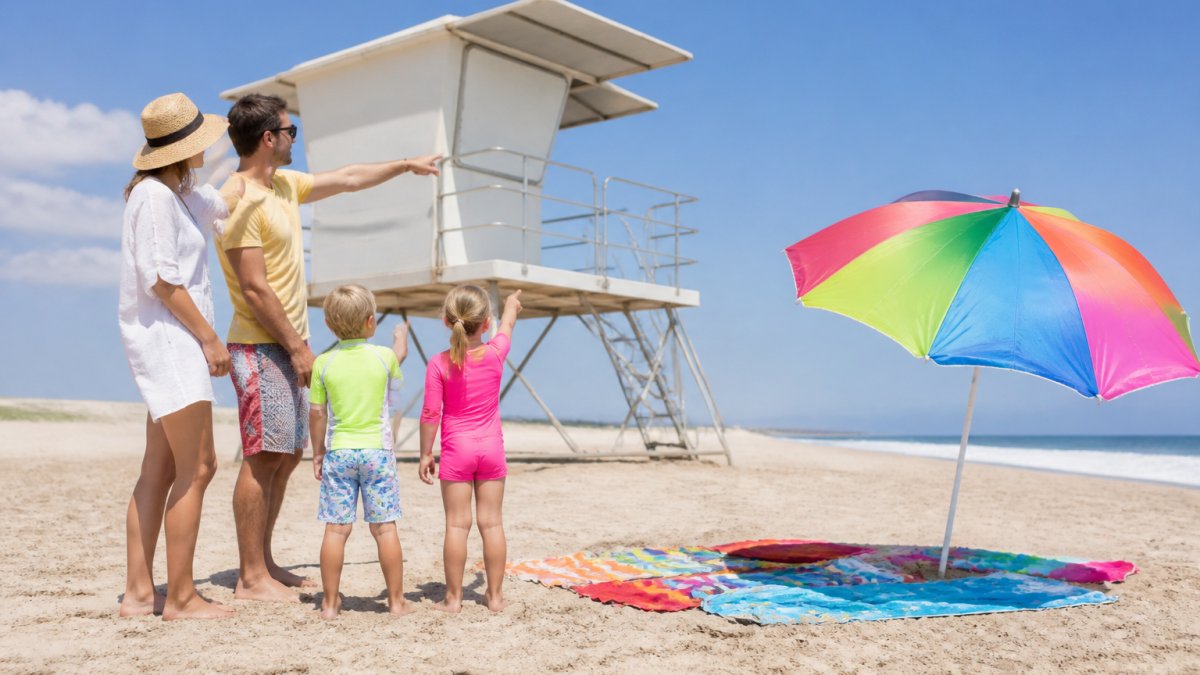
Landmarks That Work: Lifeguard Towers, Flags, and More
Lifeguard towers come first. After that, look for beach warning flags, pier entrances, permanent restroom buildings, and snack bars. Each one is fixed, visible, and easy to name.
One practical note: many beaches use colored flags to signal water conditions. Teach your child what the flags mean while you are standing at the spot. It turns a safety talk into a five-minute game.
Step 2: Make the Spot Easy to Remember for Young Children
Young children remember places through repetition and play, not through instructions. So make the spot a game, not a rule.
Try these:
- Name the spot. "Our tower" or "the big red flag" gives it an identity.
- Take a photo. Snap one picture of your child standing at the spot. Show it during the day.
- Walk the route twice. Once when you arrive, once before lunch.
- Use a song. A short chant with the landmark name sticks better than a warning.
Games and Songs That Help Kids Memorize the Spot
A simple call-and-response works well. You say the landmark, your child points and says it back. Do it three times when you arrive.
For kids ages 2 to 4, add a visual cue. High-visibility swimwear in neon colors helps here, because you can say "find the tower, then look for the bright green suit." Bright & Bold Swimwear makes rash guard sets in bold neon colorways for exactly this reason: you can spot your child fast, and your child can describe what they are wearing.
Step 3: Build a Family Beach Safety Plan Around Your Spot
A family beach safety plan is a short set of rules your whole group knows before anyone touches the water. The meeting spot is the anchor of that plan.
Keep it to four parts:
Boys Short Sleeve Rash Guard Swim Set | UPF 30+ High-Visibility Swimwear | Ages →
- The spot. Where it is, and what it looks like.
- The check-in schedule. Set times when everyone returns to the spot.
- The signals. A whistle, a wave, or a call your family recognizes.
- The buddy rule. No one swims alone.
Write it on your phone or a note card. Read it out loud in the car.
Check-In Schedules and Communication Signals
For young children, check in every 30 to 45 minutes. Set a timer so you do not have to remember. Teens and older kids can go longer, but they still check in.
Pick one signal and stick to it. A loud two-finger whistle works on a windy beach where voices do not carry. A raised arm means "I am okay." A crossed-arm overhead wave means "come to me."
Step 4: What to Do If a Child Gets Lost at the Beach
If a child gets lost at the beach, act within the first minute. Do not wait to see if they wander back. Tell a lifeguard immediately, then send one adult to the meeting spot.
Here is the order we would follow:
- Alert the lifeguard. They know the beach, the crowd, and the water.
- Send one adult to the meeting spot. Stay there. Do not leave it.
- Keep the other children together. Do not split the group further.
- Describe what the child is wearing. This is where bright swimwear pays off.
- Check the water line. Most lost children are found near the water's edge.
A child who has practiced the route will often head straight for the spot. That is the whole point of the plan.
Step 5: Use a Family Beach Day Checklist to Prepare
A family beach day checklist turns all of this into a routine you can repeat every trip. Print it, or keep it in your phone notes.
- Choose the meeting spot before you leave
- Show your child a photo of the spot
- Walk the route when you arrive
- Set the check-in timer
- Agree on the family signal
- Dress kids in high-visibility swimwear
- Pack sunscreen, water, and hats
- Point out the lifeguard tower to every adult
- Confirm who is watching which child
Bright & Bold Swimwear offers UPF 30+ protection on select rash guard sets, plus swim accessories like colorful goggles that help kids stand out in the water. Our National Drowning Prevention Alliance partnership reflects the same goal: keep kids visible and supervised.

Conclusion: A Simple Plan for a Safer, Happier Beach Day
Crowded beaches, moving water, and fast toddlers make supervision genuinely hard. A fixed meeting spot, a check-in schedule, and bright, visible swimwear close most of that gap. That is how to create a beach day family meeting spot that actually works when you need it.
At Bright & Bold Swimwear, we make high-visibility swimsuits for kids ages 2 to 7, designed so parents and lifeguards can spot a child fast. Our boys swimsuits and girls swimsuits come in bold neon colorways, with UPF 30+ protection on select items and quick-drying fabric built for all-day play. Shop our best sellers and give your family one less thing to worry about at the beach.
Frequently Asked Questions
How do you choose a meeting spot at the beach?
Look for a fixed, easy-to-spot landmark like a lifeguard tower, a brightly colored flag, or a large sign. Make sure it's away from the water's edge and in a central location. If possible, choose a spot with shade and seating so kids can wait comfortably. Point out the spot to everyone in your group before setting up your beach gear.
What should a family beach meeting point look like?
A good meeting point is visually distinct and permanent. It could be a lifeguard station, a numbered beach access sign, or a unique structure like a pier. Avoid movable objects like umbrellas or coolers. If no permanent landmark exists, create your own by tying a bright ribbon or balloon to a stationary object, but always prioritize official markers.
How can kids remember where to meet at the beach?
Turn it into a game: practice walking to the spot together and have your child describe what they see. Use a simple phrase like 'meet at the red flag' and repeat it throughout the day. For young children, pair the spot with a favorite toy or a song. You can also take a photo of the spot and show it to them periodically.
What should you do if your child gets separated from you at the beach?
Stay calm and immediately alert a lifeguard. Give them a detailed description of your child, including what they're wearing. If your child is wearing high-visibility swimwear, mention the bright colors. Check the meeting spot first, then scan the water and shoreline. Teach your child to go to the meeting spot or find a lifeguard if they get lost.