

Most Important Water Safety Rule for Children
Table of Contents
- The One Water Safety Rule That Matters Most: Constant, Distraction-Free Supervision
- Supervision Requirements for Young Swimmers: Ratios, Water Watchers, and the Buddy System
- Drowning Prevention Tips for Parents: Barriers, Lessons, and Emergency Preparedness
- The Best Swimming Gear for Toddlers: High-Visibility Swimwear, Life Jackets, and Flotation Devices
- The Psychology of Supervision: Why Even Careful Parents Look Away
- Water Safety for Neurodivergent Children: Extra Layers of Protection
- Home Pool Maintenance as a Safety Measure: What Parents Often Overlook
- Frequently Asked Questions
Last Updated: September 13, 2026
The One Water Safety Rule That Matters Most: Constant, Distraction-Free Supervision
If you remember only one water safety rule this summer, make it this: a child in or near water needs a designated adult watching at all times, with zero distractions. This single habit prevents more tragedies than any piece of gear, barrier, or class. At Bright & Bold Swimwear, we built our whole business around the belief that a parent's eyes are the most important safety device in any pool.
The reason supervision outranks everything else is simple. Drowning is fast and silent. CDC drowning prevention resources notes that young children can slip under the surface in seconds, often without a splash or a shout. That is why a phone in hand, even for a moment, is a real risk. Keep reading, because the details of how to supervise well are what most families get wrong.
Why Arm's Reach Is Non-Negotiable for Children Ages 2-7
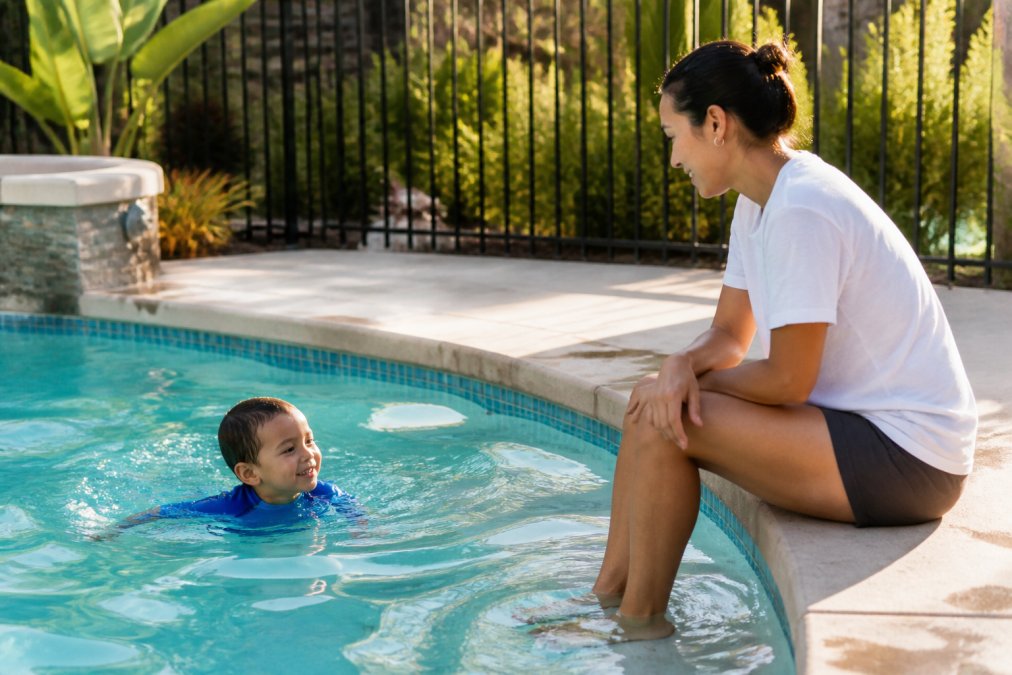
For kids ages 2 to 7, "watching" means being close enough to grab them. The American Red Cross water safety guidance calls this "arm's reach" supervision, and it is the standard for weak swimmers. A child can go under and stay under faster than you can cross a pool deck. Staying within arm's reach removes that gap entirely.
The common mistake is treating supervision as a background task. It is not. It is the job.
Supervision Requirements for Young Swimmers: Ratios, Water Watchers, and the Buddy System
Good supervision is structured, not improvised. A workable approach for young swimmers is one attentive adult per child in the water, plus a rotating "water watcher" who holds no other duty. The water watcher does not chat, scroll, or grill. They watch the water, and only the water.
The buddy system adds a second layer. Pair each child with a partner so they keep an eye on each other, and teach kids to never swim alone. Rotate the water watcher role every 15 to 20 minutes so attention stays sharp. Hand off the role out loud: "You're watching now." That verbal pass keeps someone accountable at every second.
Drowning Prevention Tips for Parents: Barriers, Lessons, and Emergency Preparedness
Layered protection is the goal, because no single measure is enough on its own. Combine close supervision with physical barriers, swim instruction, and emergency readiness. Each layer catches what the others miss.
- Barriers: A four-sided fence with a self-latching gate separates the pool from the house and yard.
- Lessons: Enroll children in swim instruction to build water competency over time.
- Emergency prep: Keep a phone charged poolside and learn CPR. The American Heart Association CPR training offers courses that prepare you to act in the first critical minutes.
A common mistake is relying on one layer, usually supervision, and assuming it is enough. Build all three.
Pool Safety Rules for Children and Open Water vs. Pool Safety
Pool and open water demand different habits. In a pool, enforce simple rules: no running on the deck, safe entry, and never swim without an adult present. These rules reduce slips and unsupervised entries.
Open water is a different challenge. Lakes, rivers, and oceans bring currents, drop-offs, and murky visibility, so even strong swimmers need a life jacket and constant, close watch. For open water, treat every child as a weak swimmer regardless of skill.
| Setting | Key Risk | Core Rule |
|---|---|---|
| Home pool | Unsupervised entry | Four-sided fence, locked gate |
| Public pool | Crowds, distraction | Designated water watcher |
| Open water | Currents, drop-offs | Life jacket, arm's reach |
The Best Swimming Gear for Toddlers: High-Visibility Swimwear, Life Jackets, and Flotation Devices
Gear supports supervision, it never replaces it. The best swimming gear for toddlers makes a child easier to see and easier to track in busy water. That is the entire purpose behind high-visibility swimwear.

Bright & Bold Swimwear designs bright, high-contrast suits so parents and lifeguards can spot a child fast in a crowded pool. Our U.S. Coast Guard boating safety partners remind families that flotation devices should be Coast Guard approved, and that water wings and inflatable toys are not safety devices.
- High-visibility swimwear: Bold neon colors that stand out against water and crowds.
- Life jackets: Coast Guard approved, sized to your child's weight.
- Flotation devices: Only as toys, never as a substitute for supervision.
Our boys swimsuits and girls swimsuits are built for exactly this. UPF 30+ protection on select items keeps kids comfortable while the neon palette keeps them visible.
The Psychology of Supervision: Why Even Careful Parents Look Away
Even devoted parents look away, and that is the honest truth behind most near-misses. Attention is not a switch; it fades. Researchers who study vigilance, the same mental system air traffic controllers and lifeguards rely on, describe a predictable pattern: focus is sharp for the first several minutes, then steadily erodes. Boredom, conversation, and phone notifications all pull focus, and the brain fills the gap with false confidence. Recognizing this is the first step to beating it.
The reason this matters so much around water is that drowning does not announce itself. A child who is struggling typically does not wave, call out, or splash. The struggle happens below the surface, in silence, which means the only warning signal is your sustained attention. When attention drifts, the warning signal disappears with it.
A few mechanisms drive most lapses:
- The familiarity trap. The longer nothing happens, the more the brain assumes nothing will. A quiet pool on a quiet afternoon feels safe, so vigilance drops right when it should not.
- The handoff gap. Two adults each assume the other is watching. Nobody is. This is one of the most common patterns in near-miss reports.
- The phone pull. A single glance at a notification can stretch into a minute. In water, a minute is an eternity.
- Task stacking. Grilling, mixing drinks, applying sunscreen, and supervising at the same time means supervising is the task that gets the least bandwidth.
The fix is to make supervision a shared, rotating job rather than one person's endless task. When one adult knows they are on duty for a set window, and everyone else knows it too, attention holds far better. This is a psychological barrier, not a character flaw, and it is one every family faces.
A practical rhythm many families find workable: watcher shifts of 15 to 20 minutes, a verbal handoff out loud ("You're watching now"), and a strict no-phone rule for whoever holds the token. Rotating the role keeps any one person from carrying the whole afternoon, and it gives every adult a real break instead of a fake one.
One more pattern worth naming: the end-of-day slump. Attention is lowest when everyone is tired, hungry, and packing up, which is exactly when kids wander back toward the water. Treat pack-up time as a high-risk window and keep the watcher role active until the last child is inside and the gate is latched.
Water Safety for Neurodivergent Children: Extra Layers of Protection
Children with autism or other developmental differences often need more layers, not fewer. This is one of the most under-covered topics in water safety, and it deserves specific guidance rather than a passing mention.
Two patterns show up again and again. Some children are drawn to water with no sense of danger, they may seek the sensory input of splashing, or bolt toward a pool, pond, or canal without warning. Others may not respond to verbal warnings, may not recognize the sound of their name being called, or may not understand that a calm-looking surface can be dangerous. A common mistake is assuming a child who dislikes water is safe. The opposite is often true: a child who avoids water at home may still wander toward it in an unfamiliar setting.
For these families, supervision is the foundation, but it must be paired with physical barriers and, where possible, swim instruction tailored to the child.
Barriers that matter most:
- Door and gate alarms. A chime on every exterior door and pool gate gives you a warning the moment a child slips out, even if you did not see them go.
- Self-latching, self-closing gates. A gate that does not reliably latch is not a barrier. Test it weekly.
- Pool covers and safety covers. A properly secured cover removes the open-water surface entirely when the pool is not in use.
- Locked doors and windows. Especially on ground floors and any room a child can reach.
Instruction that fits the child:
Not every swim program is built for neurodivergent learners. Look for instructors who use visual schedules, predictable routines, and one-on-one or small-group formats. The goal is not competitive swimming, it is water competency and, just as importantly, comfort with the rules around water. Some children benefit from repeated, short lessons over a long period rather than intensive sessions.
A note on wandering:
If your child is prone to elopement, leaving a safe space without warning, treat water as a top-tier hazard in your home safety plan. That may mean a higher fence, a louder alarm, or a GPS-enabled wearable. Talk with your child's care team about a plan that fits your specific situation.
Extra layers protect everyone. The families who navigate this well tend to treat water safety as a system, not a single habit: barriers, alarms, instruction, and close supervision, all working together.
Home Pool Maintenance as a Safety Measure: What Parents Often Overlook
A poorly maintained pool is a hidden hazard. Cloudy or unbalanced water can hide a child from view, and damaged covers or loose fencing create gaps in your protection. Home pool maintenance is genuinely a safety measure, not just a chore.
Check these regularly:
- Water clarity: clear water lets you see the bottom and spot anyone below.
- Fence and gate: confirm the latch catches and the barrier has no gaps.
- Covers and drains: secure or replace anything torn, loose, or damaged.
- Chemicals: store them locked and out of reach of children.
Most guides skip this entirely. In practice, a clear, well-kept pool is a safer pool, because you can actually see what is happening in the water.
Frequently Asked Questions
What is the most important water safety rule for children?
The most important water safety rule is constant, distraction-free supervision within arm's reach. For children ages 2-7, a responsible adult must actively watch the child at all times, without scrolling on a phone, reading, or chatting. Drowning happens silently in seconds, so this water safety rule saves lives more reliably than any other single measure.
What are the top 3 water safety rules for kids?
First, constant supervision within arm's reach by a designated water watcher. Second, use Coast Guard-approved life jackets in open water and for weak swimmers, never as a substitute for supervision. Third, build water competency through swim instruction and enforce pool safety rules like no running and safe entry. These three rules together address the highest drowning risks.
How can high-visibility swimwear improve water safety?
High-visibility swimwear in neon and high-contrast colors makes children easier to spot in pools, lakes, and crowded swim areas. When a water watcher can quickly locate a child among other swimmers, response time improves. Bright & Bold Swimwear offers UPF 30+ high-visibility options for boys and girls ages 2-7, designed to support supervision, not replace it.
What should parents look for in a lifeguard-supervised area?
Even with a lifeguard on duty, parents should still provide active supervision. Look for clearly marked depth zones, visible lifeguard stations, and posted pool safety rules. Confirm the lifeguard's position and scanning pattern, keep children within the designated swim area, and stay close enough to reach your child in seconds if needed.