

Toddler Swim Class vs Private Lessons Cost: 2026 Guide
Table of Contents
- Toddler Swim Class vs Private Lessons Cost: Quick Comparison
- Average Cost of Toddler Swim Lessons in 2026
- What Drives the Price of Toddler Swim Lessons
- Benefits of Private Swim Lessons for Toddlers
- Social and Developmental Benefits of Group Classes
- Best Swimming Gear for Toddlers to Pair With Lessons
- How to Choose the Right Format for Your Child
- Frequently Asked Questions
Last Updated: September 10, 2026
Toddler Swim Class vs Private Lessons Cost: Quick Comparison
Choosing between group lessons and one-on-one coaching comes down to one question: how much structure does your child need? This guide from Bright & Bold Swimwear breaks down the toddler swim class vs private lessons cost so you can budget with confidence.

Group classes typically cost less per session, while private lessons charge more for individualized attention. Below, we'll show you exactly how each format prices out, what drives the difference, and which one fits your family's situation.
The short answer: group lessons usually win on price, private lessons win on speed of progress, and the right choice depends on your child's comfort level and your schedule.
| Factor | Group Class | Private Lesson |
|---|---|---|
| Typical cost per session | Lower | Higher |
| Student-to-teacher ratio | 4:1 to 8:1 | 1:1 |
| Progress speed | Steady | Faster |
| Socialization | Strong | Limited |
| Best for | Confident, social kids | Anxious or special-needs swimmers |
Average Cost of Toddler Swim Lessons in 2026
Swim lesson pricing varies widely by region, facility type, and instructor experience. Most families find that group classes run roughly half the per-session cost of private instruction, though exact figures depend on your local market (the CDC). The table below shows typical ranges you can expect to see advertised, not including registration or gear.
| Format | Typical per-session range | Common package structure |
|---|---|---|
| Group class (4:1 to 8:1) | $15-$30 | Monthly membership or 8-12 week session |
| Semi-private (2:1 to 3:1) | $25-$45 | 4-8 session package |
| Private (1:1) | $40-$90 | 4-8 session package |
These ranges reflect what many facilities list for toddler-aged programs. Urban markets with high pool overhead tend to sit at the top of each range, while rural and community programs often sit at the bottom. A common pattern is that a 30-minute group class costs about what a 15-minute private lesson costs, so compare cost per minute of instruction, not just cost per class.
Group Class Pricing Breakdown
Group lessons spread the instructor's time across several children, which keeps costs down. A common approach is a monthly membership or a session-based package. Many facilities bill monthly, and some charge an annual membership fee on top of tuition. Per-session pricing for group classes is generally the most budget-friendly entry point for a beginner swimmer.
When you compare group options, ask two questions: how many children share the instructor, and how many minutes of actual water time your toddler gets. A 30-minute class with six kids means roughly five minutes of individual attention (redcross.org). That math matters more than the sticker price.
Private Lesson Pricing Breakdown
Private lessons cost more because your child gets the instructor's full attention. Facilities often sell these as packages of 4 to 8 sessions, and pricing reflects instructor experience and pool time. The trade-off is a distraction-free environment and faster skill progression for a toddler who struggles in a crowd.
A useful way to compare is total cost to reach a milestone, not cost per session. If a private package of eight sessions gets a nervous toddler floating independently, and a group track takes sixteen sessions to reach the same point, the private path can cost less overall even at a higher per-session rate. Run that math for your own child before deciding.
Regional Cost Variance
Where you live changes the bill more than any other single factor. High-cost metro areas with year-round indoor pools and high staffing costs sit at the top of the ranges above. Smaller towns and community-run programs often sit at the bottom. To estimate your local rate, call three facilities within a 20-minute drive and ask for their per-session rate, registration fee, and session length. That three-call comparison will beat any national average.
What Drives the Price of Toddler Swim Lessons
Several factors push lesson prices up or down, and understanding them helps you spot a fair rate. Geographic cost variance is the biggest one: urban areas with high facility overhead charge more than rural programs.
Other drivers include:
- Instructor experience and certifications
- Student-to-teacher ratio
- Session duration and lesson frequency
- Facility overhead such as heating and lifeguard staffing
- Time of year (summer programs often fill fast and may cost more)
Hidden Costs Beyond Tuition
Tuition is rarely the whole bill. Most competitors stop at the advertised class rate, but the true cost of swim lessons includes several line items that rarely appear in the marketing. Watch for:
- Registration or enrollment fee, often a one-time charge per family or per child.
- Annual membership fee, common at clubs and community centers.
- Required gear, goggles, a well-fitting swimsuit, and sometimes a swim cap. A properly fitted suit matters more than brand; loose suits drag and tire a toddler.
- Travel time and gas, a 20-minute drive each way, twice a week, adds up over a season. If one facility is closer, the lower travel cost can offset a slightly higher class rate.
- Make-up lesson policies, some programs charge for missed classes, others offer limited make-ups. Ask before you enroll.
- Assessment or level-test fees, some schools charge to place a child in the right class.
Add these up for a full season and the gap between the cheapest and most expensive option often narrows. A program with a higher class rate but no registration fee and free make-ups can cost less than a bargain class with add-ons.
The True-Cost Comparison Framework
To compare fairly, build a simple season budget for each option:
- Multiply per-session rate by the number of sessions you expect to attend.
- Add registration, membership, and assessment fees.
- Add gear you still need to buy.
- Add estimated travel cost (round-trip miles × your fuel cost × number of trips).
- Divide by the number of sessions to get a true cost per visit.
This framework often reveals that a slightly pricier private lesson, taken for fewer total sessions, can be the more economical path for a child who needs one-on-one attention. For anxious or sensory-sensitive toddlers, private instruction is frequently a necessity rather than a luxury, and the true-cost math usually supports it (the CDC).
Benefits of Private Swim Lessons for Toddlers
The benefits of private swim lessons for toddlers center on attention and pace. One-on-one coaching lets an instructor read your child's cues and adjust instantly, which matters for a nervous beginner.
For anxious swimmers, this focused format often shortens the learning curve. A toddler who freezes in a group can relax with a single instructor nearby. The personalized feedback also targets specific skills, like floating or kicking, rather than following a fixed swim curriculum.
The trade-off is cost and reduced group dynamics. Your child won't practice waiting their turn or watching peers, and you'll pay more per session for the individualized setting.
Social and Developmental Benefits of Group Classes
Group classes build more than swim proficiency. Children learn by watching each other, and a shared class turns water confidence into a social activity.
The group dynamics offer real developmental value:
- Socialization with peers the same age
- Turn-taking and patience
- Watching other kids attempt new skills
- A supportive, less intense environment
For a confident, social toddler, group instruction delivers strong value at a lower price. The student-to-teacher ratio matters here: a 4:1 class gives more attention than an 8:1 class, so ask before you enroll.
Best Swimming Gear for Toddlers to Pair With Lessons
Good gear supports whatever format you choose, and it protects your investment in lessons. High-visibility swimwear helps instructors and parents track a small swimmer in a busy pool, which is exactly what Bright & Bold Swimwear designs for.
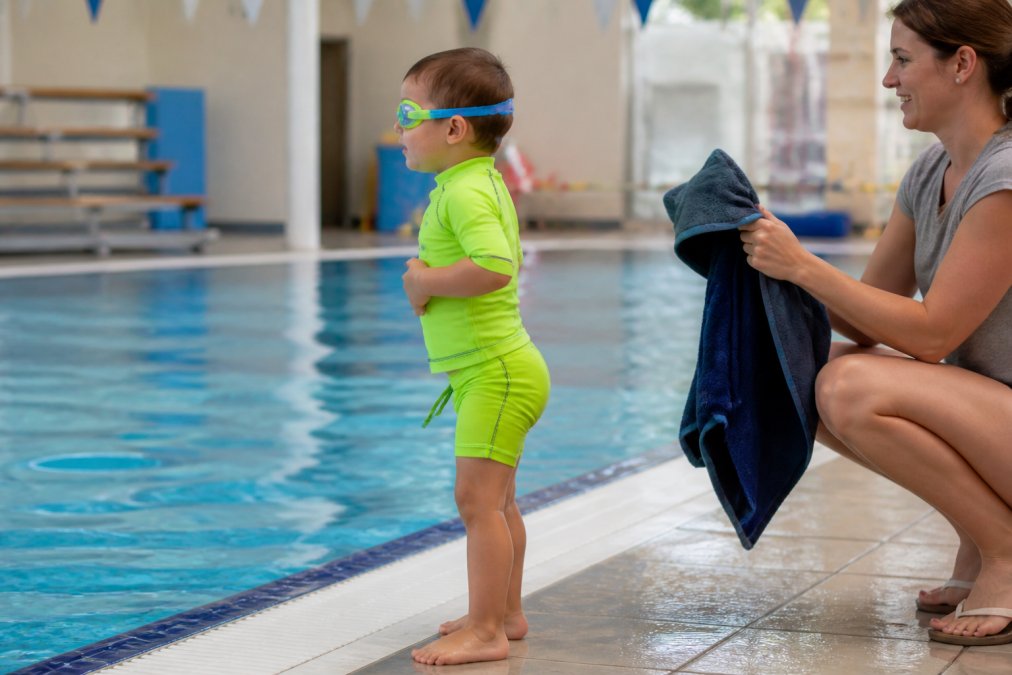
Start with a rash guard set that offers UPF 30+ sun protection for outdoor lessons. Bright & Bold Swimwear's boys short sleeve rash guard set and girls long sleeve crop top set come in bold neon colors that stand out against pool and lake water. Add kids colorful goggles for clear underwater vision, and a hooded towel for easy changing after class.

If you're teaching at home between lessons, [the Teach My Child To Swim guide](https://brightboldswim.com/products/teach-my-child-to-swim) walks parents through a structured approach for beginners.

How to Choose the Right Format for Your Child
Match the format to your child, not the other way around. A confident, social toddler thrives in a group; an anxious or special-needs swimmer usually progresses faster one-on-one.
Use this decision framework:
- Choose group classes if your child is social, comfortable in water, and you want the lowest per-session cost.
- Choose private lessons if your child is anxious, needs faster progress, or has special needs.
- Choose a hybrid if you want affordability plus periodic one-on-one check-ins.
Run a cost-benefit analysis over a full season, not a single class. Factor in enrollment fees, gear, and how many sessions each format realistically needs to reach water safety.
Frequently Asked Questions
How much do private swim lessons typically cost compared to group classes?
Private toddler swim lessons generally run $60 to $100 per 30-minute session, while group classes average $15 to $30 per session. Over a 12-week session, that means group classes cost roughly $180 to $360 total, compared to $720 to $1,200 for private instruction. The gap narrows when you factor in that private lessons often require fewer total sessions to reach basic water safety milestones.
Are private swim lessons more effective for toddlers than group settings?
Private lessons offer one-on-one coaching and a distraction-free environment, which helps anxious or easily distracted toddlers progress faster. Group classes provide socialization and peer motivation that some children thrive on. The best choice depends on your child's temperament, learning curve, and comfort level in water. Many families start with group classes and switch to private if progress stalls.
What factors influence the price of toddler swim lessons?
Key pricing factors include student-to-teacher ratio, instructor experience and certifications, session duration, facility overhead, and geographic location. Urban areas with higher operating costs charge more. Enrollment fees, annual membership fees, and billed monthly versus per-session pricing structures also affect your total cost. Always ask about the full fee schedule before committing.
Are toddler swimming lessons worth it for water safety?
Yes. Formal swim instruction builds water confidence, teaches water survival skills, and supports skill progression that reduces drowning risk. The American Academy of Pediatrics recommends starting swim lessons for most children around age 1. Even basic proficiency gives toddlers a critical layer of protection. Pairing lessons with high-visibility swimwear helps parents and lifeguards maintain visual contact during practice.
How many swim lessons does a toddler need to become water safe?
Most toddlers need 20 to 30 lessons to reach basic water safety, though this varies by age, comfort level, and lesson frequency. Consistent weekly sessions accelerate progress. Some structured programs, like guided parent-led instruction, report independent swimming in about 12 lessons for children 2.5 and older. Water safety is a continuous process, not a one-time milestone.
The real challenge isn't picking the cheaper option; it's finding the format that gets your toddler genuinely water-safe. Bright & Bold Swimwear supports that goal with high-visibility swimwear designed to help parents and lifeguards keep an eye on little ones, UPF 30+ protection on select items, and educational resources for teaching children to swim. Get started with Bright & Bold Swimwear and give your child gear that keeps them seen while they learn.