

How to Assign a Water Watcher: A Complete Guide
Table of Contents
- What Is a Water Watcher and Why It Matters
- Step 1: Select the Right Person to Assign as Water Watcher
- Step 2: Explain Water Watcher Responsibilities and Constant Supervision
- Step 3: Use Water Watcher Tags and Identification Tools
- Step 4: Set Up a Water Watcher Shift Duration and Rotation Schedule
- Best Swimming Gear for Toddlers to Support Water Safety
- How to Talk to Guests About Water Safety and Watcher Assignments
- Creating an Emergency Action Plan
Last Updated: August 17, 2026
What Is a Water Watcher and Why It Matters
A water watcher is a designated adult assigned to provide constant, undivided attention to children in or near water. This role exists specifically to prevent drowning, which remains one of the leading causes of unintentional injury-related death for children ages 1-4. The water watcher's sole responsibility during their shift is supervision, not socializing, not checking phones, not multitasking.
Drowning happens silently and quickly, often without the dramatic signs people expect. A child can slip underwater in seconds, and by the time someone notices, it may be too late.
At Bright & Bold Swimwear, we've seen how high-visibility swimwear combined with proper supervision practices creates a powerful defense against water-related accidents. When children wear bright neon colors, they're easier to spot instantly. When a designated water watcher is in place, someone is actively looking. Together, these strategies work.
The water watcher approach works because it removes ambiguity. Without a clear assignment, supervision becomes everyone's responsibility, which means it becomes no one's responsibility. A water watcher eliminates that confusion entirely.
Step 1: Select the Right Person to Assign as Water Watcher
Not every adult can serve as an effective water watcher. The person you choose needs to be old enough to understand the responsibility, physically capable of responding to emergencies, mentally alert throughout their shift, and genuinely committed to the role.
Start by identifying adults present specifically to supervise, not adults who happen to be at the pool or beach. A parent who brought their own child has divided attention. A designated water watcher has one job only.
Recommended age requirements for watchers
Most safety organizations recommend that water watchers be at least 16 years old, though 18 or older is preferable depending on the setting. The age threshold matters because younger teens may lack the physical strength to pull a struggling child from deep water and may hesitate in emergency situations.
Assign adults, not older siblings. A 15-year-old might feel responsible, but they're not developmentally equipped to make split-second emergency decisions or physically manage a rescue.
Physical and mental readiness
Your water watcher needs to be physically capable: can they see clearly? Can they hear a whistle? Can they move quickly if needed? Mental readiness matters equally. Your water watcher cannot be exhausted, intoxicated, or distracted. They cannot be managing a toddler of their own while watching other children. They cannot be on their phone.
Ask potential watchers directly: "I need someone to watch the kids in the water for the next 45 minutes. Your only job is to keep your eyes on them. Can you commit to that?" If they hesitate, pick someone else. You want enthusiastic agreement.
Step 2: Explain Water Watcher Responsibilities and Constant Supervision
Once you've selected your water watcher, explain their responsibilities with complete clarity. They're not there to enjoy the water or socialize. They're there to watch.
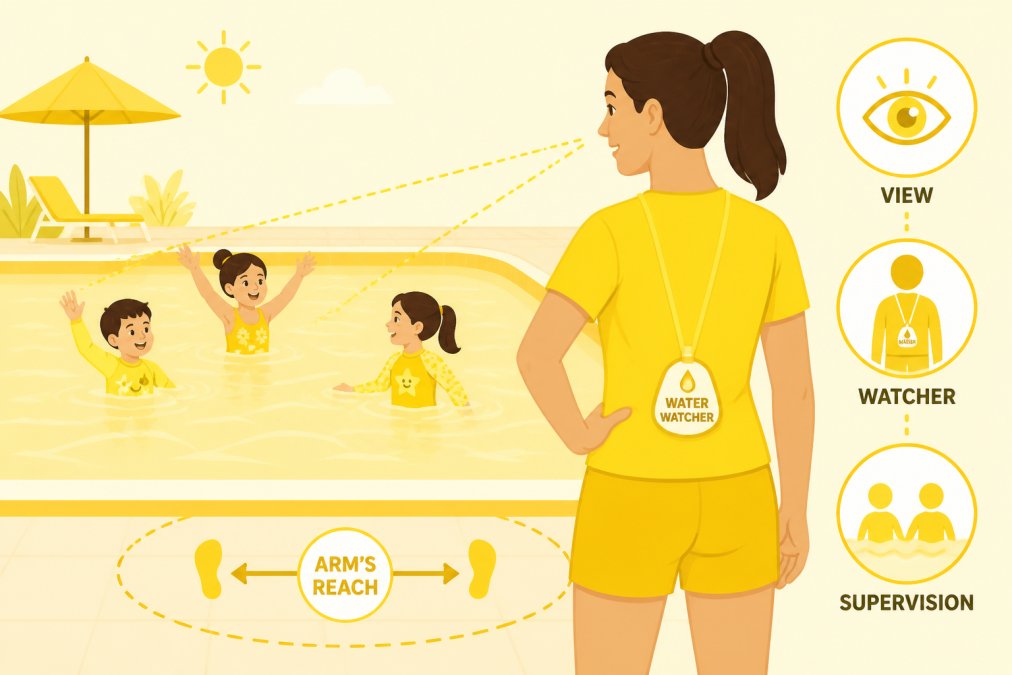
The core responsibility is maintaining constant visual contact with every child under their watch. They should stand on the deck, not wade in the water. They should keep their eyes on the children continuously, not look away to chat, check their phone, or watch other activities.
Active supervision and arm's reach proximity
Active supervision means actively monitoring every moment. Your water watcher should be able to identify each child by sight, know where they are in the water, and notice any changes in behavior or position instantly.
For very young children, supervision should include arm's reach proximity. This means an adult is close enough to reach out and grab the child within one second. For toddlers and non-swimmers, the adult should be in the water with them or immediately beside them on the deck, never more than an arm's length away.
As children get older and stronger swimmers, the distance can increase slightly, but the principle remains: the water watcher should be able to reach any child within seconds if something goes wrong.
Recognizing drowning signs
Most people expect drowning to look dramatic, splashing, calling for help, thrashing around. Real drowning looks different. A drowning child often goes silent. Their head may slip underwater for a few seconds at a time. They may look like they're just floating or playing.
Your water watcher needs to know what to watch for: a child's head tilted back in the water, mouth at water level, eyes glazed or unfocused, lack of coordinated movement, or sudden stillness. If something looks wrong, they should get the child out of the water immediately. It's better to overreact to a false alarm than to hesitate when a child is actually in danger.
Step 3: Use Water Watcher Tags and Identification Tools
Physical identification tools help make the water watcher role visible and unmistakable. When everyone at the pool knows who the designated watcher is, other adults won't duplicate the role or assume someone else is handling it.
The most common tool is a water watcher tag or lanyard, a visible marker that clearly identifies the person responsible.
Lanyards, whistles, and visibility markers
A lanyard worn around the neck makes the water watcher immediately recognizable. When it's time to switch watchers, the person coming off shift removes the lanyard and hands it to the next person. This hand-off ritual makes the transition clear and prevents confusion.
Some water watchers also carry a whistle to grab a child's attention if they're drifting away or to signal other adults if the watcher needs backup in an emergency.
High-visibility markers also help. If your water watcher is wearing bright colors, they're easier to spot in a crowded pool area. When children wear bright neon swimsuits from Bright & Bold Swimwear, the water watcher can track them instantly, making their job significantly easier.
Step 4: Set Up a Water Watcher Shift Duration and Rotation Schedule
A water watcher cannot stay alert indefinitely. Attention naturally fades after 30-45 minutes of continuous, focused supervision. Set up a rotation schedule where watchers switch regularly to keep everyone fresh.
A typical rotation might be 30-45 minutes per shift for each adult. At the end of their shift, they hand off the responsibility to the next assigned watcher.
Hand-off protocols between watchers
The hand-off moment is critical. This is when gaps in supervision can occur if the transition isn't clear. Create a simple protocol:
- The current water watcher signals that their shift is ending
- The next water watcher puts on the lanyard and confirms they're taking over
- The current watcher explicitly tells the new watcher, "I'm handing off supervision to you now"
- The new watcher confirms they understand and are ready
- Only after this explicit confirmation does the previous watcher step back
Before the day begins, write down your rotation schedule. Who's watching from 1:00-1:45? Who's next? Have this written down and shared with all adults present. When it's time to switch, refer to the schedule. No guessing, no assumptions.
Best Swimming Gear for Toddlers to Support Water Safety
The right swimwear makes a water watcher's job easier by making children visible. High-visibility swimsuits in bright neon colors create an instant visual target that's easy to track in the water.
For toddlers, look for swimwear that combines visibility with sun protection and durability. A rash guard provides UPF protection against sunburn while keeping the child comfortable. Two-piece designs allow for easy bathroom breaks and faster drying. Bright, solid colors, neon yellow, lime green, hot pink, electric blue, are significantly more visible than pastels or multicolored patterns.
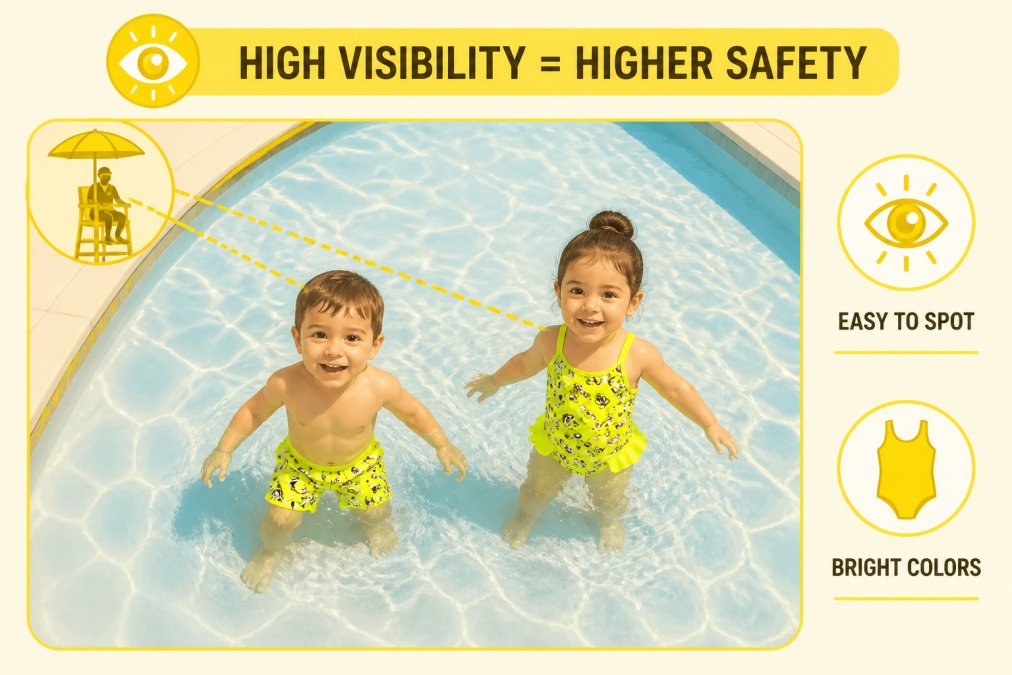
Bright & Bold Swimwear specializes in exactly this type of gear. Their Boys swimsuits and Girls swimsuits both feature high-visibility neon colors with UPF 30+ protection. The two-piece designs make these practical for active toddlers, and the bright colors solve the visibility problem immediately, allowing your water watcher to track children effortlessly in the water.
How to Talk to Guests About Water Safety and Watcher Assignments
Many water-related accidents happen at family gatherings where supervision expectations are unclear. Everyone assumes someone else is watching. The solution is to talk about it directly, before anyone gets in the water.
At the beginning of your gathering, bring all adults together for a brief conversation. Explain your water watcher system: "We're going to have a designated person watching the kids in the water at all times. Here's how it works..." Then explain the rotation schedule, show them the lanyard or tag, and confirm who's starting first.
Be specific about what you expect. "The water watcher's job is to keep their eyes on the kids. They're not swimming. They're not chatting. They're watching." This clarity prevents misunderstandings.
If you have teenagers at the gathering, explain why they're not the primary watchers. "We appreciate that you want to help, but we need adults in this role." This prevents hurt feelings and keeps expectations clear.
For guests unfamiliar with your system, briefly explain why it matters. "Drowning happens quickly and quietly. We want to make sure someone is always watching." Most people will understand and respect the approach once they know the reasoning.
Creating an Emergency Action Plan
A water watcher prevents most accidents, but you need a plan for emergencies. Before anyone enters the water, make sure all adults know what to do if something goes wrong.
Create a simple written plan:
- Recognition: How will adults identify an emergency?
- Response: Who calls 911? Who gets the child out of the water? Who performs CPR if needed?
- Communication: How will adults alert each other?
- Location: Where is the nearest phone? Where is the nearest AED if available?
- Training: Has anyone present received CPR training? Where's the first aid kit?
Post this plan somewhere visible. Walk through it with all adults before the day begins. Make sure at least one person knows CPR and basic first aid.
Water safety starts with constant attention. A designated water watcher creates that attention deliberately, removing the ambiguity that leads to accidents. When you combine this supervision strategy with high-visibility swimwear from Bright & Bold Swimwear, you create multiple layers of protection. The bright colors make children instantly visible. The designated watcher keeps their eyes on the water. Together, these approaches significantly reduce the risk of water-related accidents and give families the confidence to enjoy water activities safely.
Frequently Asked Questions
What is a water watcher and why is it important even with a lifeguard present?
A water watcher is a designated adult responsible for constant, focused supervision of a specific child or small group in and around water. While lifeguards monitor the entire pool, a water watcher provides one-on-one attention, watching for drowning signs and maintaining arm's reach proximity. Drowning happens silently and quickly, often in less than two minutes. A dedicated water watcher catches problems a lifeguard might miss, especially in crowded settings. This layered approach significantly reduces drowning risk for young children.
How long should a water watcher shift duration be?
Most safety experts recommend water watcher shifts last 15 to 30 minutes maximum. Children and adults require mental breaks to stay alert, fatigue reduces the ability to spot drowning signs. Shorter, frequent rotations keep watchers fresh and focused. For full-day pool outings, assign multiple watchers and rotate them throughout the day. Clear hand-offs between watchers prevent gaps in supervision. Use a water watcher tag or lanyard to make rotation transitions visible and accountable to everyone present.
What age can someone be a water watcher?
Water watchers should be at least 13 to 16 years old, depending on maturity level and the child's age. Younger teens can watch older children (ages 5-7); younger children (ages 2-4) require adult watchers only. The watcher must be strong enough to perform a water rescue if needed, able to stay alert for extended periods, and mature enough to understand the responsibility. Never assign water watcher duties to children under 12, regardless of their swimming ability.
What should a water watcher avoid doing while on duty?
Water watchers must avoid distractions: no phones, reading, conversations with other adults, or looking away from the child. Do not consume alcohol or drugs. Never leave the designated child unattended, even briefly. Avoid sitting in a way that blocks your view of the water. Don't rely solely on sound, drowning is often silent. Stay within arm's reach of young children (ages 2-4) and maintain constant visual contact with older children. These focused practices are what make water watching effective at preventing accidents.
This article was written using GrandRanker