

How to Tell If Clothing Has UV Protection: 2026 Guide
Table of Contents
- UPF Rating Explained: What the Numbers on the Label Mean
- Best Fabrics for Sun Protection: What to Look For
- Does Wet Clothing Lose UV Protection? The Truth About Water and UPF
- DIY Testing vs. Label Claims: Why You Can't Rely on Home Tests
- How to Wash UPF Clothing to Maintain Protection
- The Impact of Garment Age and Wear on UV Protection
- Frequently Asked Questions
Last Updated: September 16, 2026
UPF Rating Explained: What the Numbers on the Label Mean
Learning how to tell if clothing has UV protection starts with one label: the UPF rating. UPF, or Ultraviolet Protection Factor, is a standard that measures how much of the sun's ultraviolet radiation a fabric blocks before it reaches your skin. A UPF 50 fabric allows roughly 1/50th of UV radiation to pass through, while UPF 15 allows about 1/15th. That difference matters enormously for young children, whose skin is thinner and more vulnerable to sun damage than adult skin.
At Bright & Bold Swimwear, we build sun protection into the design stage, not as an afterthought. Our kids' swimwear pairs high-visibility colors with UPF 30+ coverage on select items, so parents get two layers of protection in one garment: sun defense and visibility.

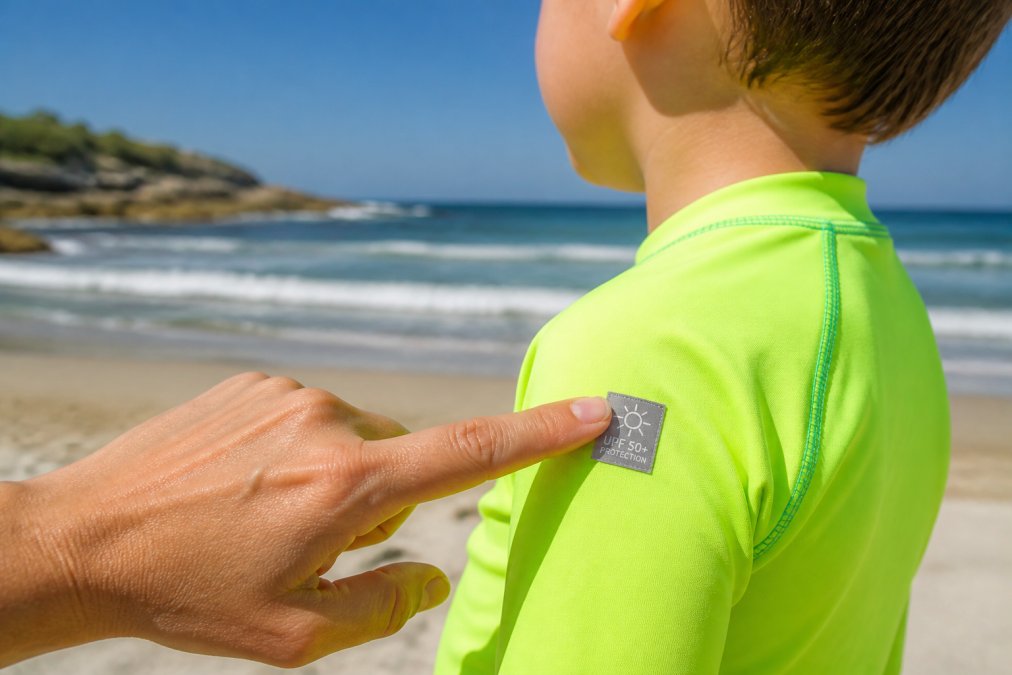
UPF 15, 30, and 50+: Decoding the Protection Levels
The numbers are not marketing decoration. According to the Skin Cancer Foundation's sun protection guidance, UPF ratings translate into clear categories of protection.
| UPF Rating | Protection Level | UV Blocked | Best For |
|---|---|---|---|
| UPF 15-24 | Good | ~93-95% | Light yard work, short walks |
| UPF 25-39 | Very Good | ~96-97% | Beach days, pool time |
| UPF 40-50+ | Excellent | ~97.5%+ | All-day sun, kids, sensitive skin |
Anything labeled below UPF 15 is not considered sun-protective clothing at all. For children who spend hours at the pool, aim for UPF 30 or higher.
Best Fabrics for Sun Protection: What to Look For
Fabric type drives UV protection more than any other single factor, but "fabric type" is shorthand for three separate variables that stack on top of each other: fiber chemistry, yarn construction, and how the finished cloth is knit or woven. Change any one of them and the same garment can swing from UPF 10 to UPF 50+.
Start with fiber chemistry. Some fibers absorb UV radiation as part of their molecular structure, this is inherent protection that cannot wash out. Others are essentially transparent to UV and rely on weave density or an added finish to block it. That distinction is the single most useful thing a shopper can learn.
Inherent vs. Treated Protection: A Key Distinction
Inherent protection lives in the fiber itself. Polyester, nylon, and other synthetics have aromatic structures in their polymer chains that absorb UV energy and dissipate it as heat. Because the protection is built into the molecule, it does not fade with washing, chlorine exposure, or normal wear. A polyester rash guard that starts at UPF 50 will still be close to UPF 50 after a full season of pool use, provided the fabric itself stays intact.
Treated protection is applied to the finished fabric. Cotton, rayon, and some blends are commonly finished with UV-absorbing chemicals, often colorless dyes or ceramic-based additives, that boost their blocking ability. These finishes work well when new, but they are the first thing to degrade. Hot water, harsh detergent, chlorine, and repeated abrasion all strip them over time. A white cotton tee labeled UPF 30 may drop below UPF 15 after a summer of laundering, even if it looks fine.
This is why a garment's care label matters as much as its UPF tag. If the fabric is natural and the protection is a finish, the rating is a starting point, not a guarantee.
How Weave, Knit, and Weight Change the Math
Construction determines how much space exists between fibers for UV to slip through.
- Woven fabrics (like most button-down sun shirts) interlace yarns at right angles, producing a tight, stable surface with minimal gaps. Tightly woven synthetics routinely hit UPF 50+.
- Knits (like t-shirts and many rash guards) loop yarns, which creates natural stretch and breathability but also more open space. A dense, high-gauge knit can still reach UPF 50; a loose, low-gauge knit may struggle to reach UPF 15.
- Fabric weight matters too. Heavier fabrics, measured in grams per square meter, generally block more UV simply because there is more material in the path of the light. A lightweight summer shirt and a heavyweight one made from the same fiber can differ by 20 or more UPF points.
Fiber-by-Fiber Comparison
| Fiber | Protection Type | Typical UPF Range (unfinished, mid-weight) | Notes |
|---|---|---|---|
| Polyester | Inherent | UPF 30-50+ | Best all-around performer; holds up in chlorine |
| Nylon | Inherent | UPF 30-50 | Strong when tightly knit; common in swimwear |
| Wool | Inherent (moderate) | UPF 20-40 | Naturally UV-absorbing but rarely used for swim |
| Cotton | Treated or weave-dependent | UPF 5-25 | Highly variable; white cotton is the weakest common option |
| Rayon / Viscose | Treated | UPF 5-15 | Low on its own; usually needs a finish |
| Bamboo / Lyocell | Treated | UPF 10-20 | Soft but not a sun-protection fabric without help |
The Role of Color and Dye
Darker, more saturated colors absorb more UV than pale ones, and some dye chemistries, particularly those used to produce deep blues, blacks, and reds, add measurable blocking on top of the base fabric. This is a secondary effect, not a primary one: a black cotton tee still underperforms a white polyester one. But when two garments share the same fiber and construction, the darker one usually wins.
Girls Long Sleeve Rash Guard Set — Full →
For children's swimwear, this creates a useful design principle. Bright, high-visibility colors are chosen for spotting a child in the water, and pairing them with a dense synthetic knit means the visibility benefit and the UV benefit reinforce each other rather than trade off.
For swimwear, synthetics also handle moisture better, which brings us to a common misconception.
Does Wet Clothing Lose UV Protection? The Truth About Water and UPF
Yes, wet clothing typically loses some UV protection. When fabric stretches and absorbs water, the fibers separate and create larger gaps for UV rays to pass through.
DIY Testing vs. Label Claims: Why You Can't Rely on Home Tests
Nearly every guide to sun-protective clothing suggests the same home test: hold the fabric up to a bright light, a lamp, or a phone flashlight, and if you can't see through it, it blocks UV.
Why the Light-Hold Test Fails
The problem is that visible light and ultraviolet light are not the same thing, and fabrics do not treat them the same way.
What Real UPF Testing Actually Measures
A legitimate UPF rating comes from a laboratory instrument called a spectrophotometer, which shines UV light through a fabric sample and measures transmission across the full UV spectrum, both UVA (315-400 nm) and UVB (290-315 nm).
A Practical Alternative: Read the Label, Then Read the Fabric
How to Wash UPF Clothing to Maintain Protection
A simple routine keeps protection intact:
- Wash in cold water on a gentle cycle
- Use mild detergent, no bleach or softener
- Air-dry or tumble on low heat
- Avoid ironing directly on treated fabric
- Check the label for specific care instructions
The Impact of Garment Age and Wear on UV Protection
Frequently Asked Questions
Do normal clothes have UV protection?
Yes, all fabrics block some UV radiation, but the level varies widely. A regular white cotton t-shirt typically offers only UPF 5-10, which is far below the UPF 30+ recommended for extended sun exposure. Darker, denser fabrics like denim or wool can reach UPF 20-50, but they may be too hot for summer. For reliable protection, look for garments labeled with a UPF rating, especially for children who spend hours outdoors.
How does wet fabric affect UV protection levels?
Wet fabric can lose up to 50% of its UV-blocking ability, depending on the material. When cotton gets wet, its fibers swell and create gaps that let more UV rays through. However, synthetic fabrics like polyester and nylon tend to maintain their UPF rating even when wet because they don't absorb as much water. For swimwear, choose quick-drying synthetic blends with a UPF 30+ rating to ensure protection in and out of the water.
What does a UPF rating actually mean for skin safety?
UPF, or Ultraviolet Protection Factor, measures how much UV radiation (both UVA and UVB) a fabric blocks. A UPF 30 rating means only 1/30th of UV rays pass through, blocking about 97%. UPF 50+ blocks 98% or more. The rating is determined by lab testing according to standards like AATCC 183. For children, dermatologists recommend UPF 30+ or higher, especially for swimwear and everyday summer clothing.
How to check UPF of clothes?
The most reliable way is to look for a label that states the UPF rating, such as 'UPF 30+' or 'UPF 50+'. This indicates the garment was tested according to standard methods. If there's no label, you can't be sure. Some brands list the rating on hangtags or product descriptions. Avoid relying on DIY tests like holding fabric up to the sun, as they don't measure UVA and UVB accurately. For guaranteed protection, purchase from reputable brands that provide certified UPF ratings.