

Are Expensive Swimsuits Worth the Money? A 2026 Review
Table of Contents
- Why the Price Gap in Swimsuits Keeps Growing
- What Actually Makes an Expensive Swimsuit Expensive?
- Fabric Quality: The Real Difference Between $20 and $80 Suits
- Construction and Seam Integrity: Where Cheap Suits Fall Apart
- Cost-Per-Wear: The Honest Math on Expensive Swimsuits
- The Hidden Cost of Fast Fashion Swimwear
- A Smart Middle Ground: High-Visibility Swimwear for Water Safety
- Why Sun Protective Clothing for Toddlers Justifies a Higher Price
- Frequently Asked Questions
Last Updated: September 5, 2026
Whether expensive swimsuits are worth the money depends on how often you swim and what you expect. For parents of young children, the calculation shifts because you are not just buying fabric, you are buying visibility, sun protection, and the peace of mind that comes from knowing a lifeguard can spot your child in a crowded pool. At Bright & Bold Swimwear, we build high-visibility swimwear for kids ages 2 to 7.
The gap between a $20 suit and an $80 suit comes down to materials, construction, and what the brand prioritizes. Below, we break down the fabric science, seam integrity, and cost-per-wear math so you can decide whether upgrading is right for your family.
Why the Price Gap in Swimsuits Keeps Growing
The swimwear market has split into two distinct lanes. Fast fashion brands produce suits at scale with thin fabrics and basic stitching, relying on high volume to keep prices low. Specialty brands invest in higher-grade synthetic fibers, reinforced seams, and features like UPF ratings that require testing and certification.
That divergence is not accidental. Raw material costs, particularly elastane and nylon blends, fluctuate with global supply chains, and brands that commit to quality control absorb those costs differently than mass-market producers. A wide price range for similar-looking products reflects differences in fabric sourcing, production oversight, and labor standards.
Growing awareness of water safety has also pushed some brands to invest in research and design. High-visibility colors require specific dye processes to maintain brightness after repeated exposure to chlorine and saltwater, and those processes cost more.
What Actually Makes an Expensive Swimsuit Expensive?
An expensive swimsuit is not just a cheaper suit with a higher markup. The price difference traces back to concrete factors that affect performance and longevity.
Fabric composition is the first and most significant factor. Premium suits typically use 20% or more elastane, giving the fabric stretch and the ability to snap back into shape. Cheaper suits may use less elastane or lower-quality synthetic fibers that lose elasticity after a few wears, resulting in a suit that bags out by mid-summer.
Construction quality is the second factor. Budget suits often have flat, single-stitch seams that can pull apart under stress, while higher-end suits use reinforced flatlock or overlock seams to withstand the tugging of kids playing in the water. The lining matters too: a quality suit has a full lining for opacity and support, while cheaper options may use a thin, sheer lining with little coverage.
Design complexity and detailing round out the list. Front zippers for easy changing, adjustable straps, and chlorine-resistant prints all add to manufacturing cost, and they are not frivolous. For parents wrestling a wet toddler into a swimsuit, a front zipper can be the difference between a pleasant pool morning and a meltdown.
Fabric Quality: The Real Difference Between $20 and $80 Suits
Fabric quality is where the gap between cheap and expensive swimsuits becomes most obvious. The core difference lies in the blend of synthetic fibers and how those fibers are knitted together.
Nylon and polyester are the two primary bases for swimwear, and each has trade-offs. Nylon feels softer and drapes more elegantly but is more susceptible to chlorine and UV damage. Polyester resists chlorine and holds color longer, which is why many performance and kids' swimsuits use it as the primary fiber. The best suits combine these with elastane for stretch and recovery.
Elastane Content and Stretch Recovery
Elastane, often known by the brand name Spandex or Lycra, is what gives swimwear its stretch. The percentage of elastane in the fabric directly affects how well the suit conforms to the body and how quickly it returns to its original shape after stretching.
A quality swimsuit typically contains 15% to 25% elastane, providing enough stretch for comfort while maintaining compression during active swimming. Suits with lower elastane content, often below 10%, feel less supportive and stretch out permanently after a few uses. Stretch recovery, how well the fabric bounces back, is the best predictor of whether a suit will still fit in August after a summer of weekly swims.
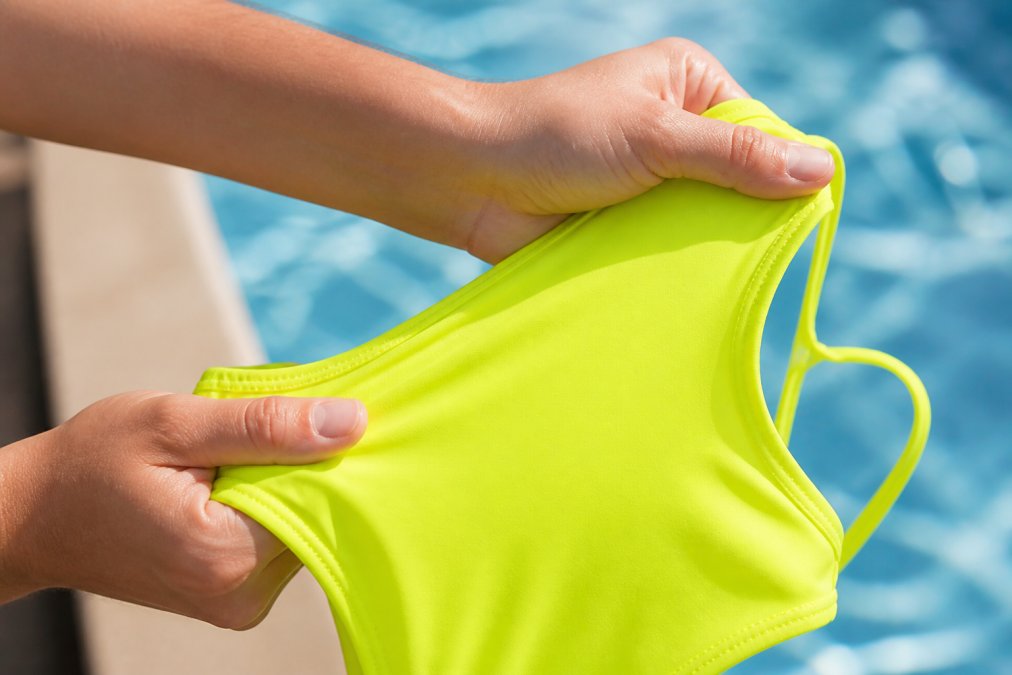
You can test stretch recovery yourself. Pull the fabric to full extension, hold it for a few seconds, then release. Quality fabric snaps back immediately; lower-grade fabric returns slowly or leaves a slight wrinkle, the first sign of permanent bagging that compromises fit and support.
Construction and Seam Integrity: Where Cheap Suits Fall Apart
Construction quality determines whether a swimsuit survives the season or ends up in the trash by July. Seam integrity is the most common failure point on budget swimwear.
Cheap suits often use single-needle stitching, which can snap under stress. Quality suits use double-stitched or flatlock seams, where two lines of thread interlock to distribute tension. This matters because kids jump, cannonball, twist, and climb, putting stress on seams at the shoulders, crotch, and leg openings. cost of activewear.
The lining is another differentiator. A cheap suit may have a partial lining that leaves the back sheer when wet, while a well-constructed suit is fully lined for opacity, durability, and comfort. For kids with sensitive skin, that lining also prevents chafing.
Hardware durability is the final piece. Zippers on budget suits are often made with lightweight metal or plastic that corrodes or breaks after repeated chlorine and saltwater exposure. Higher-quality suits use coated zippers that resist corrosion and glide smoothly when wet, a detail anyone who has fought a stuck zipper understands.

Cost-Per-Wear: The Honest Math on Expensive Swimsuits
Cost-per-wear is the most honest way to evaluate an expensive swimsuit: divide the purchase price by the number of times the child wears it.
A $20 discount store suit that falls apart after 10 wears costs $2.00 per wear. A $45.99 suit that survives 30 wears costs about $1.53 per wear. The expensive option becomes the better value the moment it lasts more than twice as long, which quality construction and fabric make likely.
| Swimsuit Price | Expected Wears (Conservative) | Cost Per Wear | Verdict |
|---|---|---|---|
| $20 budget suit | 8 to 12 wears | $1.67 to $2.50 | Cheap upfront, costly per use |
| $45.99 quality suit | 25 to 40 wears | $1.15 to $1.84 | Better value over a season |
| $80 premium suit | 40 to 60 wears | $1.33 to $2.00 | Worth it for frequent swimmers |
The math changes if you have multiple children who can hand suits down. A quality suit that survives one child can often serve a younger sibling the following year, effectively halving the cost-per-wear again.
For a child who outgrows a suit in a year, the question is whether it will last that full year. A well-made suit with high elastane content and reinforced seams is far more likely to survive a season of weekly swim lessons and weekend pool trips, making the higher upfront cost a reasonable trade.
The Hidden Cost of Fast Fashion Swimwear
Fast fashion swimwear carries costs that never appear on the price tag. Synthetic fabrics have a significant environmental impact, and the short lifespan of cheap suits means they end up in landfills quickly.
Most swimwear is made from petroleum-based synthetic fibers like nylon and polyester. These materials do not biodegrade. A cheap suit that falls apart after a few wears contributes to the growing problem of textile waste, and the production of new synthetic fibers requires substantial energy and water resources. The Environmental Protection Agency's guide on textile waste notes that textiles represent a significant portion of municipal solid waste, and extending the life of a garment is one of the most effective ways to reduce its environmental footprint.
The fast fashion cycle also affects labor practices. Brands that sell very low-priced swimsuits often achieve those prices through mass production in facilities with less oversight. Ethical manufacturing costs more, and that cost is reflected in the retail price.
For parents, the hidden cost of fast fashion is practical too. A cheap suit that fades, stretches, or falls apart mid-season means a last-minute replacement purchase, often at peak season with limited options. Buying quality the first time eliminates that cycle.
A Smart Middle Ground: High-Visibility Swimwear for Water Safety
The decision between cheap and expensive swimsuits becomes clearer when safety is part of the equation. Traditional swimsuit colors like blue, green, and black blend into the water, making it difficult for parents and lifeguards to track young children.
High-visibility swimwear for water safety uses neon colors such as yellow, orange, and pink that contrast sharply with the blues and greens of pools, lakes, and oceans. This is not a marketing gimmick. The American Lifeguard Association's water safety resources emphasize that constant visual supervision is one of the most effective layers of drowning prevention, and high-visibility clothing supports that supervision by making a child easier to spot in a crowd.
Bright & Bold Swimwear builds every suit around this principle. Our collection features neon colors selected for maximum contrast in aquatic environments, and each suit includes UPF 30+ sun protection to block harmful UVA and UVB rays. Front zipper closures make changing easier, and fully lined construction ensures the suits hold their shape and opacity through a full season.
For a parent weighing the cost, the value of a high-visibility suit is not just durability. It is the added layer of safety that comes from knowing your child stands out in the water. When you consider that drowning remains a leading cause of accidental death for young children, the investment in visibility is difficult to argue against. The Centers for Disease Control and Prevention's drowning prevention data consistently highlight supervision as the primary defense, and high-visibility swimwear makes that supervision more effective.
Why Sun Protective Clothing for Toddlers Justifies a Higher Price
Sun protective clothing for toddlers carries a higher price tag than standard swimwear for good reason. The UPF rating is not a marketing label, it is a measured standard of how much ultraviolet radiation the fabric blocks.
A garment with a UPF 30+ rating blocks approximately 96% of UV rays, and UPF 50+ blocks about 98%. These ratings require specific fabric density, fiber type, and sometimes chemical treatments. The testing and certification process adds to manufacturing cost, but the protection is real and measurable.
For toddlers with fair or sensitive skin, sun protective clothing is often easier than sunscreen. It does not wash off, covers areas that are easy to miss, and does not require reapplication every two hours. A long-sleeve rash guard with UPF protection means less sunscreen on wiggly skin and fewer missed spots on shoulders and arms.
Bright & Bold's long-sleeve rash guard sets and one-piece suits are designed for this purpose. Full-length sleeves provide coverage from shoulder to wrist, and UPF 30+ protection works whether the fabric is wet or dry. For families planning beach vacations or long outdoor swim days, that coverage is worth the difference in price, the suit does the work of sunscreen without needing reapplication.
The combination of sun protection and high-visibility color means a single garment addresses two of the biggest summer safety concerns for young children. Divided across a full season of wear, the cost-per-wear becomes difficult to beat.
Choosing between a budget swimsuit and a higher-quality option comes down to what you value. If you are buying for a single beach vacation and plan to donate it afterward, a cheaper option may suffice. But for families who swim weekly, want sun protection that actually works, and want the peace of mind of knowing their child is visible in the water, the investment in quality pays off. Bright & Bold Swimwear offers high-visibility swimsuits with UPF 30+ protection, front zipper closures, and fully lined construction built to last a full season. SHOP BEST SELLERS and give your child a suit that works as hard as you do to keep them safe.
Frequently Asked Questions
How can I tell if a swimsuit is good quality before buying it?
Check the fabric composition first. A quality swimsuit should have 15-20% elastane (spandex) content for proper stretch recovery. Stretch the fabric and see if it snaps back into place. Look at the seam construction: flatlock or overlock seams with reinforced stitching at stress points indicate better durability. Examine the lining thickness, especially in the front and seat areas. A fully lined suit with opaque fabric and corrosion-resistant zippers or clasps typically signals higher construction quality.
Do expensive swimsuits actually last longer than cheap ones?
Yes, often they do, but the difference comes down to materials and construction, not just the price tag. A swimsuit priced at $45.99 with high elastane content, fully lined interior, and reinforced seams will typically outlast a $15 fast-fashion suit that loses its shape after a few pool sessions. The key is to check the fabric composition and seam quality rather than assuming price alone guarantees durability.
What is the difference between luxury and fast-fashion swimwear fabrics?
The main difference lies in the quality of synthetic fibers and how they're knit. Fast-fashion swimwear often uses thinner fabric with lower elastane content, which breaks down quickly when exposed to chlorine and sunlight. Premium swimwear uses denser fabric with better stretch recovery and higher UPF ratings. The better fabric also resists pilling and maintains its opacity over time, so it doesn't become see-through after repeated wear.
Are high-visibility swimsuits worth the extra investment for safety?
For children, yes. High-visibility swimwear uses neon colors that stand out against the blues and greens of pools and lakes, giving parents and lifeguards a faster visual lock on little swimmers. When you're weighing the cost-per-wear of a $45.99 swimsuit against a cheaper option, the ability to spot your child quickly in a crowded pool adds a safety benefit that no standard suit provides.
This article was written using GrandRanker