

How to Keep Track of Kids at Crowded Pools
Table of Contents
- Why Keeping Track of Kids at Crowded Pools Matters
- Prepare Before You Arrive at the Pool
- Use Visual Identification for Kids at Pools
- Implement the Water Watcher Program
- Teach Kids Pool Safety Rules
- Active Monitoring Strategies at the Pool
- Use Technology and Tracking Tools Wisely
- Create Your Pool Day Emergency Plan
Last Updated: August 13, 2026
Why Keeping Track of Kids at Crowded Pools Matters
Crowded pools present a genuine safety challenge for parents. When dozens of children are splashing in the water, it takes only seconds for a child to slip beneath the surface unnoticed. Drowning happens quietly and quickly, often without the dramatic signs people expect. With the right strategies, preparation, and tools, you can significantly reduce this risk while letting your kids have fun.
At Bright & Bold Swimwear, we understand this anxiety firsthand. The approach we'll cover combines several layers of protection: preparation before you arrive, visual identification strategies, active supervision techniques, and smart use of technology. Each layer works independently, but together they create a comprehensive safety net that gives you peace of mind.
Prepare Before You Arrive at the Pool
The foundation of pool safety starts at home. Preparation reduces panic and ensures everyone knows what to do in an emergency.
Family meeting point and communication plan
Before heading to the pool, establish a clear meeting point with your family. Choose a specific, easy-to-identify landmark, perhaps the entrance gate, the lifeguard stand, or a distinctive building feature. Make sure every adult and child knows this location by name.
Discuss what your child should do if separated from you using simple, direct language: "If you can't find Mom or Dad, go to the lifeguard and tell them." Practice this conversation multiple times so it becomes automatic.
Establish a communication system with other adults supervising your child. Agree on how you'll check in with each other, hand signals, text messages, or specific time intervals. Clear communication prevents the dangerous assumption that "someone else is watching."
What to teach kids before pool day
Teach your child to stay within arm's reach of an adult in the water. For toddlers and early swimmers, make it a game: "We're staying close buddies in the pool."
Explain the difference between the shallow end and deep end, and establish which areas are off-limits without adult supervision. Teach your child to recognize lifeguards by their distinctive uniforms, whistles, and position on the lifeguard stand.
Discuss what to do if your child falls in accidentally or gets water in their nose. Teach basic responses: "If water goes in your nose, stand up and cough it out" or "If you fall in, kick your feet and move toward the edge."
For older children, teach them to identify other swimmers in distress. Help them understand that drowning doesn't always look dramatic, a struggling swimmer might be silent and still.
Use Visual Identification for Kids at Pools
High-visibility clothing is one of the most effective tools for keeping track of kids at crowded pools. When your child stands out visually, you can locate them instantly in a chaotic environment.
High-visibility swimwear and bright colors
Bright, neon colors make a dramatic difference in crowded water environments. Research from water safety organizations shows that lifeguards can spot high-visibility swimwear significantly faster than standard colors in emergency situations. Neon yellow, neon pink, and neon orange cut through the visual noise of a busy pool.
Choose swimwear in solid, bright colors rather than patterns. Patterns can camouflage a child in water, making them harder to spot. A solid neon one-piece or rash guard creates a clear visual target.
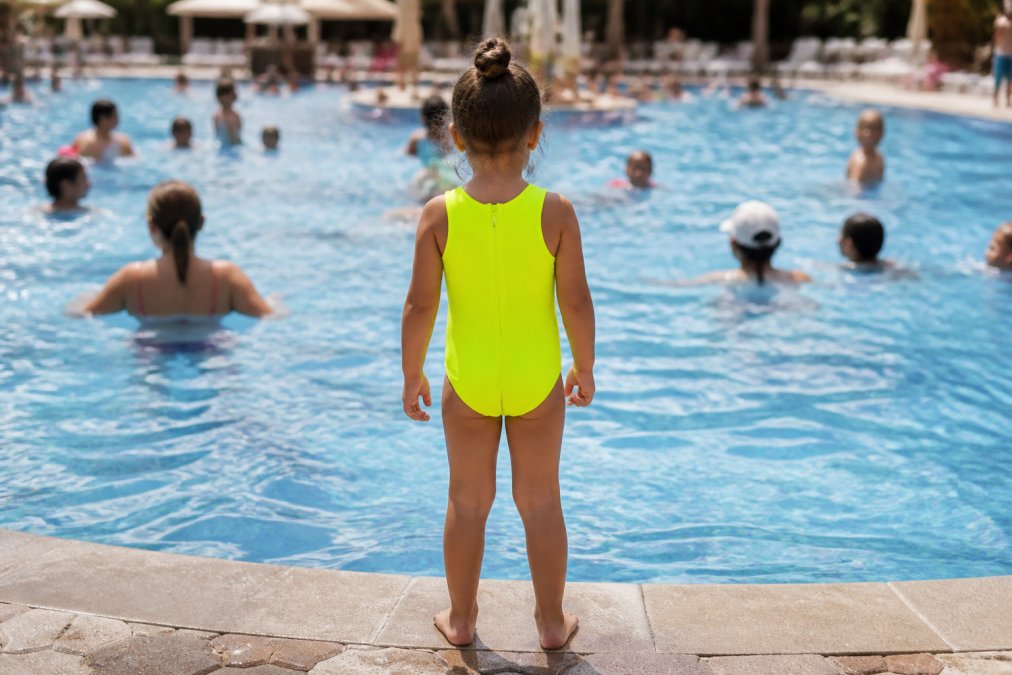
Consider pairing high-visibility swimwear with other bright elements. A neon swim cap, bright goggles, or a colored float can add additional visual markers. Bright & Bold Swimwear offers Girls swimsuits and Boys swimsuits in vibrant neon colors specifically designed for pool visibility, combined with UPF 30+ sun protection so your child stays visible and protected.
Identification bracelets and wearable markers
Identification bracelets serve a dual purpose: they help you spot your child quickly, and they provide critical information if your child becomes separated from you. Choose bracelets with your phone number clearly printed or engraved. Waterproof options ensure the information remains readable after hours in the pool.
Wearable markers like colored wristbands or swim caps in matching neon colors create a visual system. If you're supervising multiple children, assign each child a different bright color. This allows you to account for each child at a glance. Swim accessories like caps, goggles, and wristbands in bright colors complement your high-visibility swimwear strategy.
Some families use temporary tattoos with their phone number. These are inexpensive, fun for kids, and provide identification information that won't be lost or forgotten.
Implement the Water Watcher Program
The water watcher program is a structured supervision system that ensures at least one adult is always focused on the water. This program has become standard in many pools because it works.
Assigning a designated watcher
The water watcher program assigns one adult the specific responsibility of watching the water, nothing else. This person doesn't scroll their phone, chat with friends, or look away. Their entire attention is on the water and the children in it.
If you're supervising one or more children at a crowded pool, you become the designated watcher for your own kids. Your job is to maintain constant visual contact with each child. You should be able to point to them at any moment and describe what they're doing.
For families with multiple children, rotate the watcher role every 15-30 minutes. A tired adult's attention drifts. Fresh eyes catch details that exhausted eyes miss.
The designated watcher should position themselves where they have the clearest sightline to the water. Avoid sitting in the shade if it means looking into the sun's glare. Your positioning matters as much as your attention.
Supervision ratios and rotation systems
For non-swimmers and weak swimmers under age 6, the ratio should be one adult per one child in or near the water. For older children who are confident swimmers, one adult can supervise up to three children, provided that adult maintains constant visual contact with all three.
Create a rotation system if you're at the pool for an extended period. Assign one adult as the designated watcher for 20-30 minutes, then rotate to the next adult. Use a simple hand signal or verbal check-in to confirm the rotation: "I'm taking over water watch now."
Document your supervision plan before arriving at the pool. Write down the rotation schedule and share it with everyone. Ambiguous responsibility is the enemy of safety.
Teach Kids Pool Safety Rules
Children who understand pool safety rules and have practiced emergency responses are more likely to stay safe in the water.
What to do if separated from parents
Your child should know that if they can't find you, they should immediately find a lifeguard or another adult and stay with that person. Teach them to say: "I can't find my parent" or "I need help finding my mom."
Practice this scenario through role-play. Make it a game so your child isn't frightened by the idea. The goal is to make seeking help automatic, not something that requires courage in a crisis.
Teach your child not to leave the pool area to search for you. Staying in one place, ideally near a lifeguard, makes reunion faster and safer.
Memorizing contact information
Young children should memorize at least one phone number, preferably yours. Practice this regularly through songs, rhymes, or games. Repetition helps children retain information without it feeling like studying.
For children who can't yet memorize a full phone number, teach them to tell an adult: "My name is [child's name] and my parent's name is [your name]." This information alone allows a lifeguard to identify you through pool records.
Consider having your child wear an identification bracelet with your phone number as a backup if your child forgets under stress.
Active Monitoring Strategies at the Pool
Constant visual contact is the foundation of water safety. Active monitoring means you're not just present, you're engaged and aware.
Maintaining constant visual contact
Position yourself where you have an unobstructed view of your child. If you're in the water with your child, stay within arm's reach for young or non-swimming children. If you're poolside, sit or stand rather than lie down. A prone position limits your ability to respond quickly.
Scan the water regularly, even if your child is playing in a designated shallow area. Children move faster than we expect.
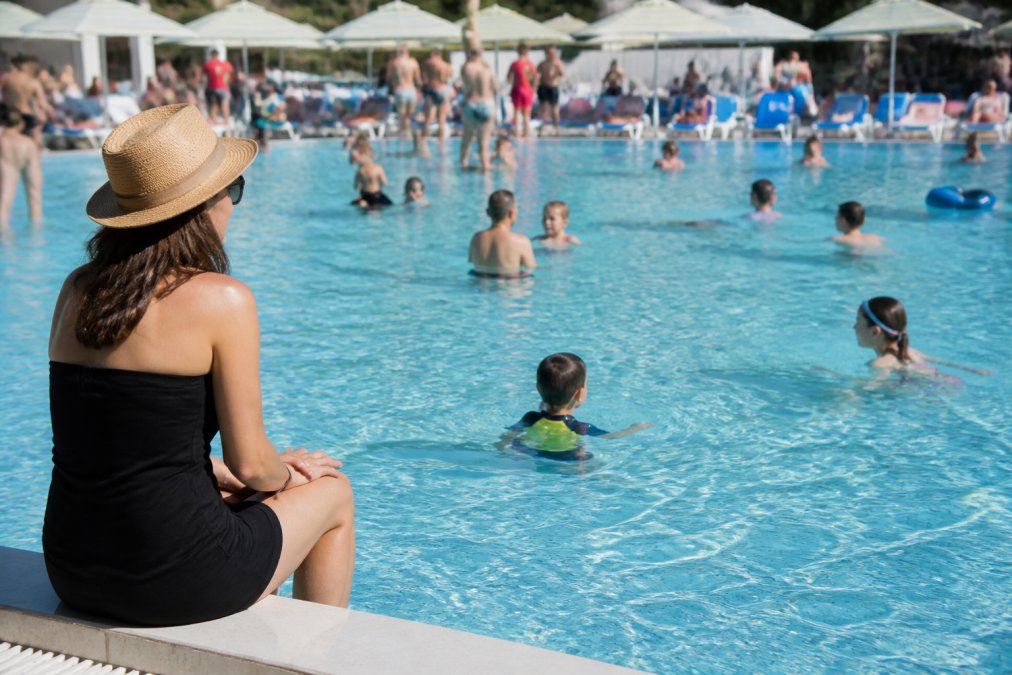
Avoid distractions during your designated water-watching time. Put your phone away. Your attention should be on the water.
If you need to look away, explicitly hand off your supervision responsibility to another adult. Say it out loud: "I'm stepping away. You have water watch."
Know what your child is wearing and their current activity. This helps you locate them quickly if you look away momentarily.
Identifying lifeguard uniforms and staff
Familiarize yourself and your child with what lifeguards look like at your specific pool. Point out the lifeguard to your child before entering the water. Explain that the lifeguard is watching the water and can help if someone needs assistance.
Note the lifeguard's position. Some pools have multiple lifeguards at different locations. Knowing where lifeguards are positioned helps you understand which areas have active supervision.
Understand that lifeguards watch for swimmers in distress, but they're not responsible for lost children or preventing separation. Their role complements your supervision, it doesn't replace it.
Use Technology and Tracking Tools Wisely
Technology can enhance your supervision strategies, but it shouldn't replace active monitoring and visual contact.
GPS watches and wearable tracking devices provide real-time location data. These tools are useful for situations where your child might wander away from the pool area. However, they work best in combination with active supervision, not as a substitute for it.
Waterproof phones or action cameras can document pool time and provide a record of your child's swimming progress. Digital identification apps allow you to store emergency contact information and medical details that can be accessed by lifeguards or medical personnel if needed.
Create Your Pool Day Emergency Plan
An emergency plan ensures everyone knows how to respond if something goes wrong.
Write down the pool's address and phone number. Program the pool's number into your phone. Identify the nearest hospital or urgent care facility and know how many minutes away it is.
Brief all supervising adults on your emergency plan before arriving at the pool. Everyone should know the meeting point, the communication system, who is watching at any given time, and what to do if a child is missing.
Discuss how you'll handle a medical emergency. Who will call 911? Who will perform CPR if needed? Who will stay with the other children? Clear roles prevent confusion and delay.
Keep a first aid kit poolside with bandages, antiseptic, and any medications your child needs. Practice your emergency plan mentally by walking through scenarios so you're more likely to respond effectively under stress.
Keeping track of kids at crowded pools requires preparation, attention, and the right tools. Bright & Bold Swimwear's high-visibility swimsuits are designed specifically to help parents and lifeguards spot children instantly in busy water environments. Combined with active supervision, clear communication, and a solid emergency plan, high-visibility gear becomes part of a comprehensive safety system that protects your child while letting them enjoy the water. Start with one strategy, perhaps investing in bright, visible swimwear, and build from there. Each layer of protection you add makes your family's pool time safer and more enjoyable.
Frequently Asked Questions
What is the Water Watcher program and how does it help keep track of kids at pools?
The Water Watcher program assigns one adult as the designated supervisor responsible for watching children in and around the water. This adult avoids distractions like phones or conversations and maintains constant visual contact with all children under their watch. The program works because it removes ambiguity about who is responsible for supervision, preventing the assumption that someone else is watching. When multiple children are present, adults rotate the watcher role every 15-30 minutes to prevent fatigue and maintain alertness.
How do I teach my child what to do if they get lost or separated from me at a crowded pool?
Teach your child to stay in one spot and look for a lifeguard or pool staff member (identifiable by their uniform) rather than searching for you. Practice memorizing your phone number before pool day. Use a specific meeting point you've discussed together, like the entrance or a distinctive landmark. Role-play separation scenarios during calm moments so your child knows what to do without panic. Consider using identification bracelets with your contact information as backup for younger children who cannot reliably remember phone numbers.
Why is high-visibility swimwear important for keeping track of kids at crowded pools?
High-visibility swimwear in bright neon colors makes children instantly recognizable in busy pool environments where dozens of children may be in the water simultaneously. The vibrant colors create visual contrast against water, deck, and other swimmers, reducing the time it takes parents and lifeguards to locate a specific child. This is especially critical in situations where supervision gaps occur or in emergencies requiring rapid identification. High-visibility swimwear serves as a constant safety layer that works passively even during momentary lapses in active monitoring.
What supervision ratio is safe for keeping track of multiple children at a pool?
The recommended ratio is one adult for every 1-3 young children (ages 2-7) in or near the water, depending on the children's swimming ability and the pool environment. For non-swimmers or weak swimmers, a 1:1 ratio is safest. In crowded public pools, maintain closer ratios and ensure at least one adult is designated as the active watcher with no other responsibilities. Never rely on older siblings or casual bystanders for primary supervision. Having a backup adult present allows for rotation, preventing fatigue-related lapses in attention.
This article was written using GrandRanker