

Does Pool Insurance Cover Safety Fences?
Table of Contents
- Does Pool Insurance Cover Safety Fences?
- Homeowners Insurance Pool Liability Requirements Explained
- Coverage B: Other Structures and Fence Protection
- Pool Fence Safety Standards ASTM and Insurance Compliance
- Best Swimming Gear for Toddlers and Layered Safety
- Umbrella Policies and Additional Liability Protection
- Post-Claim Fence Replacement and Premium Impact
- What You Need to Know Before Filing a Claim
Last Updated: August 23, 2026
Does Pool Insurance Cover Safety Fences?
Pool ownership brings joy to families, but it also brings responsibility. One of the most critical questions homeowners ask is whether their insurance covers the safety infrastructure that protects their loved ones. The answer depends on your specific policy, the type of fence, and how your insurer classifies the structure. Understanding does pool insurance cover safety fences requires knowing the difference between liability coverage and property protection.
At Bright & Bold Swimwear, we've worked with families to understand the full picture of pool safety, from visible supervision gear to proper barriers and insurance protection. This guide breaks down exactly what coverage you have, what gaps exist, and how to ensure your family is truly protected.
Homeowners Insurance Pool Liability Requirements Explained
Homeowners insurance provides liability coverage when someone is injured on your property due to negligence. Standard homeowners policies include personal liability coverage, which typically covers bodily injury claims up to your policy limit (commonly $100,000 to $300,000) (iii.org). However, liability coverage does NOT pay to rebuild or repair your fence if it's damaged. That's where "other structures" coverage comes in.
Most insurers require you to disclose that you own a swimming pool when applying for or renewing your policy. This disclosure triggers a risk assessment. Insurers may require specific safety features, including a compliant fence, as a condition of coverage. Failure to disclose a pool or to maintain required safety barriers can result in claim denial or policy cancellation.
The key requirement is that your fence must meet local building codes and ASTM standards. A fence that doesn't comply may not be covered under your policy, even if it's physically present on your property.
Coverage B: Other Structures and Fence Protection
Coverage B, also called "other structures coverage," is where pool fence protection typically lives in your homeowners policy. This coverage protects structures on your property that are NOT your main dwelling, including detached garages, sheds, and fences.
Coverage B usually provides 10% of your home's replacement cost. If your home is insured for $500,000, Coverage B provides approximately $50,000 in protection for other structures. However, your Coverage B limit must cover ALL other structures, not just the fence.
Your fence is covered IF:
- It meets local building codes and ASTM standards
- You disclosed the pool to your insurer
- The damage is covered under your policy (wind, theft, vandalism, but NOT normal wear and tear)
- The fence qualifies as a "structure" under your specific policy language
What's NOT covered: damage from lack of maintenance, failure to repair known damage, or damage that occurs because the fence was non-compliant at the time of loss.
Many homeowners are surprised to learn that Coverage B has a sub-limit for fences specifically. Some policies cap fence coverage at $1,500 or $2,500 regardless of your total Coverage B limit. Check your policy declarations page to see if a fence sub-limit applies to you.
Pool Fence Safety Standards ASTM and Insurance Compliance
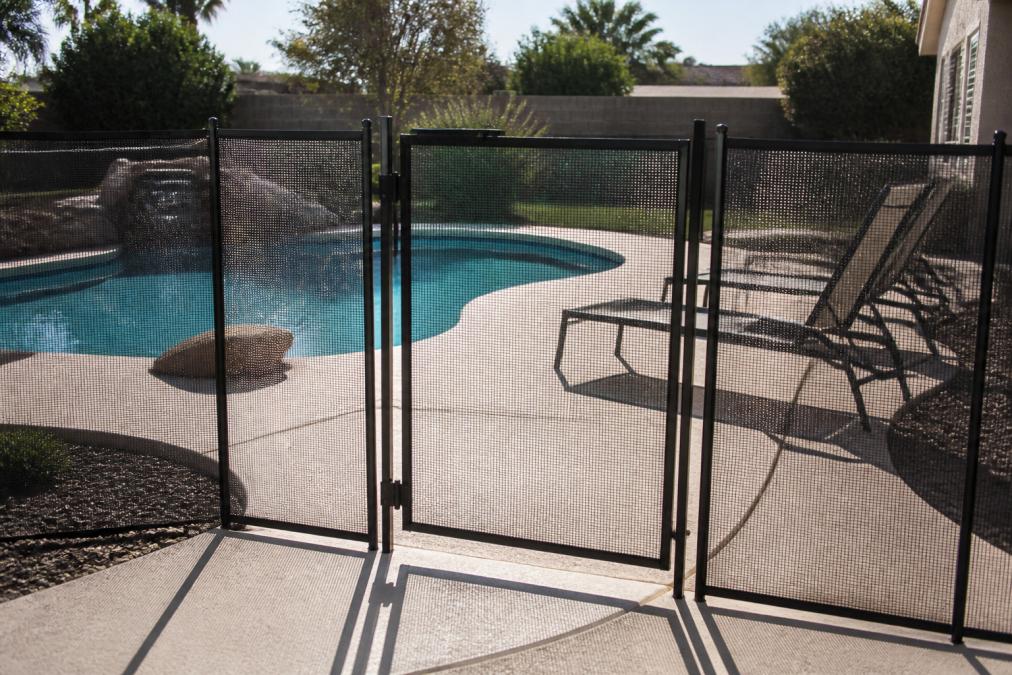
Insurance companies require fences that meet ASTM F1908, the standard for residential swimming pool barriers. This standard specifies exact measurements, materials, and mechanisms to prevent unauthorized access, especially by young children.
Height and Material Requirements
ASTM F1908 requires that pool barriers be at least 48 inches high, measured from the outside ground level (astm.org). The fence must be constructed of materials that are difficult to climb and cannot be easily breached.
Acceptable materials include vinyl or wood slats (solid, with no gaps larger than 4 inches), metal mesh or chain-link (with openings no larger than 1.75 inches), composite materials rated for pool use, and aluminum or steel components that meet corrosion standards.
Spacing between slats or mesh is critical. Horizontal members must be spaced no more than 4 inches apart to prevent a child from gaining a foothold. Vertical members must be spaced no more than 4 inches apart to prevent a child from slipping through. Many older fences don't meet these specifications, which can affect insurance coverage.
Locking Gates and Self-Closing Latches
Every gate in your pool fence must be self-closing and self-latching. The gate must close automatically when released and latch without requiring manual action. The latch must be located on the pool side of the gate, at least 54 inches above the ground, and must require intentional action to open (astm.org).
Self-closing mechanisms wear out over time. If your gate no longer closes automatically or the latch is broken, your fence is technically non-compliant. Insurance companies may require documentation that gates are inspected and maintained regularly.
Best Swimming Gear for Toddlers and Layered Safety
While fences and insurance provide structural protection, supervision and visibility create the real safety net. Insurance companies recognize that a fence alone is insufficient; multiple layers of protection are necessary. homeowners insurance coverage.
High-visibility swimwear plays an underrated role in this layered approach. Bright, easily spotted swimsuits help parents and lifeguards maintain constant visual contact in the water. When a child wears high-visibility gear like what Bright & Bold Swimwear offers, they remain instantly recognizable in the pool environment, reducing the critical seconds it takes to locate a child in distress.
Beyond swimwear, layered safety includes constant adult supervision, swim lessons, CPR certification for caregivers, rescue equipment poolside, and clear pool rules. Insurance companies factor supervision practices into their risk assessment and may offer better rates to homeowners who can demonstrate ongoing swim instruction and CPR training.
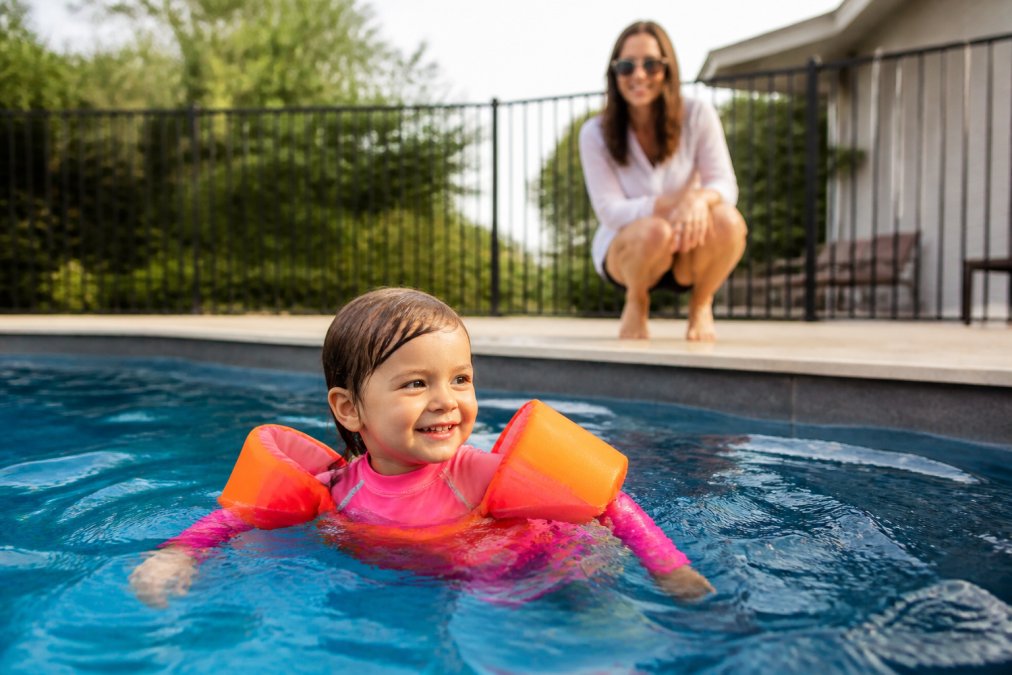
The combination of proper fencing, compliant gates, visible supervision gear, and trained caregivers creates a comprehensive safety environment. Insurance underwriters view this holistic approach favorably and are more likely to approve claims from properties where multiple safety layers are evident.
Umbrella Policies and Additional Liability Protection
Standard homeowners insurance provides baseline liability coverage, but that coverage has limits. If a serious injury occurs in your pool and legal liability exceeds your homeowners policy limit, you face personal financial exposure. This is where umbrella policies become essential.
An umbrella policy provides additional liability protection above your homeowners policy limit. Typical umbrella policies start at $1 million in coverage and can extend to $5 million or more. They cover the same types of claims as homeowners liability: bodily injury, property damage, and legal defense costs.
Umbrella policies have requirements. Most insurers will not sell you an umbrella policy unless you maintain minimum liability limits on your homeowners policy, typically $300,000 or $500,000. Additionally, the umbrella policy must be with the same insurer as your homeowners policy, or the insurer must approve the underlying coverage from a different company.
For pool owners, umbrella coverage is essential risk management. A serious injury claim can result in damages far exceeding standard homeowners limits.
Post-Claim Fence Replacement and Premium Impact
If your fence is damaged and you file a claim, several outcomes are possible. First, the claim must be for a covered peril. Covered perils typically include wind, hail, theft, and vandalism. NOT covered: normal wear and tear, lack of maintenance, or damage from failure to repair known problems.
Second, your deductible applies. If your deductible is $1,000 and the fence damage is $3,000, you pay $1,000 and insurance pays $2,000. For smaller fence damage, your deductible may exceed the repair cost, making a claim impractical.
Third, the claim triggers a premium review. Even if your claim is approved and paid, your insurer may increase your premium at renewal. Pool claims signal increased risk to insurers. Multiple claims can trigger rate increases of 15-25% or higher, and some insurers will not insure pools if you have more than two claims in five years.
The practical implication: maintain your fence proactively. Regular inspection, prompt repair of minor damage, and replacement of worn latches or corroded materials prevents small problems from becoming claim events.
What You Need to Know Before Filing a Claim
Filing a claim for fence damage requires documentation and proof:
Document the damage immediately. Take photographs and video of the damage from multiple angles. Include photos showing the surrounding area.
Report the claim promptly. Most policies require claims to be reported within a specific timeframe (often 30-60 days).
Provide proof of the covered peril. If the damage was caused by a storm, provide weather reports. If caused by theft or vandalism, file a police report.
Get repair estimates. Obtain written estimates from licensed contractors for the cost of repair or replacement.
Disclose the pool and fence status. Inform your adjuster that you have a pool and that the fence is a safety barrier. Provide documentation that the fence met ASTM standards at the time of loss.
Avoid DIY repairs until the claim is settled. Do not repair or replace the fence until the claim is approved and the payout is received.
Keep all receipts and documentation. Maintain records of all repair estimates, contractor invoices, photographs, and correspondence with your insurer.
Pool ownership requires understanding the intersection of safety standards, insurance requirements, and liability protection. Does pool insurance cover safety fences? The answer is yes, if your fence meets ASTM standards, you've disclosed the pool to your insurer, and the damage is covered under your policy. However, coverage is not automatic, and gaps in compliance or disclosure can result in claim denial.
The most effective approach is to treat your fence as both a safety requirement and an insurance asset. Maintain it proactively, ensure it meets current standards, and document its condition regularly. Pair proper fencing with visible supervision gear, like the high-visibility swimwear from Bright & Bold Swimwear, to create multiple layers of protection. Consider umbrella coverage to bridge the gap between your homeowners limit and potential liability exposure. By combining physical barriers, supervision, visibility, and adequate insurance, you create a comprehensive safety environment that protects your family and your financial security.
Frequently Asked Questions
Q: Does homeowners insurance require a fence around a pool?
A: Most homeowners insurance policies do not mandate a fence, but many insurers require one as a condition of coverage or to avoid exclusions. Insurance underwriting often treats pools as attractive nuisances, meaning you have a duty to prevent unauthorized access. A properly installed safety fence significantly reduces your liability risk and demonstrates compliance with safety standards. Check your specific policy and contact your insurer about their fence requirements before filing a claim.
Q: What pool fence safety standards ASTM does insurance require?
A: Insurance companies typically reference ASTM F1908 standards, which specify fence height (at least 4 feet), spacing between slats (no wider than 4 inches), and gate specifications including self-closing latches. These standards exist to prevent young children from accessing the pool unsupervised. While ASTM compliance is not always explicitly required by insurers, meeting these standards strengthens your claim eligibility and shows you've taken reasonable safety precautions. Some states and municipalities have their own codes that may exceed ASTM minimums.
Q: Is a pool fence covered under Coverage B (other structures) on my homeowners policy?
A: Yes, in most cases. Coverage B protects structures separate from your dwelling, including detached garages, sheds, and fences. A pool safety fence typically qualifies for this coverage if it's a permanent, freestanding structure. However, coverage limits for other structures are usually 10% of your dwelling coverage, so verify your policy limits. Some insurers may exclude fences or require additional riders. Review your declarations page or contact your agent to confirm your specific coverage and any exclusions.
Q: How does a pool safety fence affect my homeowners insurance premium?
A: Installing a compliant safety fence can lower your premium or improve your eligibility for coverage. Insurers view fences as risk mitigation because they reduce unauthorized access and demonstrate responsible pool ownership. The premium reduction varies by insurer and your location. Conversely, not having a fence when your insurer requires one can lead to exclusions, higher premiums, or coverage denial. After installation, notify your insurer to update your policy and potentially qualify for safety discounts.
This article was written using GrandRanker